Best Spice Organizers for Every Kitchen, Cabinet, and Drawer
A cluttered spice cabinet slows down every meal you cook. Here’s a full breakdown of the best spice organizers on the market right now, plus a buying guide to help you pick the right one for your space.
Why a Good Spice Organizer Matters
If you’ve ever dug through a jumbled drawer looking for cumin while a pan sizzles on the stove, you already know the problem a spice organizer solves. It isn’t just about tidiness — it’s about how efficiently your kitchen actually functions.
Most home cooks accumulate spices faster than they use them. A jar of smoked paprika bought for one recipe sits next to five-year-old bay leaves, a half-used tin of cumin, and three nearly identical bottles of chili powder purchased because the first two couldn’t be found. Without a system, that pile only grows, and the spices you reach for most often end up buried behind ones you rarely use.
A dedicated organizer solves this in a few concrete ways. First, it creates visibility. Whether it’s a tiered rack that angles every label toward you or a magnetic system that lines jars up in a single visible row on the fridge, the goal is the same: you should be able to see what you have at a glance instead of pulling out jar after jar.
Second, it protects the spices themselves. Ground spices lose potency when exposed to heat, light, and moisture. A cabinet or drawer organizer keeps jars sealed, upright, and away from the stove’s heat, which extends shelf life and keeps flavors sharper for longer. Loose jars rattling around in a junk drawer near the oven degrade faster than jars stored properly in a cool, shaded space.
Third, an organizer reduces duplicate purchases. It’s a small but real cost — buying a third jar of garlic powder because the other two were hiding is money that didn’t need to be spent. Once every spice has a visible, dedicated spot, you naturally shop smarter because you know exactly what’s running low and what’s already stocked.
Finally, there’s the simple matter of cooking speed. Recipes that call for five or six spices in the first two steps punish disorganization. When everything is labeled, sorted, and within reach, prep time drops and the whole process feels less chaotic. That’s really the throughline across every product on this list: they’re not decorative, they’re functional tools that make cooking faster and more enjoyable.
Below, we’ll walk through the main categories of spice organizers, what separates a great one from a mediocre one, and then get into detailed reviews of ten standout options currently available, covering magnetic, stackable, drawer, cabinet, and shelf-style systems.
It’s also worth acknowledging that the “right” organizer looks different depending on how you cook. A household that leans on five or six staple spices for most weeknight meals has very different needs than one that’s built up a sprawling collection across several cuisines over the years. This guide is written with both in mind, and the comparison table and reviews below should make it easy to match a product to your actual habits rather than to a generic idea of what a spice cabinet “should” look like.
Types of Spice Organizers Explained
Not every kitchen has the same layout, so not every spice organizer works for every household. Understanding the main categories helps you narrow down what will actually fit your space before you start comparing individual products.
Magnetic Refrigerator Organizers
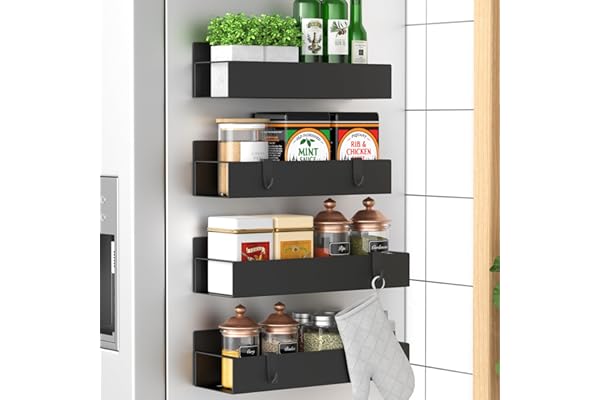
These systems use small magnetic tins or a magnetic mounting strip that attaches directly to the side or front of a refrigerator. They’re popular in smaller kitchens or apartments where cabinet space is limited, because they essentially turn unused vertical fridge space into functional spice storage. The tradeoff is that they only work on magnetic refrigerator surfaces, and tin capacity is usually smaller than a full-size jar.
Stackable Drawer Organizers
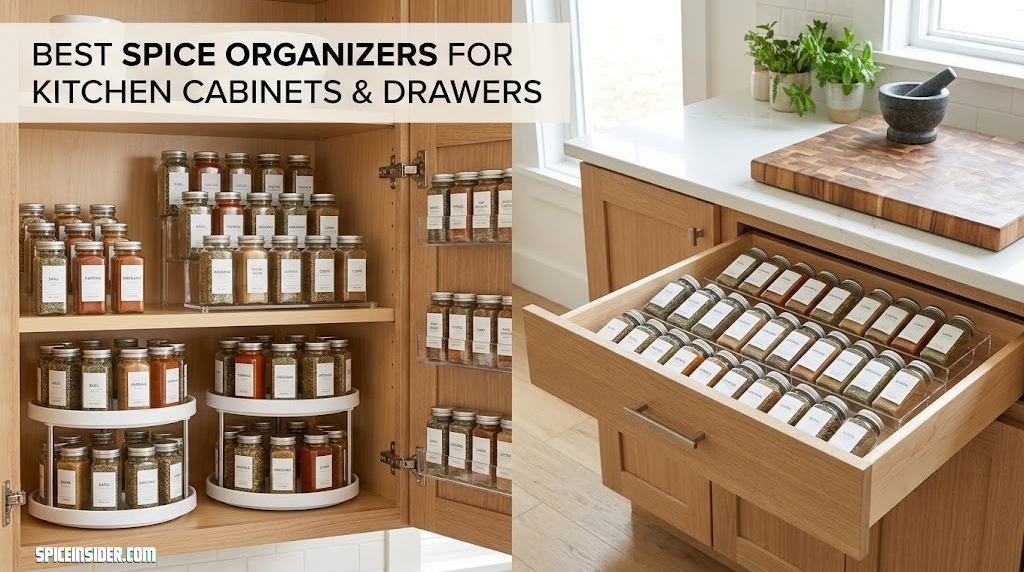
Stackable systems are designed to sit flat inside a kitchen drawer, with individual tiers that angle jars slightly so labels are visible when you open the drawer from above. Many are expandable, meaning you can add extra tiers as your collection grows. This style tends to work best in kitchens with at least one dedicated drawer near the stove or prep area.
Cabinet Shelf Organizers
These sit on an existing cabinet shelf and use tiered steps to raise the back row of jars above the front row, so nothing gets hidden. They’re a good middle ground for kitchens without a spare drawer but with decent cabinet depth to spare.
Door-Mounted and Wall-Mounted Racks
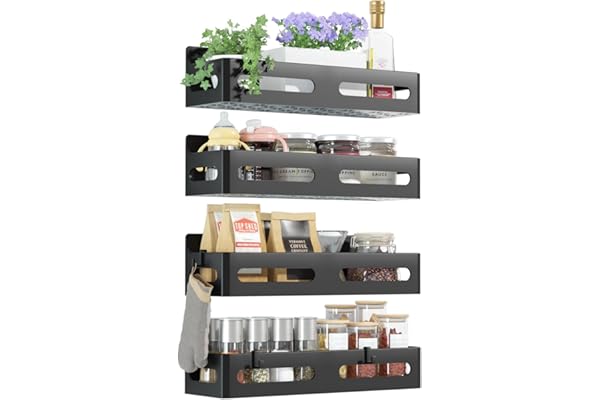
Mounted racks attach to the inside of a cabinet door or directly to a wall, using otherwise wasted vertical space. They’re especially useful in galley kitchens or rentals where floor and counter space is tight, though installation typically requires screws or strong adhesive strips.
Lazy Susan and Turntable Organizers
A rotating turntable lets you spin the entire collection into view rather than reaching or removing jars to find what’s in the back. These are especially useful for deep cabinets or corner cabinets where reach is otherwise limited.
Countertop Tiered Racks
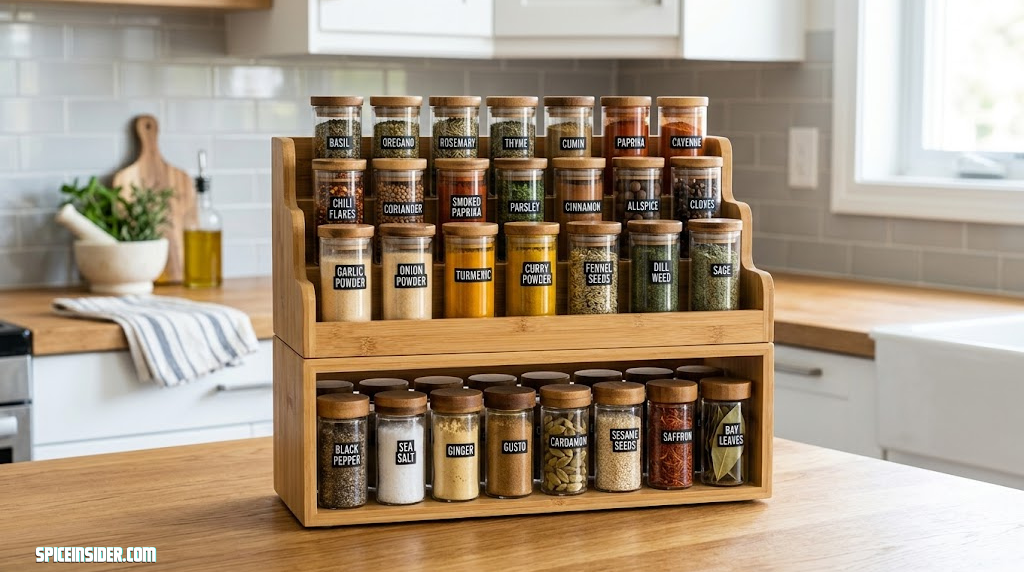
If cabinet and drawer space simply isn’t available, a standalone tiered rack sitting on the counter is the most direct solution. It sacrifices counter space in exchange for maximum visibility and the fastest possible access while cooking.
Most of the products reviewed later in this guide fall into the magnetic, stackable, and cabinet categories, since those three styles cover the vast majority of real-world kitchen layouts. Keep your own space in mind as you read through the buying guide below.
A simple way to narrow things down quickly: if you rent and can’t drill into cabinets, start with magnetic or adhesive options. If you have a dedicated drawer near your stove, a stackable system will likely serve you best. And if your cabinets are deep but your drawers are shallow or already full, a cabinet shelf or sliding-tier organizer is usually the better fit. Very few kitchens need more than two of these categories combined, so resist the urge to buy several different systems before testing one against your actual daily cooking routine.
What to Look For When Buying a Spice Organizer
Once you know which general style fits your kitchen, a handful of practical details separate a purchase you’ll actually use for years from one that ends up back in a drawer, unused, within a month.
It’s easy to get pulled toward whichever organizer has the most attractive product photos, but the products that actually earn a permanent spot in a kitchen tend to succeed on far less glamorous criteria — dimensions that genuinely fit the space, a surface that resists slipping, and a design flexible enough to handle jars you didn’t buy specifically for that organizer. The checklist below covers the details worth checking before adding anything to your cart.
1. Measure Your Space First
This sounds obvious, but it’s the single most common mistake. Before buying anything, measure the drawer depth, cabinet shelf height, or fridge surface you plan to use. Stackable organizers in particular need enough vertical clearance for at least two tiers, and cabinet organizers need enough shelf depth for the step height without blocking the shelf above.
2. Expandability
Spice collections rarely shrink. Look for systems explicitly labeled as expandable or modular, since these let you add capacity later without replacing the whole system. This is especially valuable for stackable drawer organizers, where an extra tier can often be purchased separately.
3. Material and Build Quality
Acrylic and clear plastic organizers are lightweight, affordable, and easy to wipe clean, but cheaper versions can feel flimsy or discolor over time. Bamboo and wood organizers add a warmer look and tend to be sturdier, though they typically cost more and require slightly more care around moisture. Metal wire racks are durable and often the least expensive option for basic shelf organizing, but offer less protection for jars that tip easily.
4. Non-Slip Features
If an organizer sits inside a drawer that gets opened and closed dozens of times a day, jars sliding around defeats the purpose. Rubberized feet, non-skid padding, or a slightly textured tier surface all help keep jars in place, and this is worth checking in product descriptions and reviews before buying.
5. Jar Compatibility
Some organizers are designed around a specific jar size or shape, especially matched sets that include their own labeled jars. If you already own a mixed collection of spice jars from different brands, a more universal, adjustable-width organizer will typically serve you better than a fixed-slot design.
6. Weight Capacity (For Magnetic Systems)
Magnetic tins are only useful if the magnets are strong enough to hold a full tin securely on a vertical surface without sliding or falling. Look for products that specifically mention strong or heavy-duty magnets, and check whether your refrigerator surface is actually magnetic before buying, since many modern stainless steel finishes are not.
7. Ease of Cleaning
Kitchens get messy, and spice organizers are no exception, especially near the stove where oil and steam can drift onto nearby surfaces. Removable trays, dishwasher-safe components, and smooth non-porous materials all make cleanup considerably easier over the long run.
8. Price vs. Longevity
A cheaper organizer that needs to be replaced every year isn’t actually saving money. When comparing prices, weigh build quality and expandability against the sticker price rather than choosing based on cost alone.
View on Amazon
How We Evaluated These Products
Rather than ranking organizers purely on price or star rating, we looked at how each product performs across the factors that actually determine whether an organizer gets used daily or ends up abandoned in a closet within a few months.
Build quality was assessed by looking closely at material thickness, joint and hinge construction on stackable systems, and magnet strength on fridge-mounted kits. Products that felt flimsy in construction photos or had a pattern of complaints about cracking, warping, or weak adhesion were weighted down relative to sturdier alternatives, even if their price was lower.
Expandability was treated as a meaningful differentiator rather than a nice-to-have. Spice collections almost never shrink over time, so a system that can only be purchased as a fixed, non-expandable unit scored lower than a comparable modular option, all else being equal. That’s part of why several of the picks above emphasize add-on tiers, extra tins, or additional shelf units sold separately.
We also weighed installation friction. A magnetic system with no tools required scores differently than a wall-mounted rack requiring drilling, and that distinction matters enormously for renters or anyone who wants a solution they can set up in minutes rather than over a weekend project. Products requiring adhesive strips were evaluated for how well that adhesive performs specifically in a kitchen environment, where grease, steam, and temperature swings are more common than in other rooms of the house.
Finally, real-world sizing and compatibility were factored in. An organizer that only works with one narrow jar size is less broadly useful than one built to accommodate a range of jar diameters and heights, since most home cooks own a mixed collection built up over years rather than a single matched set. Products that flexed to fit a wider range of existing jars scored better on practicality, even when a matched, uniform-jar system looked more polished in photos.
Quick Comparison Table: Best Spice Organizers
Before diving into full reviews, here’s a snapshot of how the ten organizers in this guide stack up against each other.
| Organizer | Style | Best For | Expandable | Material |
|---|---|---|---|---|
| Sevenblue Magnetic Organizer | Magnetic (fridge) | Small kitchens, apartments | Yes | Metal tins |
| SONGMICS UKCS02NB | Stackable drawer | Growing collections | Yes | Acrylic |
| HuggieGems Magnetic Organizer | Magnetic (fridge) | Renters, small spaces | Yes | Metal tins |
| SONGMICS UKCS010N01 | Stackable drawer | Deep drawers | Yes | Acrylic |
| SONGMICS UKCS062BH01 | Magnetic (fridge) | Large collections | Yes | Metal tins |
| Copco Non-Skid Organizer | Cabinet shelf | Budget shoppers | No | Plastic |
| DABIGE Cabinet Organizer | Cabinet / narrow gap | Tight cabinet spaces | No | Metal wire |
| Bunoxea Space-Saving Organizer | Cabinet door / adhesive | Rentals, minimal drilling | Yes | Plastic |
| Spicy Shelf 3.0 | Cabinet shelf | Deep cabinets | Yes | Plastic |
| Bamboo Cabinet Organizer | Cabinet shelf | Kitchen aesthetics | Yes | Bamboo |
If your spice collection has outgrown any organizer entirely, our guide on how to store bulk spices covers longer-term storage solutions worth pairing with the picks below.
Top 10 Best Spice Organizers Reviewed
We looked at build quality, expandability, ease of installation, and real-world usability for each of these picks. Here’s the full breakdown.
Sevenblue Magnetic Refrigerator Spice Organizer
The Sevenblue system is built around small magnetic tins that snap onto a mounting rail attached to the fridge, keeping every jar in a straight, labeled row at eye level. For kitchens without a spare drawer or cabinet shelf, this is one of the most space-efficient options available, since it repurposes a surface that’s normally left empty.
The tins themselves are compact, which is perfect for ground spices used in small quantities but can feel limiting if you go through certain spices quickly and prefer buying in bulk. The clear tops let you see contents and remaining quantity without opening each tin, which speeds up cooking prep considerably.
In day-to-day use, the rail-and-tin approach also makes it easy to rearrange your most-used spices without unmounting anything, since individual tins simply slide along the rail or detach and reattach in a new position. That flexibility is genuinely useful once you’ve lived with the system for a few weeks and start to notice which spices you reach for constantly versus which ones barely move.
Pros
- Uses otherwise wasted fridge space
- Clear tops for quick visibility
- Expandable rail system
- Easy install, no tools needed
Cons
- Only works on magnetic fridge surfaces
- Small tin capacity for bulk users
View on Amazon
SONGMICS Stackable Expandable Spice Organizer (UKCS02NB)
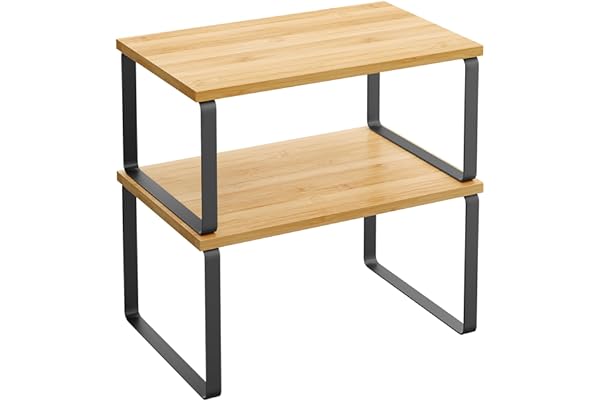
This SONGMICS tray system sits flat in a drawer and angles jars slightly upward, so labels stay visible even when the drawer is fully open. Each tier stacks on the next with interlocking edges, letting you build the exact height your drawer allows without wasted vertical space.
What stands out here is the balance between capacity and stability. Even with two or three tiers stacked, the whole unit stays steady when the drawer opens and closes repeatedly, which is where cheaper stackable systems tend to fail. The acrylic construction is easy to wipe down and doesn’t discolor with regular use.
Assembly is essentially tool-free, which matters more than it sounds like it should — a stackable system that requires screws or brackets to connect tiers adds friction to what’s supposed to be a quick setup. Here, tiers simply lock into place by hand, and taking the system apart for a deep clean or a full drawer reorganization takes only a minute or two.
Pros
- Stable even fully stacked
- Labels stay visible from above
- Easy to wipe clean
- Modular, buy extra tiers separately
Cons
- Requires a fairly deep drawer
- Acrylic can scratch with abrasive cleaners
View on Amazon
HuggieGems Magnetic Refrigerator Spice Organizer
HuggieGems takes a similar approach to other magnetic systems but at a noticeably lower price point, making it a solid entry option for anyone testing out whether a magnetic system will actually fit their cooking habits before committing to a larger set.
The magnets are strong enough for daily use, though on textured or slightly uneven fridge surfaces, a couple of users have noted needing to press tins firmly into place. For a smooth, flat magnetic fridge front, this isn’t an issue at all.
Because the tins are sold in a standard kit size, it’s a reasonable starting point for someone with a modest spice collection who isn’t ready to commit to a larger, more expensive rail system. If your collection grows later, tins from other compatible magnetic kits can often be mixed onto the same rail without much trouble.
Pros
- Affordable entry point
- Simple, no-tool setup
- Good for testing the magnetic system approach
Cons
- Magnets can feel weaker on textured surfaces
- Smaller tin openings for filling
View on Amazon
SONGMICS Spice Organizers Stackable Expandable (UKCS010N01)
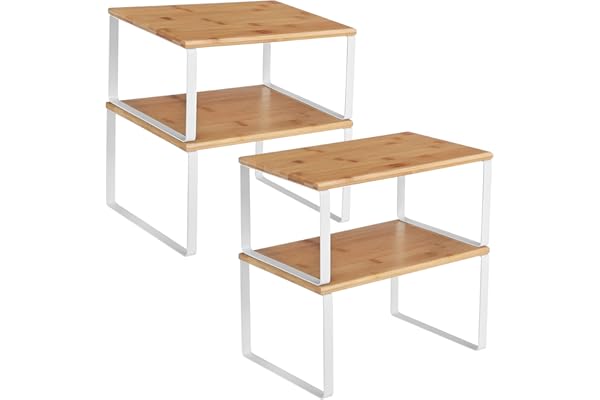
This variant from SONGMICS is built with slightly taller tiers, which makes it a better fit for deep kitchen drawers where a standard stackable system would leave unused vertical space above the top tier. If your drawer is deeper than average, this is worth prioritizing over the shallower UKCS02NB model above.
The wider slot spacing also accommodates larger jars, which is helpful if your collection includes bulk-sized bottles alongside smaller spice jars, something narrower stackable systems sometimes struggle with.
Because it shares the same interlocking design as the shallower SONGMICS model above, the two are cross-compatible, meaning households with more than one drawer available can mix tier heights across drawers while still using tiers that click together identically. That kind of cross-compatibility is rare among stackable organizer brands and worth factoring in if you might eventually expand into a second drawer.
Pros
- Taller tiers fit deep drawers well
- Wider slots fit bulk-size jars
- Same reliable stacking mechanism
Cons
- Not ideal for shallow drawers
- Slightly pricier than the standard version
View on Amazon
SONGMICS Magnetic Refrigerator Spice Organizers (UKCS062BH01)
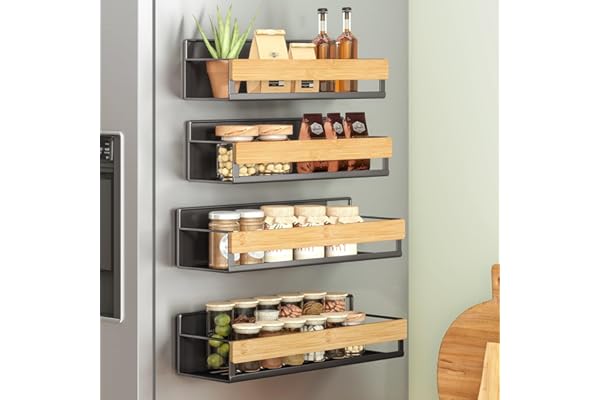
For collectors with a large number of spices and a magnetic fridge to spare, this SONGMICS set is designed to scale. It ships with a higher tin count than most competing magnetic kits and a longer mounting rail, so the whole system can span a larger section of the fridge door without gaps.
Because it’s from the same manufacturer as the stackable drawer sets above, the tin design and rail mounting hardware feel notably more refined than budget alternatives, with a tighter, more secure click when tins are attached.
For households that cook a wide variety of cuisines and therefore keep a genuinely large spice inventory on hand, spreading that inventory across a longer rail rather than cramming extra tins into a compact kit tends to produce a noticeably tidier result, since spacing between tins stays consistent instead of getting progressively tighter as more are added.
Pros
- High tin count for large collections
- Long rail covers more fridge surface
- Secure, refined mounting mechanism
Cons
- Takes up a large visible section of the fridge
- Higher price point than single-rail kits
View on Amazon
Copco Non-Skid Kitchen Spice Organizer
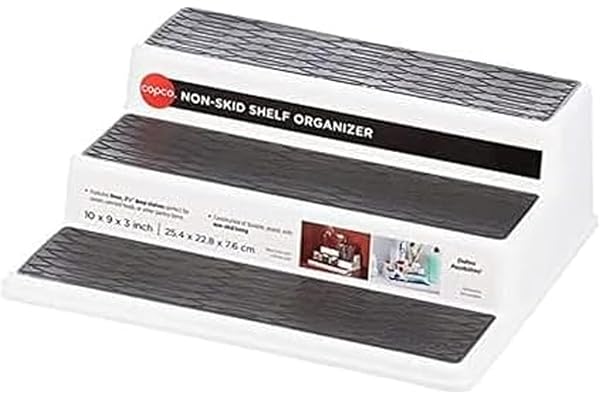
The Copco organizer is a simple, tiered plastic tray meant to sit directly on a cabinet shelf. It’s a no-frills option, but the non-skid backing does exactly what it promises, keeping the whole tray from sliding when the cabinet door opens and closes.
It isn’t expandable, so what you see is what you get, but for anyone with a moderate, stable spice collection who just needs jars raised and visible rather than a fully modular system, it’s a dependable low-cost pick.
It also doubles reasonably well outside the spice cabinet, since the same tiered shape works for canned goods or small condiment bottles if your spice collection happens to be smaller than the tray’s total capacity. That kind of flexibility helps justify the purchase even for households still building up a spice collection from scratch.
Pros
- Very affordable
- Non-skid base actually works
- Simple, no assembly required
Cons
- Not expandable
- Fixed tier height won’t fit every jar size
View on Amazon
DABIGE Spice Organizer Cabinet Organizer
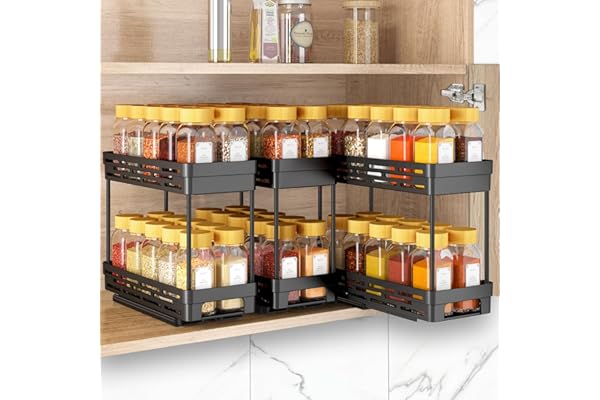
At roughly four inches wide, the DABIGE organizer is purpose-built for the awkward, narrow gaps that show up in real kitchens, such as the sliver of space between a refrigerator and a wall, or a slim cabinet built for trays rather than jars.
The wire-frame, multi-tier construction is lightweight and easy to slide in and out for cleaning, and while it isn’t expandable, its narrow footprint means it’s often used as a second or third organizer alongside a larger primary system rather than a standalone solution for an entire collection.
It’s also worth considering for households that keep bulk spice bags or backup bottles rather than everyday jars in a secondary location, since the open wire shelving allows for quick visual scanning of what’s stored without needing to pull anything out first.
Pros
- Fits genuinely narrow spaces
- Lightweight, easy to remove and clean
- Good secondary storage solution
Cons
- Not expandable
- Low total jar capacity given its size
View on Amazon
Bunoxea Space-Saving Spice Organizer
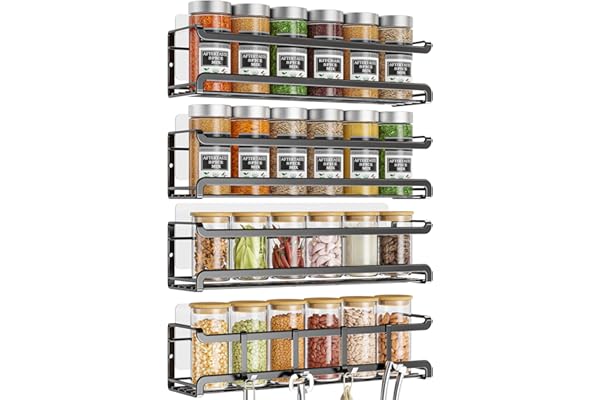
The Bunoxea system mounts to the inside of a cabinet door using adhesive strips rather than screws, making it a strong choice for renters who can’t drill into cabinetry. It essentially converts unused cabinet-door space into a slim storage row for smaller jars and packets.
Because it relies on adhesive rather than a drilled bracket, weight capacity is more limited than a screwed-in rack, so it works best for lighter jars and seasoning packets rather than large glass containers.
Installation is straightforward, but like any adhesive-mounted product, surface prep matters more than it might seem. Cleaning and fully drying the cabinet door surface before applying the strips makes a measurable difference in how long the mount holds up over time, especially in humid kitchens.
Pros
- No drilling required
- Uses otherwise wasted door space
- Good for renters
Cons
- Adhesive has a lower weight limit
- Best for smaller/lighter jars only
View on Amazon
Spicy Shelf 3.0 Expandable Organizer
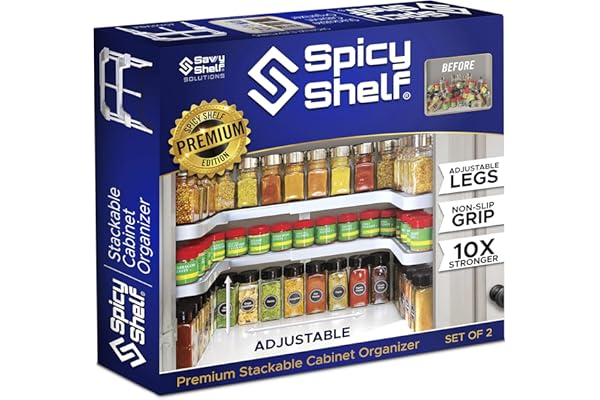
The Spicy Shelf 3.0 is a sliding, tiered shelf system designed specifically for deep cabinets where jars in the back row typically disappear from view. Each tier slides independently, so you can pull forward just the row you need instead of removing multiple jars to reach the back.
It’s genuinely expandable, with additional shelf units sold separately, which makes it one of the more scalable cabinet-based systems on this list, particularly for anyone with a large pantry cabinet dedicated to spices and seasoning blends.
The sliding mechanism itself feels sturdy rather than gimmicky, gliding smoothly under light-to-moderate jar loads without binding or tipping forward, a common complaint with cheaper sliding shelf products. For a cabinet that’s otherwise wasted depth, this is one of the more satisfying products on this list to actually use daily.
Pros
- Sliding tiers solve the “hidden back row” problem
- Genuinely expandable with add-on shelves
- Great for deep pantry cabinets
Cons
- Takes up more shelf depth than static organizers
- Assembly required
View on Amazon
Bamboo Kitchen Cabinet Spice Organizer, Expandable
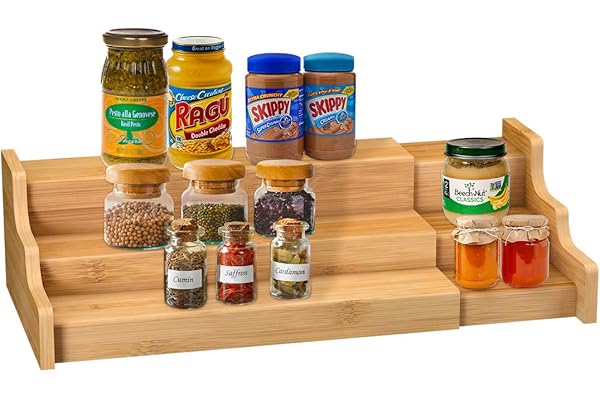
For anyone who cares about how their open cabinet or pantry actually looks, this bamboo organizer is the standout. The natural wood finish fits neatly into farmhouse, natural, or minimalist kitchen aesthetics far better than plastic or acrylic alternatives, and it holds up well structurally as a tiered shelf riser.
Being expandable, it can widen as your collection grows, sliding out to accommodate more jars without needing a second unit. The main tradeoff is price and slightly more careful cleaning, since bamboo shouldn’t be soaked the way plastic organizers can be.
For kitchens with butcher-block counters, wood cabinetry, or other natural material accents already in place, this organizer tends to disappear into the existing design rather than standing out as an obvious storage add-on, which is precisely the appeal for buyers who care as much about how their open shelving looks as how well it functions.
Pros
- Attractive natural wood finish
- Expandable width
- Sturdy, solid construction
Cons
- Higher price than plastic options
- Needs gentler cleaning care
View on Amazon
Magnetic vs. Drawer vs. Shelf Organizers: Pros and Cons
Since these three styles cover most of the products above, it’s worth comparing them head-to-head to help you decide which category to shop within before comparing individual products.
Magnetic Fridge Organizers
Pros
- No drawer or cabinet space used
- Very visible, eye-level placement
- Simple no-tool installation
Cons
- Requires a magnetic fridge surface
- Smaller tin capacity
- Fridge front can look cluttered
Stackable Drawer Organizers
Pros
- Keeps spices hidden from view but organized
- Angled tiers show labels clearly
- Modular and expandable
Cons
- Requires a dedicated drawer
- Needs enough drawer depth for stacking
Cabinet Shelf Organizers
Pros
- Works with existing cabinet shelves
- No installation or tools needed
- Good for larger, mixed jar collections
Cons
- Takes up cabinet depth and height
- Not ideal for shallow cabinets
In practice, many kitchens end up using a combination — for example, a stackable drawer system for everyday cooking spices, plus a cabinet shelf organizer for backup and bulk-size bottles. There’s no rule that says you have to pick just one style, and combining two complementary systems is often the most realistic solution once a collection grows past 20 or 30 jars.
When deciding where to start if you’re building a system from zero, think about which spices you reach for during an actual cooking session versus which ones sit untouched for months at a time. The everyday tier — salt, pepper, garlic powder, a go-to blend or two — deserves the most accessible placement your kitchen allows, whether that’s a magnetic tin at eye level or the front row of a drawer tray. Everything else can reasonably live in a secondary, slightly less convenient location without it costing you any real time during meal prep.
How to Organize Your Spices for Maximum Efficiency
Buying the right organizer is only half the job. How you actually arrange spices inside it determines whether it saves you time or just becomes a slightly neater version of the same clutter.
Start by pulling every spice you own out onto the counter at once. This step is unavoidable and a little tedious, but it’s the only way to see the true size of your collection, check expiration dates, and catch duplicates before they go back into storage. Anything that’s lost its smell or color when rubbed between your fingers has likely lost most of its flavor too and is worth replacing.
From there, group spices by how you actually cook rather than alphabetically first. Most people find it faster to keep baking spices — cinnamon, nutmeg, vanilla, allspice — together in one zone, savory cooking staples like garlic powder, onion powder, and Italian seasoning in another, and heat-based spices such as cayenne, chili powder, and red pepper flakes in a third. Within each zone, alphabetical order works well as a secondary sort so you’re not hunting inside a category either.
Place your most-used spices — usually salt, pepper, garlic powder, and a go-to all-purpose seasoning — in the most accessible slot in your organizer, whether that’s the front row of a stackable tray or the first tin on a magnetic rail. Reserve the back rows or higher shelves for spices you use only occasionally, like specialty blends or spices tied to a specific cuisine you cook less often.
For readers dealing with a genuinely large or chaotic starting collection, our full walkthrough on how to organize spices in your kitchen goes deeper into zone-by-zone layout planning, including how to handle multiple storage locations across a single kitchen.
Finally, build in a light maintenance habit. Once a season, do a quick five-minute pass: check for anything expired, wipe down the organizer, and confirm nothing has drifted out of place. A system only stays useful if it’s occasionally reset, and five minutes every few months is a small price for a drawer or cabinet that never slides back into chaos.
If more than one person cooks in your household, it’s worth briefly walking them through the layout once it’s set up, especially if you’ve organized by cooking category rather than strict alphabetical order. A system that only makes sense to the person who built it tends to drift out of order quickly once someone else starts putting jars back in whatever spot seems convenient at the time.
Labeling Tips for Spice Jars
An organizer without labels only solves half the visibility problem, especially for jars filled from bulk containers or transferred out of their original packaging.
Top-down labels matter more than most people expect, particularly for stackable drawer systems where jars are viewed from above rather than from the side. A label printed only on the side of a jar becomes useless once it’s tucked into a tier and viewed from directly overhead, so it’s worth adding a second label to the lid for any organizer style that opens from the top.
Consistency also matters more than fancy design. A uniform label style — same font, same size, same placement — makes the whole collection easier to scan quickly, even more so than individually decorative labels that vary jar to jar. Waterproof, oil-resistant label material is worth the small extra cost too, since labels near a stovetop are exposed to steam, splatters, and regular handling.
If you’re starting a labeling project from scratch or relabeling an entire collection at once, our dedicated guide on how to label spice jars walks through label material options, placement strategy, and a few printable templates that pair well with most standard jar sizes.
One more detail worth considering: include a fill date somewhere on the label, even a small handwritten one in the corner. Ground spices generally hold their best flavor for around a year, and whole spices considerably longer, but without any record of when a jar was filled, it’s nearly impossible to judge freshness by sight alone. A simple date stamp turns “does this still smell okay?” guesswork into a quick, confident glance.
View on Amazon
Storing Bulk Spices the Right Way
Bulk-bought spices — whether from a warehouse store or a specialty spice shop — usually come in bags or oversized containers that don’t fit neatly into any of the organizers reviewed above. Handling that overflow properly protects both your spice budget and the flavor of what you’ve bought.
The core idea is to separate your working supply from your reserve supply. Keep a small, everyday jar in your organizer for active cooking use, and store the bulk of a large bag or container somewhere cool, dark, and airtight, refilling the working jar as needed. This limits how often the bulk of your spice is exposed to air, light, and kitchen heat, all of which accelerate flavor loss.
Airtight containers matter more for bulk storage than for everyday jars, since bulk bags are rarely sealed as well as a manufacturer’s original packaging. A container with a solid rubber gasket seal will preserve potency dramatically longer than a bag closed with a simple clip or fold.
For a full breakdown of container types, ideal storage locations, and how long different spice categories realistically last once opened, our guide on how to store bulk spices covers the topic in much more depth, including specific advice for whole spices versus ground spices, which degrade at different rates.
It’s also worth thinking about location, not just container quality. A pantry shelf or a cabinet away from the stove and out of direct sunlight will preserve bulk spices far longer than a spot above the range or beside a sunny window, even if the container itself is perfectly airtight. If your kitchen doesn’t have an obvious cool, dark spot, a lower cabinet or a closed pantry closet almost always outperforms open shelving for long-term bulk storage.
Pairing Your Organizer With a Spice Grinder
An organizer solves storage, but freshness ultimately comes down to how the spice was processed before it ever reached the jar. Whole spices, ground fresh right before use, consistently outperform pre-ground versions in both aroma and flavor intensity.
If your organizer includes room for a few whole spices — whole peppercorns, cumin seed, coriander seed, whole nutmeg — pairing that setup with a dedicated grinder lets you get noticeably fresher results for the spices where it matters most, without needing to grind an entire jar’s worth at once.
Peppercorns in particular lose most of their aromatic oils within about twenty minutes of being ground, which is part of why pre-ground black pepper tastes noticeably flatter than pepper cracked fresh at the table. Keeping a small grinder next to your organizer, rather than buried in a separate drawer, makes it far more likely you’ll actually use it consistently instead of reaching for the pre-ground jar out of convenience.
We’ve put together a full breakdown of grinder options, from manual to electric, in our guide to the best spice grinders, which is worth reading alongside this organizer guide if freshness is as much of a priority for you as tidiness.
When choosing where to place a grinder alongside your organizer, treat it the same way you’d treat your most-used jars: put it somewhere you’ll actually reach for it mid-recipe. A grinder tucked away in a back cabinet tends to get used only for special occasions, while one sitting right next to your everyday spice organizer becomes part of the normal cooking rhythm almost immediately.
Spice Storage and Modern Kitchen Design
Spice organizers used to be an afterthought, but kitchen design has shifted toward treating them as a real part of the layout planning process, especially in smaller homes and apartments where every inch of storage has to earn its place.
Open shelving, which remains popular in many kitchen renovations, has pushed more households toward uniform jar systems, since a mismatched jumble of spice bottles looks noticeably different on an open shelf than it does hidden behind a cabinet door. This is part of why matched jar sets with printed labels have grown more common alongside traditional plastic or acrylic organizers — the organizer isn’t just functional anymore, it’s also part of the visible kitchen aesthetic.
At the same time, smaller apartment kitchens have driven demand in the opposite direction, toward space-saving solutions like magnetic fridge systems and adhesive door-mounted racks that don’t require any dedicated cabinet or drawer space at all. Renters in particular have become a significant audience for tool-free, damage-free installation options, since traditional screwed-in racks aren’t always allowed under a lease.
Pull-out and sliding mechanisms, like the tiered sliding shelf featured earlier in this guide, reflect a broader trend in kitchen storage generally, where deep cabinets are increasingly fitted with mechanisms that bring contents forward rather than requiring a reach to the back. This same logic has moved from pot-and-pan storage into spice organization as manufacturers realized the same “lost in the back” problem applies just as much to a five-ounce jar of cumin as it does to a stockpot.
Whatever your kitchen’s overall style, the organizers reviewed in this guide span enough range in material and appearance — from stainless-look magnetic tins to natural bamboo shelving — that finding one which fits your existing design shouldn’t require much compromise on either function or looks.
Common Mistakes to Avoid
Even with the right organizer in hand, a few avoidable habits quietly undo the benefit of having one at all. Being aware of these pitfalls ahead of time will save you from having to reorganize everything a second time just a few months after your initial setup.
- Buying before measuring. An organizer that’s a half-inch too tall for a drawer or too deep for a shelf becomes dead storage space instead of a solution. Always measure the actual space first.
- Placing organizers too close to heat. A magnetic system mounted directly beside the stove, or a shelf organizer positioned right above it, exposes every jar to heat that speeds up flavor loss. Keep spice storage a reasonable distance from direct heat sources whenever the kitchen layout allows.
- Skipping labels on lids. As covered above, side-only labeling defeats the purpose of a top-down stackable system. It’s a small extra step that pays off every single time you open the drawer.
- Overfilling a non-expandable organizer. Cramming extra jars into a fixed-size system just recreates the same clutter problem you were trying to solve, only now inside the organizer itself. If a collection has outgrown a fixed system, it’s time to add a second unit rather than force more jars in.
- Ignoring expiration dates during setup. Transferring an old, stale spice into a new labeled jar doesn’t restore its flavor. Use the initial organizing pass as an opportunity to actually replace anything past its useful life.
- Choosing style over function. A beautiful organizer that doesn’t fit your actual cooking habits or kitchen layout will get abandoned within weeks. Prioritize fit and usability first, then choose the best-looking option that still checks those boxes.
Frequently Asked Questions
Final Verdict
There isn’t a single best spice organizer for every kitchen, and honestly, that’s a good thing — it means there’s a genuinely good fit for whatever setup you’re working with. If you’re short on cabinet and drawer space, a magnetic system like the Sevenblue or HuggieGems options turns unused fridge space into a fully functional spice wall. If you have a dedicated drawer to spare, the SONGMICS stackable trays offer some of the most stable, expandable storage in this entire roundup. And for anyone dealing with deep, hard-to-reach cabinets, the sliding-tier Spicy Shelf 3.0 solves a problem that most other organizers simply can’t.
Whichever style you land on, remember that the organizer itself is only the foundation. Pairing it with a consistent labeling system, a sensible sorting method, and a proper plan for bulk storage is what actually turns a cluttered spice cabinet into one you can navigate in seconds, even mid-recipe with something already on the stove.
Ready to get started? Pick the option above that best matches your kitchen layout, and check current pricing before it changes.
View on Amazon