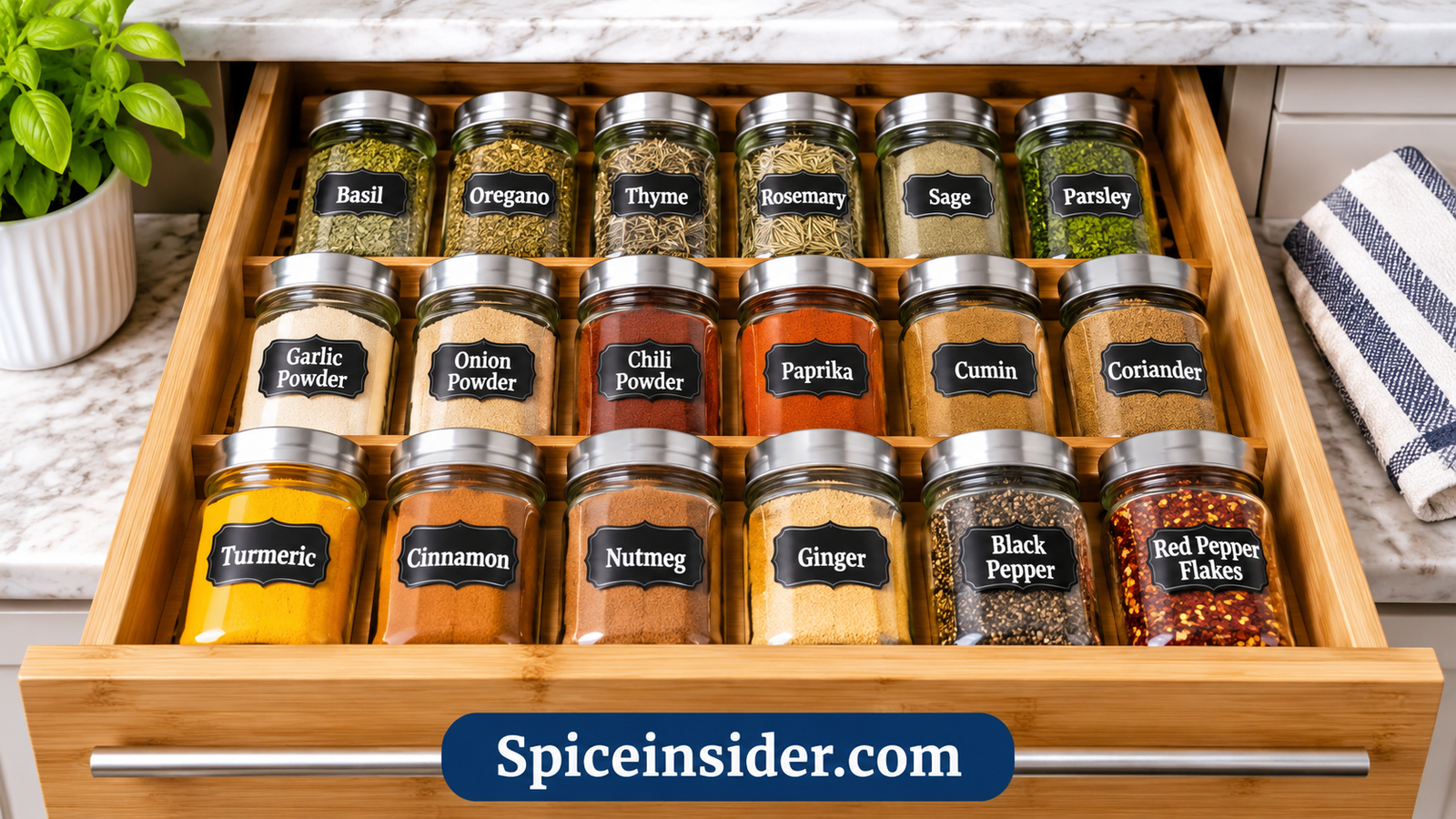
Kitchen Organization
How to Organize a Spice Drawer: A Step-by-Step Guide to a System That Stays Organized
From emptying and auditing to labeling, loading, and maintaining — a complete method for turning a jumbled spice drawer into the most useful space in your kitchen.
There is a specific kind of frustration unique to cooking with a messy spice drawer. You are mid-recipe, pan already hot, and you need a teaspoon of cumin. What you get instead is a three-minute excavation: jars sliding under each other, labels facing every direction but up, something sticky on the bottom, and the growing suspicion that the jar you just found expired a long time ago.
Spice drawers are one of the most satisfying things to organize in a kitchen and one of the most commonly done wrong. Not because people lack effort — usually the opposite. They buy beautiful matching jars, decant everything with great enthusiasm, and then the system falls apart within weeks because the layout did not match how the drawer is actually used.
This guide is the full method, start to finish. You will learn how to empty and audit what you own, measure your drawer honestly, choose containers that fit the space rather than the aesthetic, sort spices into groups that match your cooking, label them so they are readable at a glance, load the drawer by reach and frequency, and maintain the whole thing so it stays organized instead of gradually returning to chaos.
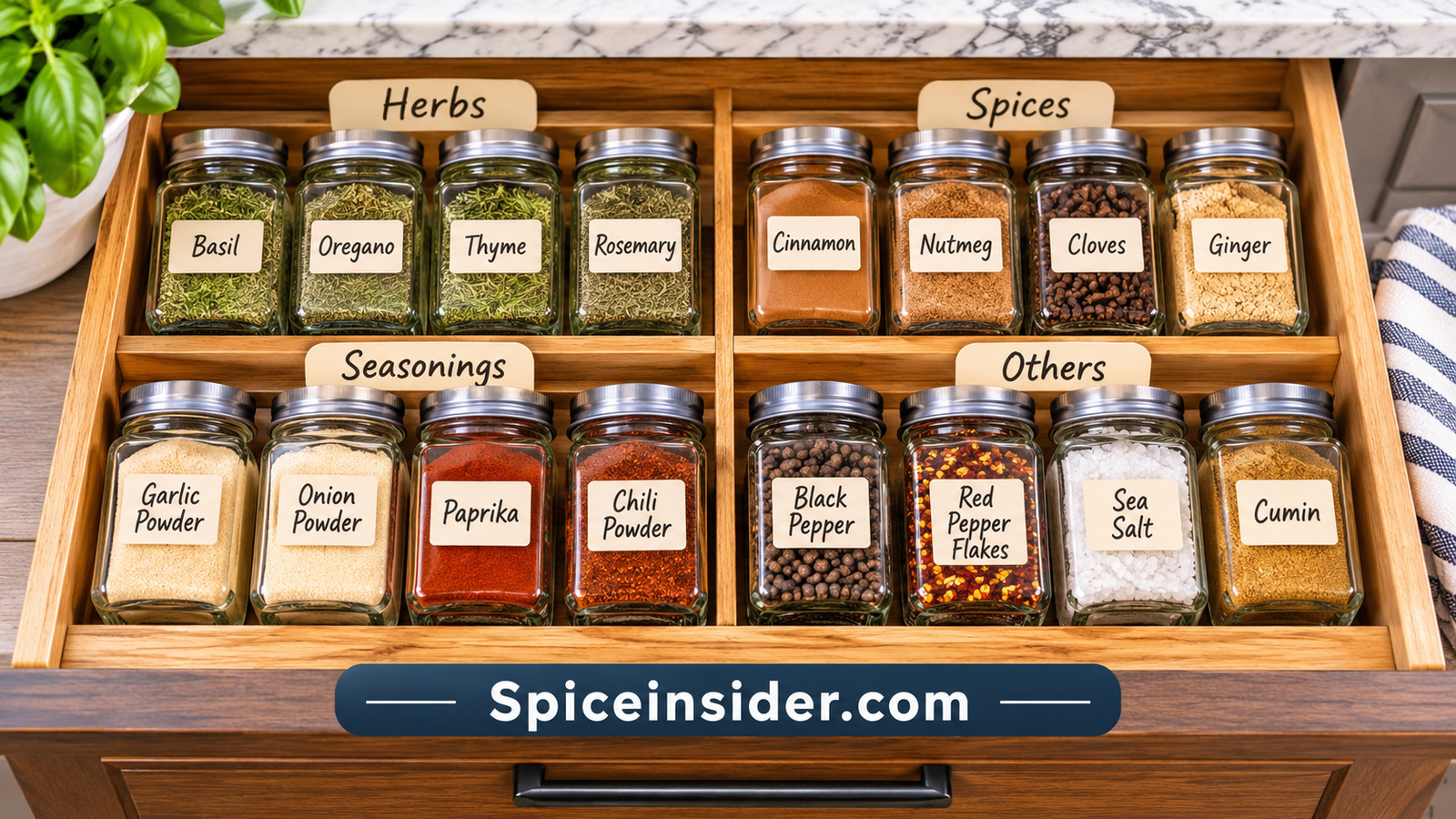
Along the way we will cover the gear that genuinely helps — inserts, risers, labels, and the jars worth buying — as well as the edge cases that trip people up: deep drawers, narrow drawers, shallow drawers under a countertop lip, and drawers that have to hold bulk bags alongside neat jars. Where a topic deserves its own deep dive, you will find links to our related guides, from the best spice organizers to the details of how to label spice jars properly.
The goal here is not a drawer that photographs well. It is a drawer where you can find anything in under five seconds, where nothing gets lost at the back, and where you can see at a glance what needs restocking before you start cooking.
STEP 1Empty the Drawer and Audit What You Own
Every good organization project begins with the same slightly alarming act: take everything out. Not some of it. Everything, including the jars at the very back that have not seen daylight in years, the packet of something that came free with a cookbook, and the little bag of seeds someone gave you.
Set it all on the counter where you can see it. This is the only moment in the process where you have complete information about what you own, and it is the moment most people rush. Do not rush it. The audit is what separates a system that lasts from one that simply rearranges the same clutter.
Everything leaves the drawer, then gets sorted into two piles before anything goes back.
Run the Four-Test Audit
For each jar, work through the same four checks. It takes about ten seconds per jar and it will immediately shrink the collection.
- The smell test. Open the jar and rub a pinch between your fingers. Good spices smell like themselves instantly. If you have to press your nose into the jar to detect anything, it has faded and will flavor nothing.
- The color test. Paprika should be vivid red, turmeric a strong gold, dried herbs a recognizable green. Washed-out color almost always means washed-out flavor.
- The texture test. Ground spices should pour freely. Persistent clumps suggest moisture got in, and anything with visible moisture or an off smell goes in the discard pile regardless of how recently it was bought.
- The use test. When did you last reach for this? If the honest answer is a very long time ago and you cannot name a specific dish you would use it for, it does not need drawer space.
Sorting Out What Counts as a Spice
During the audit, most people discover that about a third of the drawer is not spice at all: bouillon cubes, food coloring, decorative salt, packets of seasoning mix, and sweeteners. Decide deliberately what stays in the spice drawer versus what belongs in another zone. If you have ever debated whether salt belongs here at all, our explainer on whether salt counts as a spice settles the taxonomy question — and the same discussion comes up with sweeteners.
What Usually Comes Out of the Drawer
Every audit turns up roughly the same collection of surprises. Expect to find duplicates — two half-used jars of cinnamon, three containers of garlic powder in varying degrees of emptiness. Expect to find ghosts: spices bought for a single ambitious recipe and never touched again. Expect to find at least one jar with no label at all, containing a brown powder of unknowable identity.
Consolidate duplicates into one container where they are the same spice and both are still good. Discard unlabeled mysteries without guilt; there is no safe way to guess what a powder is, and it is not worth risking a dish over.
When you are finished, you should have three groups: what stays, what gets relocated elsewhere in the kitchen, and what leaves the house. Count what stayed — that number drives every decision in the next step.
Set Yourself Up for the Audit
A few spare jars make consolidating duplicates painless
and keep the drawer from filling back up.
STEP 2Measure the Drawer and Plan the Layout
This is the step everyone skips and the reason so many tidy-looking spice drawers fail. Jars are bought first, measurements taken later, and the result is a drawer where the front row wobbles, the back row is unreachable, or the lids catch on the countertop lip every time the drawer closes.
Measure before you buy anything. You need three numbers, and a tape measure plus five minutes is all it takes.
Three measurements decide everything: interior width, depth front to back, and clear height under the lip.
The Three Numbers You Need
- Interior width. Measure inside the drawer walls, not across the face. Then divide by your intended jar width to find out how many columns you can fit — always rounding down.
- Depth, front to back. This tells you how many rows you can realistically reach. If you need more than two rows to reach the back comfortably, plan on an insert that lifts the rear row.
- Clear height. Measure from the drawer floor to the underside of the countertop lip above it, not the full drawer side height. This is the number that determines your maximum jar height, and it catches most people out.
Write these numbers on a scrap of paper and take that paper shopping. It prevents the classic mistake of buying jars that look perfect in a photograph and are three centimeters too tall for the drawer.
Choosing a Layout Style
| Layout | Best For | How It Works | Watch Out For |
|---|---|---|---|
| Flat rows with top labelsMost Reliable | Shallow and standard drawers | Jars sit upright in straight rows, labels read from above | Back rows can get lost without a riser |
| Tiered or angled insert | Deep drawers with plenty of height | Rear rows sit higher so every label stays visible | Needs height clearance to close cleanly |
| Divider lanes | Narrow drawers and jars of mixed sizes | Long channels keep rows aligned when the drawer moves | Wasted space if jar sizes are inconsistent |
| Two-zone split | Drawers shared with other items | One half for spices, one for wraps, bags or tools | The non-spice half tends to creep into the spice half |
If you are weighing a tiered insert against simple flat rows, the deciding factor is almost always height. Tiered systems look spectacular and let you see everything at once, but they consume vertical space. In a shallow drawer they are frustrating; in a deep drawer they are transformative.
We go further into the available styles in our roundup of the best spice organizers, which covers commercial inserts as well as the simple riser approach that works in nearly any drawer.
Plan Before You Purchase
Measure the interior, then choose an insert or jars to match.
Never the other way around.
STEP 3Choose the Right Jars and Containers
Jar choice is where form most often wins over function, and where drawers get sabotaged before they are even filled. A beautiful round jar with a wide base wastes enormous amounts of drawer space, because circles leave gaps at every corner. A jar that is lovely in the hand may be too tall for your drawer. A jar with a narrow mouth is elegant and impossible to fit a measuring spoon into.
The right container is the one that maximizes how many spices you can store while keeping every label visible and every jar easy to grab. Here is what actually matters.
Shape matters more than style: square jars in uniform heights simply hold more spice.
Container Comparison
| Container Type | Strengths | Weaknesses | Best Use |
|---|---|---|---|
| Square glass jars | Pack tightly, no wasted corners, easy to clean | Heavier and breakable if knocked | Standard drawers where jars sit upright |
| Round glass jars | Widely available, easy to find replacements | Wastes drawer space and rolls out of alignment | Small collections of a dozen or fewer |
| Tins or metal jars | Light, block light completely, stack well | Contents are invisible from outside | Light-sensitive spices and bulk storage |
| Original supermarket jars | Free and zero effort | Inconsistent heights and widths break the grid | Low-budget setups with divider lanes |
The Feature Checklist for Spice Jars
- Airtight lid. Oxygen is the enemy of aroma. A proper seal is more important than the material of the jar itself.
- Uniform height. The drawer must close. Measure clear height first and buy jars that sit comfortably below it.
- Wide enough mouth for a teaspoon. If you cannot fit a measuring spoon in without pouring, you will end up pouring, and you will end up over-seasoning.
- Flat lid surface. Flat tops take labels cleanly and allow a riser to sit on the row below without wobbling.
- Consistent set. Matching jars are not about looks — they are about predictable spacing, which is what keeps a grid intact over months of opening and closing the drawer.
The Measurement Trap
Product photographs are frequently misleading about scale. Before ordering a large set, measure one jar of a known size against your drawer and compare. A set that is slightly too tall or slightly too wide will quietly ruin the layout you planned in the previous step.
Once the jars are chosen, the question becomes what goes in them and in what order — which is the subject of the next step.
Get the Jars Right
Uniform square jars with airtight lids and wide mouths
are the backbone of every drawer that stays tidy.
STEP 4Sort and Group Your Spices
How you group spices determines how fast you find them under pressure. Alphabetical order feels logical and is genuinely useful in very large collections. But most home cooks do not think “I need something beginning with C” — they think “this is a taco” or “this is a baking project.” Grouping by how you cook is almost always faster than grouping by the alphabet.
There are four workable systems. Pick one deliberately and stick with it; mixing systems is what makes drawers feel chaotic again within weeks.
Group by how you cook, then place each group in its own row or lane.
Four Grouping Systems Compared
| System | How It Works | Best For | Downside |
|---|---|---|---|
| By use | Everyday, baking, heat, blends | Most home cooks | Some spices fit two zones |
| By cuisine | Mexican, Indian, Mediterranean, Asian | Cooks who rotate cuisines | Shared spices like cumin need a home |
| Alphabetical | Strict A to Z order | Large collections and shared kitchens | Slower during active cooking |
| By frequency | Reach zone, weekly zone, rare zone | Small drawers with limited space | Needs re-sorting as habits change |
Most households end up with a hybrid: frequency zones across the drawer, and use-based groups within each zone. That combination gives you speed during cooking and structure during cleanup.
The “Where Does This Belong?” Problem
A handful of spices resist categorization. Cinnamon lives in baking for some cooks and in chili for others. Paprika appears in nearly every cuisine. Salt and sugar come up constantly — is sugar even a spice, and does it belong in the same drawer at all? Our explainers on whether sugar counts as a spice and the broader question of which spices go well together are genuinely useful here, because the pairing logic often suggests the grouping.
For multi-purpose spices, the rule is simple: place them where you will look first, and if you are not sure, put them in the everyday zone. You can always move a jar later; you cannot cook without finding it.
Blends Deserve Their Own Lane
Commercial blends and homemade mixes behave differently from single spices, and they are used differently too. Keep them in a dedicated section so a blend is never mistaken for a single ingredient mid-recipe. Understanding what is actually inside common blends helps you decide where they belong: our breakdowns of what goes into pumpkin pie spice, Chinese five spice, and sumac show how blends and single spices relate.
If you need a refresher on naming before you sort — helpful when a recipe uses a term you have not met before — our reference on the complete list of spice names is worth keeping open in a second tab.
Give Each Group a Home
Small bins or divider trays turn four zones
from an idea into an actual drawer layout.
STEP 5Label Everything Clearly
Labeling is the step that looks optional and is not. A drawer full of identical jars without labels is a guessing game, and a guessing game always ends with someone sniffing a spoon over a hot pan trying to identify a powder.
The good news is that labeling well takes about twenty minutes and one decision: where the label goes. For a drawer, that decision is straightforward — labels go on top.
Top labels are what make a drawer scannable; side labels are optional extra information.
What to Put on the Label
- The name, in a consistent position. Same corner or same center point on every jar. Consistency is what allows your eye to scan quickly.
- The fill date. The single most useful piece of extra information you can add. It turns vague guilt about old spices into an actual decision.
- Whole or ground. Especially useful for spices you keep in both forms, like cumin or coriander.
- Heat level or variety, where relevant. “Hot paprika” and “sweet paprika” are different ingredients; label them as such.
We have a dedicated walkthrough on how to label spice jars covering label types, printing versus handwriting, and how to remove old labels cleanly when you reorganize. It is worth reading before you buy labels in bulk, because the wrong adhesive on the wrong surface creates a cleanup project you did not plan for.
Top Labels Versus Side Labels
Top Labels
- Readable the instant the drawer opens
- Never hidden by the jar in front
- Perfect for flat-lidded jars
- Fastest option for busy cooking
Side Labels Only
- Look tidy on a shelf, not in a drawer
- Blocked by adjacent jars
- Require lifting the jar to read
- Slower and more frustrating mid-recipe
The practical answer for drawers is top labels as the primary system, with a small side label if you want extra detail. If you also keep spices on a shelf or in a cabinet, use side labels there instead — the location dictates the label position, not the other way around.
Label It Once, Find It Forever
Clear top labels with names and dates
turn a jar collection into an actual system.
STEP 6Load the Drawer With Logic
Now the satisfying part: everything goes back in. But it goes back in a specific order, because where a jar sits determines how often it gets used and how quickly the drawer returns to chaos.
The principle is simple and worth tattooing on your memory: frequency determines position. The spices you touch every day sit closest to your hand. Weekly spices go in the middle. Occasional spices go at the back. Anything you use less than a few times a year does not need drawer space at all.
Front row for daily staples, middle for weekly workhorses, back for occasional specialty items.
The Reach Map
- Front row: daily drivers. Salt, pepper, garlic powder, onion powder, the herb you use most, the chili you use most. These should be grabbable without looking.
- Middle rows: weekly workhorses. Cumin, paprika, oregano, cinnamon, and whatever else appears in your regular rotation.
- Back rows: specialty and blends. Sumac, saffron, five-spice, seasonal baking mixes, anything used occasionally.
- Out of the drawer entirely. Bulk refill bags, backup jars, and anything used rarely enough that drawer space is wasted on it.
Left-to-Right Order Within Each Row
Once the rows are set, arrange within them. Two systems work well. The first is group order — keep your zones contiguous, so the baking group sits together and the heat group sits together. The second is alphabetical within each group, which gives you the findability of alphabetical order without the incoherence of a full A to Z layout.
A small detail that makes a noticeable difference: turn every label to face the same direction before you finish. It takes thirty seconds and it is the difference between a drawer that feels organized and one that merely looks tidy.
The Stability Trick
Jars shift when drawers open and close, especially in deep drawers. A non-slip liner at the bottom, or a simple divider between rows, keeps the grid intact. Without it, rows drift and the layout you planned slowly dissolves into a jumble again.
Keep the Grid From Sliding
Non-slip liner and simple dividers are inexpensive
and they protect the layout you just built.
STEP 7Maintain the System and Restock Smartly
Any organizational system decays without maintenance, and a spice drawer decays faster than most because the failure is invisible. Nothing looks obviously wrong when a spice fades — the jar is still there, still labeled, still full. Only the food tells you.
Maintenance here takes five minutes a month. The payoff is a drawer that stays useful for years instead of needing a full rebuild every time you cannot find the turmeric.
A short monthly loop keeps freshness high and the layout intact.
The Monthly Five-Minute Routine
- Sniff the front row. These are the jars that get opened constantly and lose aroma fastest. Rub a pinch, smell, and note anything that has gone quiet.
- Refill before empty. A jar that runs out mid-recipe usually gets replaced in a hurry, by whatever is nearest, at whatever price. Restocking a little early is cheaper and calmer.
- Re-align the rows. Thirty seconds of straightening prevents the slow drift that ruins layouts.
- Check the dates. Anything approaching its prime window gets used deliberately in the next few weeks rather than quietly ignored.
Restocking Without Wasting Money
Spice pricing is wildly uneven, and drawer organization intersects with it more than people expect. Buying in bulk is the best value for spices you use weekly and the fastest way to waste money on anything else. Our guide to how to store bulk spices covers the transfer and storage side, which matters because bulk bags do not belong in a tidy drawer.
Quality also varies enormously by spice. Some ingredients reward careful sourcing and some simply do not. If you want to know where extra spending genuinely pays off, our guides cover the ones worth being picky about: turmeric powder, smoked paprika, whole nutmeg, and cinnamon for baking — plus the deeper question of Ceylon versus cassia cinnamon if you bake seriously. Vanilla deserves the same attention, whether you choose vanilla bean brands or decide between formats using our comparison of extract versus bean paste.
And then there is saffron, which is in a category of its own. If you keep it in your drawer, store it carefully and buy it from a source you trust — our guide to the best saffron brands and the companion piece on how to tell if saffron is real explain why this particular spice is so often adulterated. It also happens to be the most expensive spice in the world, which is reason enough to keep it somewhere safer than the back of a crowded drawer.
Restock Before You Run Out
Small refill quantities keep spices fresh
and keep the drawer from becoming storage.
08Organizers, Inserts and DIY Options
Once the jars and the layout are settled, the question becomes whether you need dedicated hardware to hold everything in place. The honest answer is: sometimes. A drawer with identical square jars sitting in tight rows often needs nothing at all. A drawer with mixed jar sizes, a wide footprint, or a deep profile usually benefits enormously from an insert.
Here is how the main options compare.
| Option | Best For | Why It Works | Considerations |
|---|---|---|---|
| Tiered acrylic insertMost Popular | Deep drawers with good height clearance | Lifts rear rows so every label stays visible | Needs vertical space to close cleanly |
| Adjustable divider rails | Narrow or oddly shaped drawers | Creates lanes that keep rows from drifting | Must be sized to your exact drawer width |
| Simple risers or steps | Budget setups and standard drawers | Lifts the back row at almost no cost | Does not prevent lateral sliding |
| Non-slip liner only | Uniform jars in a tight grid | Grip keeps jars exactly where placed | No separation between groups |
| DIY cardboard or wood dividers | Temporary setups and odd dimensions | Custom-fit to any drawer at minimal cost | Wears out and looks worn over time |
What to Look For in a Commercial Organizer
- Adjustability. Drawers are rarely standard. Expandable or modular systems forgive measurement errors.
- Open sides for cleaning. Spice dust gets everywhere eventually, and a system you cannot wipe out will collect it.
- Compatibility with your jar diameter. A tiered insert designed for a different jar width will leave gaps or squeeze your jars.
- Materials that tolerate moisture. Kitchens are humid environments near stoves and sinks; untreated cardboard is a short-term fix.
We tested and compared a wide range of these systems in our guide to the best spice organizers, covering both drawer-specific inserts and the cabinet and countertop alternatives that make sense when drawer space simply is not available.
When Not to Buy an Organizer
If your jars are uniform, your collection is under a dozen, and your drawer is shallow, non-slip liner and disciplined placement will do the job. Hardware solves geometry problems, not habit problems.
Hold the Layout in Place
An adjustable insert or a set of divider rails
keeps the drawer from undoing your work.
09Fixing Awkward Drawer Shapes
Perfectly rectangular, generously deep drawers are the ones shown in every photograph. Real kitchens have shallow drawers under a countertop lip, narrow drawers beside a sink, wide drawers that also hold other things, and corner drawers that are shaped like nothing else. Each of these needs a slightly different approach, and the good news is that all of them are solvable.
| Drawer Type | The Challenge | Best Approach | Jar Choice |
|---|---|---|---|
| Shallow drawer | Low clearance; lids catch on the lip | Low-profile jars laid flat or short upright jars | Short, wide-mouth jars only |
| Deep drawer | Rear rows are hard to reach | Tiered insert or riser to lift the back row | Uniform tall jars work well |
| Narrow drawer | Only one or two columns fit | Single-file rows front to back by frequency | Slim, consistently sized jars |
| Wide shared drawer | Spices compete with other items | Hard split with a divider; zones on one side | Square jars to keep the grid tight |
| Corner or angled drawer | Unusable triangular corners | Zone the usable rectangle; store bulk items in corners | Mix of sizes, grouped by width |
The Shallow Drawer Problem
Shallow drawers are the most common complaint and the most fixable. If jars will not stand upright, lay them on their sides with the label facing up — this works well with slim cylindrical jars and gives you a very scannable drawer. The alternative is transferring to short, wide jars designed for tight clearance. Either way, measure the clear height first; this is the number that caught you out in step two and it will catch you out again here.
The Deep Drawer Problem
Deep drawers are a luxury until you realize the back third is functionally invisible. A tiered insert solves it outright. If you would rather not buy one, a simple riser — a small step or shelf under the rear row — achieves most of the effect for very little money. The goal is that every label is visible from above when the drawer opens.
The Shared Drawer Problem
Many kitchens cannot dedicate an entire drawer to spices, and that is fine. The key is a hard boundary rather than a soft one. Use a divider, a tray, or a small bin to make the spice zone physically separate. Soft boundaries — “spices go roughly on this side” — fail within days, because bags and tools migrate into whatever space is available.
A Note on Heat and Moisture
Whatever drawer you choose, avoid the one directly above an oven or dishwasher if you can. Repeated heat exposure accelerates the fading of every spice in it. If that is your only option, prioritize airtight containers and accept that refill cycles will be shorter.
Make Any Drawer Work
Risers, slim jars and dividers solve more awkward
drawers than a full kitchen renovation ever would.
10Whole Spices, Blends and the Gear Around Them
A well-organized spice drawer raises a natural question: what about the things that do not fit neatly into a jar grid? Whole spices, bulk refills, blends, and the equipment used to process them all need a home, and putting them in the wrong place is one of the fastest ways to undo an organized drawer.
Where Whole Spices Belong
Whole spices — peppercorns, cumin seed, coriander seed, cinnamon sticks, whole nutmeg — often live better in a small secondary container or a dedicated section rather than in individual jars, especially if you grind them fresh. The payoff for keeping them is significant: whole spices hold their aroma far longer than pre-ground, and the difference in finished food is obvious. Our comparison of whole versus pre-ground spices covers exactly how big that gap is.
If you go this route, you will want something to grind with. A good electric grinder handles most home needs quickly — start with our roundup of the best spice grinders — and the mechanical choice between blade and burr designs is worth understanding before buying, which is where our guide to blade versus burr grinders for spices comes in. If you prefer quiet and control, manual spice grinders and a classic mortar and pestle are both excellent, and cooks who work heavily with hard seeds may want to look at grinders specifically suited to Indian spices.
Getting the Most From Whole Spices
Owning the tool is only half of it. The technique is what turns whole spice into noticeably better food: toasting before grinding deepens flavor dramatically, and short grinding pulses preserve the volatile oils that give spices their aroma. Our walkthrough on toasting spices before grinding is the single highest-value technique in this section.
If you own a grinder, a few habits keep it performing well — loading small batches, pulsing rather than holding, and cleaning between strongly flavored spices. Our guide on how to use a spice grinder covers the day-to-day technique, and spice grinder dos and don’ts is the short version worth remembering.
Keeping Grinder and Drawer Systems in Sync
Grinder maintenance matters more than most people expect, because residue from one spice migrates into the next and stale oil turns rancid. Routine cleaning is quick: empty fully, wipe the chamber, and do a deeper clean when lingering aroma builds up. Our complete guide to cleaning a spice grinder covers both, and the closely related question of whether a spice grinder can be washed with water depends on the motor housing. For stubborn odors, our odor removal guide walks through the dry methods that work best.
And if you have ever wondered whether you can grind without any equipment at all — useful when you are traveling or when the grinder is mid-clean — our guide on how to grind spices without a grinder covers the pantry-workarounds that genuinely work.
What to Do With Specialty Items
Every drawer collects a few items that resist the grid: a sachet of saffron, a bag of dried chilies, a jar of homemade blend, a bottle of extract. The solution is a small dedicated bin or basket at the back of the drawer, labeled as “specialty.” It keeps them contained and visible without disrupting the main grid. Extracts and anything in liquid form generally live better in a cupboard than in a drawer anyway.
Grind Fresh, Store Smart
Whole spices plus a reliable grinder extend freshness
and make a small drawer collection go further.
11Matching the System to How You Cook
Organization is not an end in itself. The whole point of a well-sorted spice drawer is that it disappears into your cooking — you reach, you find, you season, and you never break your train of thought. Which means the final design decision is about you, not about jars.
The most useful way to think about it is to reverse-engineer your drawer from your habits. What do you actually cook in an average week? Those dishes determine what sits in the front row.
Build the Drawer Around Your Real Meals
- If you roast a lot of chicken and vegetables, the front row belongs to garlic powder, paprika, thyme, oregano, salt, and pepper. Everything else can move back.
- If you cook a lot of tacos, chili, and beans, cumin, chili powder, oregano, onion powder, and cayenne lead, with coriander and smoked paprika close behind.
- If baking is your thing, cinnamon, nutmeg, ginger, cloves, allspice, and vanilla sit up front, and the savory spices move to the middle.
- If you rotate cuisines, group by cuisine zone instead, and put the shared staples in a small cross-over lane at the front.
For pairing logic that helps you decide where things belong, we have detailed guides on the combinations people reach for most: what spices go with chicken, what spices go with pork, what spices go with salmon, and what spices go with sweet potatoes. If your cinnamon lives in two worlds at once, our guide to what goes well with cinnamon shows how a single jar can serve both the baking zone and the savory zone.
If You Are Building From Scratch
Anyone organizing a drawer for the first time is often also building a collection for the first time, and that is a genuinely enjoyable project. Our complete guide to the spices every kitchen needs covers what to buy first and why, organized by flavor role rather than by shopping aisle. It pairs perfectly with this article: one tells you what to own, the other tells you where to put it.
Small Habit Changes That Keep It Working
- Return jars with labels facing up, immediately. Not later. Later is how grids dissolve.
- Restock from the front. Move the older jar forward when you open a new one, so the older spice gets used first.
- Keep a running list. A small note on the inside of a cabinet door listing what needs refilling saves the emergency mid-recipe purchase.
- Resist the matching-set trap. A perfectly matching drawer that is organized around someone else’s cooking habits is still the wrong drawer.
Organize Around Your Cooking
Build the drawer from the dishes you make most
and it will stay organized without effort.
12Common Mistakes and the Long-Game System
Almost every failed spice drawer fails in one of a handful of predictable ways. Knowing them in advance is the cheapest insurance there is.
| Mistake | Why It Happens | The Fix |
|---|---|---|
| Buying jars before measuring | Aesthetics get decided before geometry | Measure width, depth and clear height first, every time |
| Keeping too much | Discarding feels wasteful | Audit on the four tests; unlabelled or faded spices go |
| Alphabetical by default | It feels logical without being tested | Group by use or frequency instead |
| Side labels only | Shelf thinking applied to drawers | Top labels for drawers, side labels for shelves |
| Ignoring drawer drift | No liner or dividers to hold the grid | Non-slip liner and row dividers |
| Restocking in bulk | Price per jar looks like value | Bulk only for spices used weekly; small jars elsewhere |
The Two Habits That Matter Most
Strip away all the detail and a spice drawer that stays organized comes down to two habits. First, everything returns to its assigned position immediately after use — not at the end of the session, not tomorrow. Second, the collection gets reviewed on a rhythm rather than when something goes wrong. Those two behaviors do more than any product.
A Well-Run Drawer Delivers
- Anything findable in seconds, mid-recipe
- Fresher flavor because older jars get used first
- Less waste and fewer duplicate purchases
- Cooking that stays calm instead of scrambling
What Slows It Down
- Impulse buys that never get assigned a place
- Containers that do not fit the drawer geometry
- Label systems that are hard to maintain
- Sharing the drawer without a hard boundary
When Things Go Wrong Mid-Recipe
Even with a perfect drawer, cooking occasionally goes sideways: too much heat, a spice that tasted stronger than expected, a blend that took over the dish. It is worth knowing the recovery techniques before you need them — our guide on how to reduce spice in food covers the dilution and fat strategies that actually work, and it is far easier to apply when you already know it exists.
The Long Game
A spice drawer is never really finished. Your cooking changes, the collection changes with it, and the layout evolves. What lasts is not the specific arrangement you choose today — it is the framework: audit regularly, group by habit, label for speed, place by frequency, and maintain on a rhythm. Everything else is detail.
Build the System, Not Just the Shelf
Good containers plus good habits are what keep
a spice drawer organized for the long haul.
Frequently Asked Questions
The questions that come up most often when people organize a spice drawer for the first time.
What is the best way to organize a spice drawer?
Empty it completely, audit every jar, measure the interior, choose containers that fit the space, group spices by how you cook, label the tops of each jar, and load them by frequency with daily staples at the front. The system works because each step supports the next.
Should spice jars face up or on their side in a drawer?
Face up in most cases, with labels on the lid so they read from above. In very shallow drawers where upright jars will not fit, laying slim jars on their sides with the label facing up is a good alternative.
Should I organize spices alphabetically?
You can, and it works well for large collections or shared kitchens where multiple people need to find things. For most home cooks, grouping by use or by cooking frequency is faster, because you think in terms of dishes rather than letters while cooking.
How do I know which spices to keep and which to throw away?
Use four tests: smell, color, texture, and when you last used it. Spices that barely smell, look faded, have clumped from moisture, or have not been touched in a very long time should go. Anything unlabelled should be discarded rather than guessed at.
Do I need to buy matching jars?
Matching jars are helpful rather than essential. Uniform sizes make the grid predictable and let you fit more into the same space, which is the real advantage. If budget is tight, organizing consistent sizes together in lanes achieves much of the same effect.
Where should labels go on spice jars for a drawer?
On the lid. Top labels are readable the moment the drawer opens, and they are never blocked by the jar in front. Side labels are better suited to shelves and cabinets where jars are viewed from the front.
How do I keep jars from sliding around in the drawer?
Non-slip liner at the bottom is the simplest fix. Divider rails or an insert also work, especially in deep drawers where the drawer’s movement shifts the rows. Straightening the rows during your monthly check keeps drift under control.
Should spices be stored in a drawer or a cabinet?
Both work well as long as the location is cool, dark, and dry. Drawers have the advantage of visibility from above; cabinets keep spices out of direct light. What matters most is distance from the stove, oven, and sink.
How often should I replace spices?
There is no fixed schedule — freshness depends on how the spice was stored and whether it is whole or ground. Ground spices fade noticeably faster than whole ones. A monthly smell test tells you far more than any date on the label.
What about bulk spices and refill bags?
Bulk bags belong in storage, not in the organized drawer. Transfer what you use regularly into your working jars and keep the rest in a cool, dark cupboard in airtight containers. Buying in bulk makes sense for spices you go through quickly.
Can I organize a spice drawer if I also store other things in it?
Yes, but use a hard boundary — a divider, tray, or bin — rather than a soft one. Shared drawers fail when the boundary is informal, because other items gradually take over the spice space.
Still Deciding on Your Setup?
Start with the audit and the measurements.
Everything else becomes obvious once those two are done.
Conclusion: A Drawer That Works as Hard as You Do
Organizing a spice drawer is one of those projects that looks like it is about containers and labels and is actually about something else entirely: reducing friction in the part of the day where you have the least patience for it. The cooking is the point. Everything in this guide exists to get you back to the pan faster.
Start by emptying the drawer and being honest about what is in it. Measure the space before you buy anything. Choose containers that fit the geometry rather than the mood board. Group your spices the way you actually think about food, label them for reading speed, and place them by how often you reach for them. Then keep a light monthly rhythm so the whole thing stays intact.
None of it requires a big budget or a full day. A single afternoon gets you most of the way there, and the difference shows up at dinner the same evening.
Ready to Organize Your Spice Drawer?
Start with the audit and the measurements.
The rest of the system follows quickly.
You May Also Like
More from Spice Insider to keep your spices fresh and your kitchen running smoothly.
Why Your Spice Grinder Isn’t Getting Fine Enough
Batch size, pulse timing, and the loading mistakes behind coarse results.
TroubleshootingWhy Your Spice Grinder Leaves Chunks
Oily spices, wall build-up, and the simple fixes that produce even grinds.
MaintenanceSpice Grinder Motor Burning Smell
What causes it, how to stop it, and when it signals real trouble.
MaintenanceSpice Grinder Lid Stuck? Here’s How to Open It
Safe, non-damaging methods for a lid sealed by oil residue.
GearCan You Grind Coffee in a Spice Grinder?
What happens to flavor when one chamber does both jobs.
ReviewCuisinart SG-10 Review
A close look at one of the most widely used compact electric grinders.
ReviewSecura Spice Grinder Review
Where this popular grinder shines and where it shows its limits.
Buying GuideChoosing a Spice Grinder That Doesn’t Break
What durability actually looks like in a hard-working kitchen grinder.
CleaningGetting Smells Out of a Spice Grinder With Rice or Bread
The classic dry-absorbing method, explained step by step.