Ceylon vs Cassia Cinnamon: Which One Actually Belongs in Your Pantry?
A deep, no-nonsense comparison of flavor, health effects, price, and everyday use — so you can finally stop guessing which jar to grab off the shelf.
Introduction: Two Spices, One Confusing Name
Walk into almost any grocery store and grab a jar labeled “cinnamon,” and there’s a very good chance you’re holding cassia, not true cinnamon. That single mislabeling has confused home cooks for generations, and it matters more than most people realize. Ceylon and cassia are related, but they come from different trees, taste noticeably different, and carry different health implications when consumed regularly.
This guide breaks down everything that separates Ceylon cinnamon from cassia cinnamon: where each one comes from, how they taste, what the science says about long-term consumption, and which one actually makes sense for your kitchen. If you’ve ever wondered why some recipes specify “Ceylon cinnamon” while others just say “cinnamon,” you’re about to get a clear answer.
We’ll also touch on how cinnamon fits into a broader spice cabinet. If you’re building out a serious collection of spices at home, it’s worth checking our guide to the best cinnamon for baking alongside this comparison, since baking performance is one of the biggest differentiators between the two types.
What Cinnamon Actually Is
Cinnamon isn’t a single plant — it’s a spice made from the inner bark of trees belonging to the genus Cinnamomum. When the bark is peeled away, dried, and curled, it forms the familiar quills we associate with cinnamon sticks. Ground cinnamon is simply that dried bark, pulverized into a fine powder.
The confusion starts because at least four species are commercially sold as “cinnamon” worldwide, but only one — Cinnamomum verum, also called Ceylon cinnamon or “true cinnamon” — is considered the authentic article by botanists and culinary historians. Cassia cinnamon actually refers to several closely related species, most commonly Cinnamomum cassia (Chinese cassia), Cinnamomum burmannii (Indonesian/Korintje cassia), and Cinnamomum loureiroi (Vietnamese/Saigon cassia).
In the United States and much of Europe, food labeling laws are lenient enough that any of these can simply be sold as “cinnamon” without distinguishing which species is inside the jar. That’s the root of nearly every point of confusion in this comparison.
Origins and Where Each One Grows
Ceylon cinnamon is native to Sri Lanka (formerly known as Ceylon) and parts of southern India. The climate, soil composition, and traditional hand-processing methods used there produce bark that’s thin, papery, and easy to grind. Sri Lanka still supplies the overwhelming majority of the world’s Ceylon cinnamon, and it remains a significant agricultural export for the country.
Cassia, on the other hand, is grown much more broadly. Chinese cassia comes primarily from southern China and parts of Vietnam. Indonesian cassia (often labeled Korintji or Korintje) is harvested from Sumatra. Saigon cassia comes from Vietnam and is prized for being unusually strong and pungent compared to other cassia varieties. Because cassia trees grow faster, tolerate more diverse climates, and produce thicker, hardier bark, cassia has become the dominant cinnamon in global trade — accounting for the vast majority of cinnamon sold in North American grocery stores.
Appearance and How to Tell Them Apart
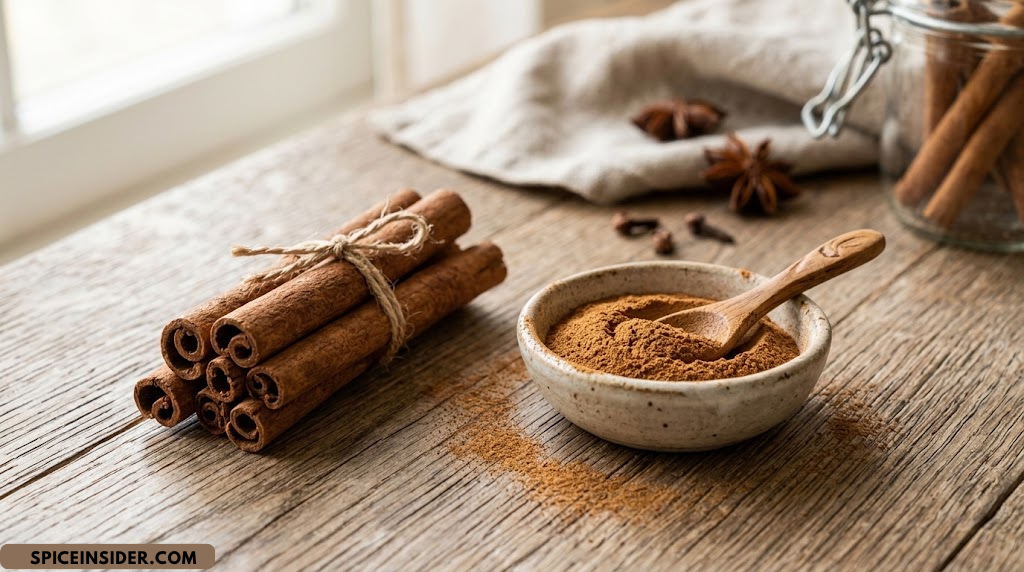
If you’ve ever seen a whole cinnamon stick from each type side by side, the difference is unmistakable. Ceylon cinnamon sticks are made of many thin layers of bark rolled together, resembling a cigar or a stack of thin paper rolled into a tube. They’re light tan to medium brown, brittle, and can be crushed by hand with relatively little force.
Cassia sticks look completely different. They’re thicker, harder, and typically formed from a single layer of bark that curls inward from both sides, creating a shape that looks more like a scroll or a single rolled tube rather than a multi-layered cigar. Cassia bark is a darker reddish-brown and is dense enough that breaking it by hand is difficult — you’ll usually need to crack it.
In powdered form, the visual difference shrinks but doesn’t disappear entirely. Ceylon powder tends to be a lighter tan color, while cassia powder skews darker and more reddish. If you’re ever uncertain which one you’re holding, the “multiple thin layers versus one thick curl” test on whole sticks is the most reliable way to check.
| Trait | Ceylon Cinnamon | Cassia Cinnamon |
|---|---|---|
| Stick structure | Multiple thin layers, cigar-like | Single thick curl, scroll-like |
| Texture | Brittle, easy to crumble | Hard, dense, difficult to break |
| Color | Light tan to medium brown | Reddish-brown, darker |
| Powder color | Lighter, tan | Darker, reddish |

Check Price on Amazon
Flavor Profile Compared
This is where most people notice the biggest practical difference. Ceylon cinnamon has a flavor that’s often described as delicate, citrusy, and subtly sweet, with floral undertones. It’s less intense than cassia and doesn’t have the sharp, almost peppery bite that many people associate with “cinnamon flavor.” Because of that subtlety, Ceylon is often favored in dishes where you want warmth without the cinnamon overpowering everything else — think custards, delicate pastries, or spiced teas.
Cassia is bolder, spicier, and more assertive. It has that classic “red hot” cinnamon candy intensity, with a stronger, almost woody heat that lingers on the palate. This is the flavor most people in North America grew up associating with cinnamon rolls, apple pie, and cinnamon toast, simply because cassia has dominated the American spice market for decades.
Neither flavor is objectively “better” — it depends entirely on what you’re making. A cinnamon-heavy recipe like snickerdoodles or a spiced chai blend often benefits from cassia’s punch, while a delicate rice pudding or a Sri Lankan curry might call for Ceylon’s gentler sweetness. If you regularly experiment with spice blends, pairing this knowledge with our guide on the best turmeric powder can help you round out a more nuanced spice cabinet for both sweet and savory cooking.
The Coumarin Question: Why This Comparison Actually Matters
Coumarin is a naturally occurring aromatic compound found in cassia cinnamon at much higher concentrations than in Ceylon cinnamon. In large amounts, coumarin has been linked to liver toxicity in animal studies, and several European food safety authorities have issued guidance around limiting daily cassia intake, particularly for children, because of this compound.
Ceylon cinnamon contains only trace amounts of coumarin — so little that it’s generally considered safe to consume in much larger daily quantities without the same concern. Cassia, by contrast, can contain anywhere from several hundred to over a thousand times more coumarin per gram than Ceylon, depending on the specific cassia variety and how it was processed.
It’s worth noting that coumarin toxicity concerns are dose-dependent and tied to regular, high-volume consumption rather than occasional culinary use. A dash of cassia in your morning coffee isn’t a health risk. A tablespoon of cassia every day for months is a different story.
Health Benefits Compared
Both types of cinnamon share several documented health properties, since they contain overlapping compounds like cinnamaldehyde, which gives cinnamon much of its characteristic aroma and is associated with antioxidant and anti-inflammatory effects. Some research has also explored cinnamon’s potential role in supporting healthy blood sugar levels, though the effect sizes vary between studies and neither type should be treated as a substitute for medical treatment.
Where the two diverge is in the coumarin content discussed above, and in cinnamaldehyde concentration, which also tends to differ between species. Ceylon generally offers a milder overall chemical profile, making it the preferred choice for people who want to incorporate cinnamon into a daily wellness routine — such as adding it to smoothies, teas, or capsules — without worrying about cumulative coumarin exposure.
Ceylon — Better For
- Daily or high-frequency consumption
- People sensitive to strong spice flavors
- Supplement-style use (capsules, daily tea)
- Delicate desserts and pastries
Cassia — Better For
- Bold baked goods (rolls, pies, cookies)
- Occasional, flavor-forward cooking
- Budget-conscious everyday use
- Recipes that specifically expect a strong bite
Nutritional Breakdown
Calorie- and macronutrient-wise, Ceylon and cassia are nearly identical — both are used in such small quantities that their contribution to daily calories, fat, or protein is negligible. The meaningful differences lie in the trace compounds discussed earlier rather than in traditional nutrition facts panel numbers.
| Per 1 tsp ground (approx.) | Ceylon Cinnamon | Cassia Cinnamon |
|---|---|---|
| Calories | ~6 | ~6 |
| Carbohydrates | ~2g | ~2g |
| Fiber | ~1.4g | ~1.4g |
| Coumarin content | Trace (very low) | Significantly higher |
| Cinnamaldehyde | Lower, milder | Higher, more pungent |
If you’re focused on general spice-cabinet nutrition and want to compare cinnamon against other common spices, our breakdown of the best smoked paprika covers a similarly detailed nutritional and flavor comparison for a different pantry staple.
It’s worth remembering that cinnamon, in either form, is used in such small doses that it functions more as a flavor and aroma agent than as a significant source of vitamins or minerals in your diet. The trace minerals present, including small amounts of manganese and calcium, are present in quantities too small to meaningfully impact daily intake unless cinnamon is consumed in unusually large amounts, which circles back to the coumarin considerations discussed earlier for cassia specifically.
Best Culinary Uses for Each Type
Ceylon’s subtlety makes it an excellent match for dishes where cinnamon plays a supporting role rather than the lead. Sri Lankan and South Indian curries often call specifically for Ceylon, as do many Middle Eastern rice dishes, delicate custards, rice pudding, and spiced teas where you want warmth without an overpowering bite. Ceylon also blends beautifully into savory spice mixes, since it won’t clash with other bold spices the way cassia sometimes can.
Cassia earns its dominance in Western baking for a reason — its intensity holds up beautifully against sugar, butter, and yeast. Cinnamon rolls, snickerdoodles, apple pie, cinnamon toast, and spiced holiday baking all traditionally use cassia, and switching to Ceylon in these recipes can sometimes result in a flavor that tastes “flat” or underwhelming to palates accustomed to cassia’s punch. If a recipe was developed and tested with standard grocery-store cinnamon (which is almost always cassia), swapping in Ceylon may require increasing the quantity by 1.5 to 2 times to hit a comparable flavor intensity.
For spice blends and rubs used in savory cooking, both work, but many chefs default to cassia because its stronger flavor holds up against competing spices like cumin, chili, and clove. If you’re building a home spice station and want it organized efficiently for quick access while cooking, take a look at our guide on how to organize spices in your kitchen.
Baking With Cassia vs Ceylon: What Actually Changes
Home bakers who switch between the two often notice three practical differences beyond flavor intensity. First, texture: Ceylon powder tends to be slightly finer and lighter, which can very marginally affect how it distributes through a batter, though this difference is minor compared to flavor strength. Second, color: cassia’s darker reddish tone can very slightly deepen the color of baked goods, while Ceylon keeps things a touch lighter. Third, and most significant, aftertaste: cassia’s heat lingers longer on the palate, which is part of why it dominates flavor-forward baked goods like cinnamon rolls where that lingering warmth is the whole point.
If you’re testing a recipe with Ceylon for the first time, start by using roughly 1.5 times the amount called for if the recipe was originally developed with standard cinnamon, then adjust to taste on your next batch. This single adjustment resolves the majority of complaints people have about Ceylon “not tasting like cinnamon” in baked goods.

Check Price on Amazon
Price and Availability
Cassia is almost always cheaper. Because it’s grown more widely, harvested more efficiently, and produced in far greater global volume, cassia typically costs a fraction of what Ceylon costs per ounce. This is the primary reason cassia became the default “cinnamon” on grocery store shelves in the first place — it was simply more economical to produce and ship at scale.
Ceylon commands a premium because of its more labor-intensive harvesting process (the thin bark layers are hand-rolled) and more limited global supply, concentrated almost entirely in Sri Lanka. Expect to pay anywhere from two to four times more for Ceylon cinnamon compared to an equivalent amount of cassia, depending on the brand and where you’re purchasing it.
That price gap has narrowed somewhat in recent years as demand for Ceylon has grown due to increased awareness of the coumarin issue, but it’s still very much a “budget spice versus specialty spice” divide at most retailers.
How to Buy the Right One
The single biggest buying mistake people make is trusting the word “cinnamon” alone on a label. Because labeling laws in many countries don’t require distinguishing between species, a jar simply marked “Ground Cinnamon” is almost always cassia unless it explicitly says “Ceylon” or “true cinnamon” somewhere on the packaging.
When shopping for Ceylon specifically, look for labels that say “Ceylon Cinnamon,” “true cinnamon,” or reference Sri Lanka as the country of origin. Reputable Ceylon brands will often proudly display this information because it’s a genuine differentiator worth marketing. For whole sticks, you can also visually confirm using the multi-layer test described earlier in this guide.
For cassia, if you want the mildest and most consistent version, Vietnamese (Saigon) cassia is generally considered the most flavorful and highest quality among cassia varieties, while Indonesian (Korintje) cassia tends to be the most affordable and widely available option in bulk.
It’s also worth paying attention to packaging when buying either type. Cinnamon sold in clear plastic bags or thin containers exposed to light on a store shelf tends to lose potency faster than cinnamon sold in opaque, airtight jars or tins. If you’re buying online rather than in person, look for sellers who specify a harvest or packaging date, since cinnamon that’s been sitting in a warehouse for an extended period will have noticeably duller flavor and aroma than a fresher batch, regardless of which type you’re purchasing.
Finally, don’t assume that a higher price automatically means higher quality within the same category. Two jars both labeled “Ceylon cinnamon” can vary meaningfully in freshness, grind consistency, and sourcing transparency. Reading reviews, checking for a clear country-of-origin statement, and buying from established spice brands rather than unfamiliar generic sellers will get you a more reliable result than price alone.
If you’re setting up a whole spice pantry from scratch and want more general guidance on sourcing quality ingredients, our resource on the best vanilla bean brands follows a similar sourcing-and-labeling framework that applies well beyond just cinnamon.
How Each Type Is Harvested and Processed
The processing method behind Ceylon cinnamon is genuinely artisanal, even at commercial scale. Harvesters cut young branches, then skilled workers carefully peel away the outer bark before scraping and separating the thin inner bark layers by hand. Those thin layers are then rolled together while still pliable, nested inside one another to form the characteristic multi-layer quill, and left to dry slowly. This entire process is time-intensive and requires real skill — a rushed or poorly executed peel can tear the delicate inner bark, reducing yield and quality, which is part of why experienced Ceylon peelers are highly valued in Sri Lanka’s spice-growing regions.
Cassia processing is comparatively mechanized and less delicate, in part because cassia bark is naturally thicker and more durable, making it more forgiving to harvest at scale. Bark is stripped from mature branches or trunks, cut into manageable sections, and left to dry and curl naturally without the intricate hand-rolling process Ceylon requires. This more straightforward process is a major reason cassia can be produced faster, in greater volume, and at lower cost than Ceylon, even before accounting for the wider geographic range where cassia trees grow successfully.
These processing differences aren’t just historical trivia — they directly explain the price gap and the texture differences discussed earlier. A spice that requires more skilled labor per pound harvested will always carry a higher price tag than one that can be processed quickly and mechanically, all else being equal.
Storage and Shelf Life
Both Ceylon and cassia store best in airtight containers, away from direct light and heat. Whole sticks retain their flavor considerably longer than pre-ground powder because the essential oils responsible for aroma and taste degrade faster once the bark’s surface area is increased through grinding. Whole cinnamon sticks can retain good flavor for up to two to three years when stored properly, while ground cinnamon of either type is best used within about six months to a year for peak potency.
If you regularly go through cinnamon quickly, buying whole sticks and grinding small batches as needed will noticeably improve flavor compared to buying pre-ground jars that may have been sitting on a shelf for months before reaching your pantry. For that approach, pairing your cinnamon sticks with a good grinder is worth considering — see our comparison of blade vs burr grinders for spices to figure out which style handles hard cinnamon bark best.
Storage location matters too — keep both types away from the stove and any direct sunlight, since heat and light accelerate the breakdown of the aromatic oils in the bark. A cool, dark pantry shelf or a drawer away from appliances will meaningfully extend shelf life for both types.
A simple freshness test for either type: rub a small amount of ground cinnamon between your fingers or crush a bit of a stick and smell it immediately. If the aroma is faint, dusty, or barely noticeable, the cinnamon has likely lost much of its potency and it may be time to replace it, regardless of how long ago you purchased it. Fresh cinnamon, whether Ceylon or cassia, should have a noticeably strong, warm aroma the moment it’s disturbed.
Side-by-Side Comparison Table
| Category | Ceylon Cinnamon | Cassia Cinnamon |
|---|---|---|
| Botanical source | Cinnamomum verum | Cinnamomum cassia and relatives |
| Common origin | Sri Lanka, South India | China, Indonesia, Vietnam |
| Flavor | Mild, sweet, citrusy | Bold, spicy, intense |
| Coumarin level | Very low | Considerably higher |
| Stick appearance | Thin, multi-layered | Thick, single curl |
| Price | Higher | Lower |
| Best for | Daily use, delicate dishes | Baking, bold flavor recipes |
| Availability | Specialty stores, online | Nearly every grocery store |

Shop Cinnamon Options
A Short History of Cinnamon Trade
Cinnamon has one of the longest and most colorful trade histories of any spice. For centuries, the exact origin of cinnamon was deliberately obscured by the merchants who controlled its supply. Arab traders who brought cinnamon to the Mediterranean world told elaborate stories about giant birds carrying the bark to inaccessible cliffside nests, partly as a way to protect their monopoly on the trade route and justify the extraordinary prices they charged. It worked for a remarkably long time — cinnamon remained one of the most expensive and mysterious commodities in the ancient world for over a thousand years.
The real source, Sri Lanka’s Ceylon cinnamon, wasn’t confirmed to Europeans until Portuguese explorers reached the island in the early sixteenth century. What followed was a long and often brutal contest for control of the cinnamon trade, first among the Portuguese, then the Dutch, and eventually the British, each of whom recognized that controlling Sri Lanka’s cinnamon groves meant controlling one of the most valuable spices in the global market. The Dutch East India Company in particular built much of its early wealth on a near-total monopoly over Ceylon cinnamon exports during the seventeenth and eighteenth centuries.
Cassia, meanwhile, had an entirely separate and much older trade history rooted in China, where it had been used in cooking and traditional medicine for thousands of years before it ever reached Western markets. As global trade expanded and shipping costs fell, cassia’s wider growing range and lower production costs allowed it to gradually overtake Ceylon as the dominant cinnamon in most Western markets — a shift that was largely complete by the twentieth century and explains why most people today grew up thinking cassia’s bold flavor simply is what cinnamon tastes like.
Understanding this history helps explain why the two spices are so often confused today. It isn’t a modern labeling accident so much as the tail end of a centuries-long shift in which spice dominated global cinnamon supply. If you enjoy tracing the backstory behind common pantry spices, our piece on the best saffron brands covers a similarly rich trade history for another spice that was historically worth its weight in gold.
Common Cinnamon Myths, Debunked
A number of persistent myths circulate about cinnamon, and separating fact from folklore is useful before you decide which type to buy. The first myth is that all cinnamon is essentially the same and any differences are marketing hype. As this guide has laid out in detail, the flavor, coumarin content, and botanical origin differences between Ceylon and cassia are real and measurable, not marketing spin.
A second common myth is that cassia cinnamon is dangerous and should be avoided entirely. This overstates the actual risk. Coumarin sensitivity is a dose-and-frequency issue, not an acute poison. Occasional cassia use in normal cooking quantities poses minimal risk for the vast majority of healthy adults; the concern is specifically about sustained, high-volume daily intake over long periods.
A third myth suggests that Ceylon cinnamon is a proven cure for diabetes or other metabolic conditions. While some studies have explored cinnamon’s potential role in supporting healthy blood sugar levels, the research is mixed, effect sizes are generally modest, and cinnamon should never be used as a replacement for prescribed medical treatment or professional guidance.
Finally, many people assume that more expensive automatically means better in every context. That’s not quite right either — cassia’s boldness is genuinely the better choice for many baked goods, and paying a premium for Ceylon in a recipe that specifically benefits from cassia’s intensity can actually produce a worse result. Matching the spice to the dish matters more than defaulting to whichever option costs more.
Cultural and Regional Uses
Cinnamon’s role in cooking varies enormously by region, and much of that variation lines up with which type of cinnamon was historically available locally. In Sri Lankan cuisine, Ceylon cinnamon is a foundational spice used in curries, milk rice, and traditional sweets, where its gentler profile allows it to complement rather than overwhelm other spices like cardamom, cloves, and curry leaves.
In the Middle East and parts of South Asia, cinnamon — often Ceylon or a milder cassia — appears in savory rice dishes, slow-braised meats, and warming spice blends alongside cumin, coriander, and allspice. The goal in these cuisines is typically a background warmth rather than a dominant cinnamon flavor, which is part of why Ceylon fits so naturally into these culinary traditions.
In North America and much of Western Europe, cassia’s bold, spicy-sweet profile became deeply associated with dessert and breakfast foods: cinnamon toast, cinnamon rolls, apple pie, spiced lattes, and holiday baking. This cultural association is strong enough that many people genuinely expect cinnamon to taste like cassia and find true Ceylon cinnamon “underwhelming” the first time they try it, simply because their palate was calibrated by decades of cassia-dominant products.
Chinese and broader East Asian cuisines have their own long tradition of using cassia bark (often called “cinnamon” or sometimes distinguished as “cassia bark” specifically) in slow-braised dishes, five-spice powder, and traditional medicine, where its stronger, more medicinal warmth is exactly what the dish calls for. If you’re interested in how cinnamon interacts with other warming spices in blends like five-spice or garam masala, our guide to the best whole nutmeg covers a similarly foundational warming spice often paired alongside cinnamon in both sweet and savory blends.
Sourcing and Sustainability Considerations
Because Ceylon cinnamon is concentrated almost entirely in Sri Lanka, its production is closely tied to the livelihoods of a relatively small number of smallholder farmers and processors who often still use traditional, labor-intensive peeling and rolling techniques passed down through generations. Buying Ceylon cinnamon, particularly from brands that are transparent about direct sourcing or fair-trade relationships, can support this smaller-scale, more traditional supply chain.
Cassia’s much larger and more industrialized production footprint, spread across China, Indonesia, and Vietnam, generally involves larger-scale farming operations. This scale is part of what keeps prices low, but it also means less of the price premium tends to flow back to individual small farmers compared to some Ceylon supply chains.
Neither spice faces major supply scarcity concerns at present, but shoppers who care about traceability and ethical sourcing may want to look specifically for brands that disclose their sourcing region and farming practices rather than simply listing a generic country of origin on the label. This is increasingly common among specialty spice brands as consumer interest in ingredient transparency continues to grow.
Frequently Asked Questions
Is Ceylon cinnamon really “real” cinnamon and cassia isn’t?
Botanically, Ceylon (Cinnamomum verum) is the species historically referred to as “true cinnamon.” Cassia is a closely related but distinct group of species. Both are legitimately called cinnamon in commerce and cooking, but only Ceylon carries the “true cinnamon” designation among botanists and culinary historians.
Which one is in the grocery store jar labeled just “Cinnamon”?
Unless the label explicitly says “Ceylon,” it’s almost certainly cassia. Most mainstream grocery store cinnamon in North America is cassia, typically Indonesian (Korintje) cassia due to its lower cost and wide availability.
Is cassia cinnamon unsafe to eat?
No, cassia is safe for typical culinary use. The coumarin concern applies mainly to high-volume, daily, long-term consumption — not to occasional use in cooking and baking. Moderate everyday use in normal recipe quantities is not considered a health risk for most people.
Can I substitute Ceylon for cassia in a recipe 1:1?
You can, but the flavor will likely be noticeably milder. Most bakers increase the Ceylon quantity by about 1.5 times to match the intensity a recipe expects if it was originally developed with standard cassia cinnamon.
Why is Ceylon cinnamon more expensive?
Ceylon is more labor-intensive to harvest and process, and it’s grown in a much smaller geographic area concentrated in Sri Lanka, which limits global supply relative to demand. Cassia, by contrast, is grown across a much broader region and harvested more efficiently at scale.
Which type is better for blood sugar support?
Some research has looked at cinnamon’s potential role in supporting healthy blood sugar levels, and Ceylon is often preferred for this purpose because it can be consumed more frequently without the coumarin concerns tied to cassia. That said, neither should be treated as a replacement for medical guidance or prescribed treatment.
How can I tell whole cinnamon sticks apart at the store?
Look closely at the cross-section. Ceylon sticks are made of many thin layers rolled together, resembling a cigar. Cassia sticks are a single thick piece of bark curled inward from both edges, forming a denser, harder scroll shape.
Does Ceylon cinnamon taste better than cassia?
“Better” is subjective and depends on the dish. Ceylon is milder, sweeter, and more citrusy, which some people prefer for delicate dishes and daily use. Cassia is bolder and spicier, which many people associate with classic cinnamon flavor in baked goods.
Is Vietnamese (Saigon) cinnamon Ceylon or cassia?
Saigon cinnamon is a cassia variety (Cinnamomum loureiroi), not Ceylon. It’s known for being one of the strongest and most pungent types of cassia available, with a higher essential oil content than most other cassia varieties.
How should I store cinnamon to keep it fresh longest?
Store both types in an airtight container away from heat, light, and moisture. Whole sticks last longer than ground powder — up to two to three years versus roughly six months to a year for ground cinnamon at peak flavor.
Can I grind whole cinnamon sticks at home?
Yes, and it’s a great way to maximize freshness. Cassia sticks are harder and may require a sturdier grinder, while Ceylon’s brittle, layered structure grinds more easily. A dedicated spice grinder makes this process much faster than trying to grind by hand.
Do Ceylon and cassia cinnamon smell different?
Yes. Ceylon has a softer, sweeter, slightly floral and citrusy aroma, while cassia has a sharper, spicier, more assertive scent that most people immediately recognize as “classic cinnamon.”
Final Verdict: Which Should You Actually Buy?
There’s no universal winner here — the right choice depends on how you plan to use it. If you want a strong, classic cinnamon flavor for baking cinnamon rolls, pie, or cookies, and you only use cinnamon occasionally, cassia remains a completely reasonable, budget-friendly choice. It’s what most recipes were developed with, and it delivers the bold flavor people expect.
If you consume cinnamon daily, use it as part of a wellness routine, or simply want a more refined, subtle flavor for delicate dishes, teas, and everyday sprinkling, Ceylon is worth the higher price. Its low coumarin content makes it the safer option for frequent, high-volume use, and its gentler flavor profile shines in dishes where you don’t want cinnamon to dominate.
Many experienced home cooks end up keeping both in their pantry — cassia for baking projects that call for a bold punch, and Ceylon for daily use, delicate recipes, and anything where subtlety matters. Now that you know the real differences, you can make that choice with confidence instead of just grabbing whatever jar says “cinnamon” on the shelf.
Whichever you choose, buying whole sticks over pre-ground powder when possible, storing them properly away from heat and light, and grinding only what you need in the short term will do more for flavor quality than almost any other single decision. Cinnamon is one of those spices where freshness genuinely changes the eating experience, and a stale jar of either Ceylon or cassia will underdeliver no matter how good the underlying bark was to begin with. Treat it with the same care you’d give any specialty ingredient, and you’ll notice the difference in everything from your morning coffee to your holiday baking.

Check Price on Amazon