
Best Cinnamon for Baking: The Complete Buyer’s Guide to Ground, Ceylon, and Cassia Cinnamon
Tested, compared, and ranked — the cinnamon brands worth keeping in your pantry

Why Your Cinnamon Choice Actually Matters
Cinnamon is one of those pantry staples that most people buy once and never think about again. It sits in the spice drawer for years, slowly losing its aroma, until a recipe calls for it and you shake out a spoonful that smells more like sawdust than spice. The truth is that not all cinnamon is created equal, and the brand you choose can be the difference between a banana bread that tastes warm and complex and one that tastes flat and generic.
Most of the cinnamon sold in American grocery stores is cassia cinnamon, a bolder, spicier variety native to China and Indonesia. Ceylon cinnamon, sometimes called “true cinnamon,” has a softer, sweeter, more citrus-forward flavor and comes almost exclusively from Sri Lanka. Both have their place in baking, but the difference in flavor, coumarin content, and texture is significant enough that it’s worth understanding before you commit to a jar.
In this guide, we’ve rounded up nine of the most popular cinnamon products on the market, ground powders and whole sticks alike, and broken down exactly where each one shines and where it falls short. Whether you’re baking a batch of snickerdoodles, building a spice blend for cinnamon rolls, or just topping your morning oatmeal, there’s a pick here for you.
We’ve also included a full breakdown of how the two main cinnamon families differ, practical tips for getting more flavor out of whatever cinnamon is already in your pantry, guidance on storage so your jar doesn’t lose its punch after a few months, and a recipe-by-recipe matching guide so you know exactly which variety to reach for depending on what you’re baking. By the end, you should have a clear sense not just of which product to buy, but why it’s the right one for how you actually cook.
Ceylon vs. Cassia Cinnamon: The Real Difference
Before diving into individual products, it helps to understand the two cinnamon families you’ll encounter while shopping. If you want the deep-dive version of this comparison, we’ve written an entire piece on Ceylon vs. Cassia cinnamon that walks through the botanical and culinary distinctions in detail, but here’s the short version.
Ceylon Cinnamon
Ceylon cinnamon comes from the inner bark of the Cinnamomum verum tree, which grows almost exclusively in Sri Lanka. It has a delicate, papery bark structure that curls into multiple thin layers when rolled into a quill, a lighter tan color, and a flavor that’s often described as sweet, floral, and slightly citrusy. Because of its lower coumarin content, a naturally occurring compound that can be hard on the liver in large doses, Ceylon is generally considered the safer choice for people who consume cinnamon daily or in large quantities.
Cassia Cinnamon
Cassia is the cinnamon most people grew up with. It’s what you’ll find in the vast majority of grocery store spice racks, and it’s what gives snickerdoodles and cinnamon rolls their punchy, assertive flavor. Cassia bark is thicker and rolls into a single, tight curl. It has a darker reddish-brown color and a much more intense, almost peppery heat compared to Ceylon. Cassia also contains significantly higher levels of coumarin, which isn’t a concern for occasional baking but matters more if cinnamon is a daily habit.
For everyday baking where cinnamon is a background note, cassia is perfectly fine and often more economical. For recipes where cinnamon is the star, or if you bake with it frequently, Ceylon tends to deliver a more refined result.
How We Chose These Cinnamons
We evaluated each product across four criteria that matter most to home bakers: aroma strength when the jar is first opened, flavor performance once baked into a recipe (rather than just tasted raw), grind consistency for powders or bark thickness for sticks, and value relative to quantity. We also considered organic certification, country of origin transparency, and packaging quality, since cinnamon that isn’t stored in an airtight container starts losing potency within weeks of opening.
If you’re also curious about upgrading other spices in your pantry, our guides to the best turmeric powder and best smoked paprika follow a similar testing approach.
Top Cinnamon Picks at a Glance
| Product | Type | Best For |
|---|---|---|
| Simply Organic Ground Ceylon Cinnamon | Ground Ceylon | Best Overall |
| True Organic Pure Ceylon Cinnamon Powder | Ground Ceylon | Best Flavor |
| Micro Ingredients Organic Ceylon Cinnamon | Ground Ceylon | Best Bulk Value |
| 52USA Organic Ceylon Cinnamon Sticks | Whole Sticks | Best Whole Sticks |
| Rani Cinnamon Sticks 7oz | Whole Sticks (Cassia) | Best Budget Sticks |
| McCormick Ground Cinnamon | Ground Cassia | Best Grocery Store Pick |
| 365 by Whole Foods Organic Ground Cinnamon | Ground Cassia | Best Everyday Organic |
| Naturevibe Botanicals Ceylon Cinnamon (1lb) | Ground Ceylon | Best for Frequent Bakers |
| FGO Organic Ceylon Cinnamon Powder | Ground Ceylon | Best Fine Grind |
Simply Organic Ground Ceylon Cinnamon
A reliable, widely trusted Ceylon option
Simply Organic has built its reputation on consistency, and its Ground Ceylon Cinnamon lives up to that reputation. The grind is fine and even, which makes it dissolve smoothly into batters instead of clumping the way some coarser powders do. The aroma when you first crack the seal is noticeably sweeter and lighter than a standard cassia jar, with a warm, almost vanilla-adjacent note that works beautifully in muffins, quick breads, and spiced cookies.
Because it’s certified organic and sourced specifically as Ceylon, this is a solid choice if you’re trying to reduce coumarin intake without sacrificing flavor intensity. It performs well baked into high-heat recipes, holding onto its aroma rather than turning bitter, which is a common complaint with lower-quality cinnamon exposed to oven temperatures for extended periods.
Pros
- Fine, consistent grind blends easily into batter
- True Ceylon sourcing with organic certification
- Holds flavor well under high oven heat
- Widely available and easy to reorder
Cons
- Smaller jar size means frequent bakers reorder often
- Slightly pricier per ounce than cassia options
Check current price and availability on Amazon.
Check Price on AmazonTrue Organic Pure Ceylon Cinnamon Powder
Bright, complex flavor that stands out raw or baked
If flavor alone is your deciding factor, True Organic’s Ceylon powder is the one to beat in this lineup. It has a bright, almost fruity sweetness that other Ceylon powders sometimes underdeliver on, likely due to sourcing bark harvested at peak maturity. Sprinkled dry over toast, the difference versus a standard supermarket cassia jar is immediately obvious; baked into a batch of cinnamon rolls, it lends a rounded warmth that doesn’t overpower the dough’s sweetness.
The powder texture is a touch coarser than Simply Organic’s, which some bakers actually prefer because it disperses more visibly through streusel toppings and sugar coatings rather than disappearing entirely into the mix.
Pros
- Exceptionally bright, complex Ceylon flavor
- No additives or anti-caking fillers
- Great visual texture for coatings and toppings
Cons
- Coarser grind can clump slightly in liquid batters
- Jar lid isn’t as tightly sealing as some competitors
Check current price and availability on Amazon.
Check Price on AmazonMicro Ingredients Organic Ceylon Cinnamon Powder

The bulk-buyer’s Ceylon option
For home bakers who go through cinnamon quickly, whether that’s weekly cinnamon-swirl bread or a coffee habit that involves a daily dusting, Micro Ingredients offers real value in a larger bag format. It’s still true Ceylon, still organic, and the flavor profile lands in the same sweet, mild territory as the other Ceylon picks on this list, but the cost per ounce drops substantially at this size.
The tradeoff is packaging: a resealable bag doesn’t protect aroma as well over months of use as a glass jar does, so if you go this route, plan on transferring it into an airtight container once opened. We cover exactly how to do that properly in our guide on how to store bulk spices.
Pros
- Excellent price per ounce for true Ceylon
- Large enough for frequent bakers to avoid reordering
- Third-party lab tested for purity
Cons
- Bag packaging needs to be transferred to a jar for best freshness
- Not ideal if you only bake occasionally and won’t use it fast enough
Check current price and availability on Amazon.
Check Price on Amazon52USA Organic Ceylon Cinnamon Sticks
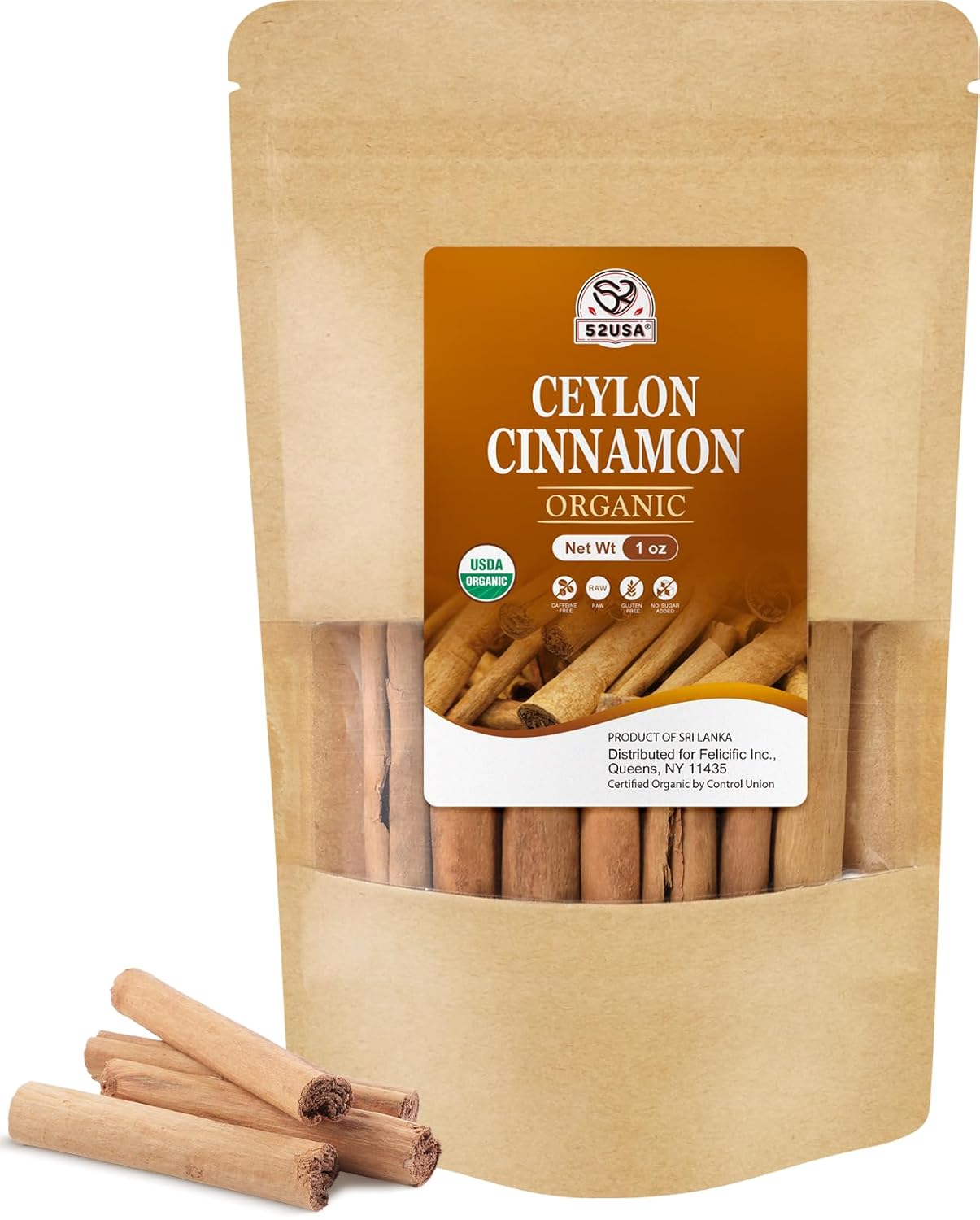
Multi-layered quills ideal for infusing, not just grinding
Whole cinnamon sticks aren’t just for mulled cider. In baking, they’re indispensable for infusing cream, milk, or simple syrup with cinnamon flavor without the grittiness that ground cinnamon can leave behind in custards, pastry creams, or poached fruit. 52USA’s sticks are true Ceylon quills, easily identified by their multiple thin, papery layers rolled together, as opposed to the single thick curl of a cassia stick.
They snap cleanly rather than splintering, which matters if a recipe calls for breaking a stick into smaller pieces for a spice sachet. If you want to grind your own fresh cinnamon powder from these sticks for maximum aroma, our guide on how to grind spices without a grinder covers several no-equipment methods.
Pros
- Authentic Ceylon quill structure, easy to verify
- Great for infusions, syrups, and poaching liquids
- Snaps cleanly for portioning
Cons
- Not useful if a recipe specifically calls for ground cinnamon
- Requires a grinder or mortar for powder use
Check current price and availability on Amazon.
Check Price on AmazonRani Cinnamon Sticks 7oz (200g)

Bold cassia sticks at an unbeatable price
Rani’s cinnamon sticks are cassia rather than Ceylon, identifiable by their thick, single-curl bark structure. For recipes where you want an assertive cinnamon punch, think spiced poaching liquids for pears, chai concentrate, or a mulled wine reduction destined for a holiday tart, cassia’s bolder profile actually works in your favor. At 7oz, this bag also offers a generous quantity for the price, making it a smart pick if cinnamon sticks are more of an occasional-use ingredient in your kitchen rather than a daily one.
Because cassia sticks are denser and thicker than Ceylon quills, they hold up better to long simmering without disintegrating, which is worth knowing if you’re making a slow-simmered chai or spiced syrup.
Pros
- Very affordable per stick
- Thick bark holds up well during long simmering
- Generous 7oz quantity
Cons
- Higher coumarin content than Ceylon varieties
- Not certified organic
Check current price and availability on Amazon.
Check Price on AmazonMcCormick Ground Cinnamon

The familiar, dependable cassia standard
McCormick is the cinnamon most Americans grew up baking with, and there’s a reason it’s stayed on shelves this long: it’s dependable. The grind is fine and consistent batch after batch, the flavor is a straightforward, bold cassia profile that works exactly as expected in classic recipes like apple pie, snickerdoodles, and cinnamon toast, and it’s sold in nearly every grocery store in the country, which makes it the easiest option to replace when you run out mid-recipe.
It won’t wow anyone looking for nuance, and it lacks the organic certification and Ceylon sourcing of the picks above it, but for everyday baking where cinnamon plays a supporting role rather than the lead, McCormick does exactly what’s asked of it without fuss.
Pros
- Extremely consistent flavor and grind
- Available at nearly every grocery store
- Affordable and easy to replace
Cons
- Not organic or Ceylon-sourced
- Flavor is one-dimensional compared to specialty options
Check current price and availability on Amazon.
Check Price on Amazon365 by Whole Foods Market, Organic Ground Cinnamon

A grocery-store-easy way to go organic
Whole Foods’ 365 line has become a go-to for shoppers who want organic staples without paying specialty-brand markups, and its ground cinnamon fits that mold well. It’s a cassia variety, so expect the same bold, spicy profile as McCormick, but with the reassurance of USDA organic certification and no synthetic anti-caking additives. The grind is a touch coarser than McCormick’s, giving it a slightly better textural presence in streusel toppings and cinnamon-sugar coatings.
This is a smart middle-ground pick for bakers who want to move away from conventional spice brands but aren’t ready to commit to pricier Ceylon options for daily use.
Pros
- Organic certification at a reasonable price point
- Solid, familiar cassia flavor
- Slightly coarser texture works well in coatings
Cons
- Only available where Whole Foods or Amazon delivers
- Not Ceylon, so coumarin content is on the higher end
Check current price and availability on Amazon.
Check Price on AmazonCeylon Cinnamon Powder (1lb) by Naturevibe Botanicals

A full pound of true Ceylon for serious bakers
If you bake often enough that a small jar of Ceylon cinnamon disappears within a month, Naturevibe Botanicals’ full-pound bag solves that problem outright. The flavor is consistent with the other Ceylon powders on this list: sweet, mild, and aromatic rather than fiery, and the grind is fine enough to work smoothly in both batters and dry rubs. Because it’s Non-GMO verified and sourced as true Ceylon, it checks the same quality boxes as the pricier small-jar options while dramatically improving the cost-per-ounce math for anyone using cinnamon multiple times a week.
As with any large bag of ground spice, aroma retention depends heavily on how you store it after opening. Transferring it into a dark, airtight jar rather than leaving it in the bag will meaningfully extend how long it stays potent.
Pros
- Best cost-per-ounce among true Ceylon options here
- Fine grind performs well in both batters and rubs
- Non-GMO verified sourcing
Cons
- Bag format is bulky for small kitchens
- Best used within a few months of opening for peak aroma
Check current price and availability on Amazon.
Check Price on AmazonFGO Organic Ceylon Cinnamon Powder

An ultra-fine texture built for smooth incorporation
FGO’s Ceylon cinnamon stands out for its unusually fine, almost powdery texture, which is a genuine advantage in recipes where any graininess would be noticeable, like a smooth pastry cream, a whipped cinnamon buttercream, or a latte foam dusting. It incorporates into liquids and fats without leaving visible flecks, and the flavor carries the same mild sweetness that defines Ceylon cinnamon across the board.
The resealable bag is a reasonable middle ground between the convenience of a jar and the value of bulk packaging, though as with other bagged spices, transferring to a rigid airtight container will help preserve aroma over the long run.
Pros
- Exceptionally fine texture, ideal for smooth applications
- True Ceylon with organic certification
- Resealable packaging
Cons
- Very fine texture can clump if exposed to moisture
- Less visual “grain” for toppings that want texture
Check current price and availability on Amazon.
Check Price on AmazonFull Comparison Table
| Product | Type | Grind/Form | Organic | Best Use |
|---|---|---|---|---|
| Simply Organic Ground Ceylon | Ceylon | Fine powder | Yes | All-purpose baking |
| True Organic Pure Ceylon | Ceylon | Medium powder | Yes | Flavor-forward recipes |
| Micro Ingredients Ceylon | Ceylon | Fine powder | Yes | Frequent use / bulk |
| 52USA Ceylon Sticks | Ceylon | Whole quills | Yes | Infusions, syrups |
| Rani Cinnamon Sticks | Cassia | Whole sticks | No | Simmering, chai |
| McCormick Ground | Cassia | Fine powder | No | Classic baking |
| 365 Whole Foods Organic | Cassia | Medium powder | Yes | Everyday organic use |
| Naturevibe Ceylon (1lb) | Ceylon | Fine powder | Non-GMO | High-volume baking |
| FGO Organic Ceylon | Ceylon | Ultra-fine powder | Yes | Smooth batters, creams |
Using Cinnamon in Baking: Tips for Better Results
Cinnamon behaves differently depending on how and when it’s added to a recipe. Ground cinnamon added directly to dry ingredients tends to disperse evenly, but it can also lose some of its volatile aromatic oils to prolonged oven heat, especially in low, slow bakes like banana bread. Whole sticks, by contrast, are better suited for infusing liquid components, milk for a custard, cream for a pastry filling, or simple syrup for soaking a cake, since the flavor releases gradually into the liquid without any grittiness.
A few practical tips that make a real difference:
- Bloom it in fat first. Briefly toasting ground cinnamon in melted butter before adding it to a batter wakes up its aromatic oils and produces a noticeably deeper flavor than adding it straight to dry ingredients.
- Pair it with citrus zest. Ceylon cinnamon’s natural citrus notes pair especially well with orange or lemon zest in muffins and quick breads.
- Don’t skip the salt. A pinch of salt in a cinnamon-sugar coating amplifies the spice’s perceived warmth.
- Grind fresh when possible. If you have whole sticks, grinding your own powder just before baking preserves far more aroma than pre-ground cinnamon that’s been sitting on a shelf. Our guide on how to use a spice grinder walks through the process step by step.
Cinnamon also plays well with other warm spices. If you’re building a custom pumpkin spice or chai blend, pairing it thoughtfully with whole nutmeg and a touch of vanilla bean rounds out the flavor profile far better than cinnamon alone.
Storage & Shelf Life: Getting the Most Out of Your Cinnamon
Ground cinnamon starts losing potency the moment it’s ground, since grinding exposes far more surface area to air and light than a whole stick does. On average, ground cinnamon stays reasonably fresh for about six months to a year when stored properly, while whole sticks can last two to three years without significant flavor loss.
“Properly stored” means an airtight container, away from direct light and heat, ideally not in a cabinet directly above the stove where temperature fluctuations accelerate flavor breakdown. If your cinnamon has been sitting in a clear glass jar on an open shelf for a year and it smells more like cardboard than spice when you open it, it’s time to replace it, regardless of what the “best by” date says.
For a full breakdown of container types, humidity control, and labeling systems, our guides on how to organize spices in the kitchen and how to label spice jars cover the details that make a real difference over time.
Buying Guide: What to Look For When Choosing Cinnamon
1. Ceylon or Cassia?
Decide based on how you’ll use it. If cinnamon is a daily habit or you want the most nuanced flavor, lean Ceylon. If you’re baking occasionally and want a bold, familiar flavor at a lower price, cassia works fine.
2. Whole Sticks vs. Ground Powder
Ground powder is more versatile for everyday baking, while whole sticks are better for infusions and long-simmered applications. Many serious bakers keep both on hand.
3. Organic Certification
Organic certification doesn’t necessarily change flavor, but it does reduce the likelihood of pesticide residue and ensures the product meets stricter sourcing standards.
4. Packaging
Glass jars with tight-sealing lids protect aroma better than plastic bags over the long term, though bags are usually more economical for bulk purchases.
5. Country of Origin Transparency
Brands that clearly state Sri Lankan sourcing for Ceylon cinnamon are generally more trustworthy than those that simply label a product “cinnamon” without specifying the variety.
If you’re building out a broader spice collection beyond cinnamon, our guides to the best saffron brands and best black peppercorns follow the same evaluation approach and are worth a look.
Matching Cinnamon Type to the Recipe
One of the most overlooked baking decisions is which cinnamon variety actually suits the recipe in front of you. Bakers often default to whatever jar is already open in the cabinet, but a little intentionality here pays off in noticeably better results. Below is a practical breakdown of where each type tends to shine.
Cinnamon Rolls and Sweet Yeasted Breads
Cinnamon rolls are one of the few recipes where cassia’s bold, spicy punch is genuinely an advantage. The dough itself is fairly neutral and sweet, so a filling made with a milder Ceylon cinnamon can get lost under the brown sugar and butter. If you do prefer Ceylon here, consider increasing the quantity slightly, or layering in a small amount of orange zest to boost the aromatic complexity without adding heat.
Snickerdoodles and Cinnamon-Sugar Cookies
Snickerdoodles are defined by their cinnamon-sugar coating, which means the cinnamon isn’t just a background flavor, it’s front and center on every bite. A classic McCormick-style cassia or the 365 Whole Foods organic cassia both work well here because the recipe expects that familiar, punchy warmth. Ceylon can absolutely be used, but the result will taste noticeably milder and sweeter, which some bakers actually prefer for a more refined cookie.
Apple Pie and Fruit-Based Desserts
Apple and cinnamon are a classic pairing precisely because cassia’s spiciness balances the tartness of baking apples like Granny Smith or Honeycrisp. A Ceylon cinnamon in an apple pie tends to taste pleasant but slightly flat next to the fruit’s acidity, so this is another case where cassia’s boldness earns its place.
Pastry Cream, Custards, and Panna Cotta
This is where Ceylon cinnamon, particularly in stick form, truly excels. Infusing warm milk or cream with a Ceylon quill produces a delicate, floral cinnamon flavor that doesn’t overwhelm the dairy the way a heavy dose of ground cassia can. It also avoids the slight grittiness that ground cinnamon can leave behind in a strained custard base.
Banana Bread and Quick Breads
Quick breads benefit from either variety, but because they typically bake at a lower temperature for a longer time, a lot of ground cinnamon’s aromatic oils can dissipate before the loaf is done. Blooming the cinnamon briefly in melted butter before mixing it into the batter, as mentioned earlier, helps preserve more of that flavor regardless of which type you choose.
Chai, Mulled Wine, and Spiced Syrups
For long-simmered liquid applications, whole sticks of either variety work, but cassia sticks like Rani’s hold their structural integrity better over an extended simmer, while Ceylon sticks tend to soften and break apart faster due to their thinner, layered structure. If your recipe calls for straining out the sticks after a long simmer, cassia is generally the more forgiving choice.
Understanding Coumarin: Should You Actually Worry About It?
Coumarin is a naturally occurring aromatic compound found in cinnamon bark, and it’s the primary reason health-conscious bakers sometimes seek out Ceylon over cassia. In large, sustained doses, coumarin has been associated with liver stress in some studies, which led European food safety authorities to set daily intake guidelines for the compound.
Cassia cinnamon contains substantially more coumarin than Ceylon, sometimes estimated at ten to fifty times the amount depending on the specific source and testing method. For someone baking a batch of cookies once a week and eating a normal portion, this difference is unlikely to be meaningful. The concern becomes more relevant for people who consume cinnamon supplements daily, add heaping tablespoons of cassia to a daily smoothie, or otherwise use cinnamon in unusually large quantities on a regular basis.
If you fall into that higher-consumption category, or if you simply prefer to minimize coumarin intake as a precaution, switching your everyday cinnamon to a Ceylon variety like Simply Organic, True Organic, or Naturevibe Botanicals is a straightforward way to reduce exposure without giving up the flavor entirely. For occasional baking, the distinction matters far less, and choosing based on flavor preference and budget is entirely reasonable.
Where Your Cinnamon Actually Comes From
Sourcing transparency varies quite a bit across brands, which is worth paying attention to if origin matters to you. True Ceylon cinnamon is grown almost exclusively along Sri Lanka’s southwestern coast, where the climate and soil conditions are particularly well suited to the Cinnamomum verum tree. Harvesting is a genuinely labor-intensive process: workers peel thin layers of inner bark by hand, which are then dried and rolled into the characteristic multi-layered quills.
Cassia cinnamon, by contrast, is grown much more widely, primarily across southern China, Indonesia, and Vietnam, with each region’s cassia carrying slightly different flavor nuances. Indonesian cassia (sometimes called Korintje) tends to be milder and sweeter than Chinese cassia, while Vietnamese cassia (sometimes called Saigon cinnamon) is often the most intensely spiced of the three. Most mass-market ground cinnamon sold in the United States, including many grocery store brands, is a blend of cassia sourced from whichever region offers the best price and quality at a given time, which is part of why flavor can vary slightly between purchases even of the same brand.
Brands that specify both the variety (Ceylon vs. cassia) and the country of origin on their packaging are generally more transparent and consistent than those that simply list “cinnamon” without further detail.
A Brief History of Cinnamon in the Kitchen
Cinnamon has one of the longest documented histories of any spice traded globally, with references dating back thousands of years across ancient Egyptian, Chinese, and Mediterranean cultures. For much of that history, it was considered a luxury good, valuable enough that it played a role in trade routes stretching from Sri Lanka through the Middle East and into Europe. Sri Lanka’s near-monopoly on true Ceylon cinnamon made it a strategically important export for centuries, and colonial powers including the Portuguese, Dutch, and British all fought for control of Sri Lankan cinnamon production at various points.
Cassia cinnamon, being more widely available across a broader geographic range, gradually became the more common and affordable option as global trade expanded, which is part of why it dominates supermarket shelves today. Ceylon cinnamon has retained something of its historical reputation as the more refined, “true” version of the spice, even though both varieties are entirely legitimate and useful depending on the application.
Frequently Asked Questions
Is Ceylon cinnamon really better than cassia for baking?
“Better” depends on the recipe. Ceylon offers a softer, more nuanced flavor and lower coumarin content, which makes it a good choice for recipes where cinnamon is the star or for people who eat cinnamon daily. Cassia offers a bolder, spicier flavor that’s often preferred in classic American desserts like snickerdoodles or apple pie, where a stronger cinnamon punch is expected.
How can I tell if cinnamon is Ceylon or cassia just by looking at it?
Whole sticks are the easiest way to tell. Ceylon quills are made of multiple thin, papery layers rolled together, while cassia sticks are a single thick curl. Ground cinnamon is harder to distinguish visually, so check the label for “Ceylon” or “Cinnamomum verum” specifically.
Does cinnamon go bad?
Cinnamon doesn’t spoil in a way that makes it unsafe to eat, but it does lose flavor and aroma over time. Ground cinnamon is generally best used within six months to a year, while whole sticks can stay flavorful for two to three years if stored in an airtight container away from heat and light.
Can I substitute cassia cinnamon for Ceylon cinnamon in a recipe?
Yes, in most recipes you can substitute one for the other, though cassia is noticeably stronger, so you may want to use slightly less than the recipe calls for if swapping in cassia for Ceylon.
Why is Ceylon cinnamon more expensive than cassia?
Ceylon cinnamon is grown almost exclusively in Sri Lanka, has a more labor-intensive harvesting and processing method due to its delicate bark, and is produced in smaller volumes globally compared to cassia, which is grown widely across China, Indonesia, and Vietnam.
What’s the best way to store cinnamon to keep it fresh longer?
Store cinnamon in an airtight, opaque or dark glass container, away from direct sunlight and heat sources like the stove or oven. Whole sticks generally hold their flavor longer than ground powder because less surface area is exposed to air.
Is it safe to eat cinnamon every day?
Moderate daily cinnamon consumption is generally considered safe for most people. If you eat cinnamon daily in significant amounts, Ceylon is the safer choice due to its much lower coumarin content compared to cassia.
Can I grind my own cinnamon sticks into powder at home?
Yes, a spice grinder, coffee grinder dedicated to spices, or a sturdy mortar and pestle can all grind cinnamon sticks into powder. Freshly ground cinnamon typically has a noticeably stronger aroma than pre-ground powder that’s been sitting on a shelf.
Why does my cinnamon taste bitter after baking?
Bitterness after baking usually comes from either using too much cinnamon relative to the recipe, using a lower-quality cassia blend that includes more bark fragments than pure inner bark, or exposing the cinnamon to very high heat for an extended period, which can degrade its aromatic compounds.
What’s the difference between “cinnamon” and “true cinnamon” on a label?
In the United States, products can legally be labeled simply “cinnamon” whether they’re cassia or Ceylon, since regulations don’t require the distinction. “True cinnamon” typically refers specifically to Ceylon cinnamon (Cinnamomum verum), so if the variety matters to you, look for “Ceylon” explicitly on the label rather than relying on the generic term.
How much cinnamon should I use in a typical baking recipe?
Most baking recipes call for somewhere between half a teaspoon and two tablespoons of ground cinnamon, depending on the size of the batch and how prominent the flavor should be. If substituting Ceylon for cassia, you can typically use a similar amount or slightly more, since Ceylon’s flavor is milder.
Do cinnamon sticks and ground cinnamon taste the same?
They come from the same source, but ground cinnamon that’s been sitting pre-packaged for months often tastes flatter than cinnamon ground fresh from a stick, since grinding accelerates the loss of aromatic oils. If you want maximum flavor intensity, grinding your own from whole sticks right before baking is the better option.
Final Verdict: Which Cinnamon Should You Buy?
For most home bakers, Simply Organic Ground Ceylon Cinnamon is the best all-around choice, balancing a fine, consistent grind with authentic Ceylon flavor and reliable organic sourcing. If flavor intensity is your top priority, True Organic’s Ceylon powder edges it out with a brighter, more complex profile. And if you bake often enough that cost per ounce matters, Naturevibe Botanicals’ full-pound bag or Micro Ingredients’ bulk Ceylon powder will save you money without sacrificing quality.
Whichever you choose, buying a true, well-sourced cinnamon rather than a generic supermarket blend is one of the simplest upgrades you can make in your baking pantry.
Shop Our #1 Pick on AmazonAs an Amazon Associate, we earn from qualifying purchases. Prices and availability are accurate as of the date of publishing and are subject to change. This post contains affiliate links, and we may receive a small commission at no additional cost to you if you make a purchase through them.