
Best Whole Nutmeg: The Full Buying Guide to the Nuttiest, Warmest Spice in Your Pantry
Nine top-rated whole and ground nutmeg picks, tested for aroma, oil content, freshness, and value — plus everything you need to know about buying, grinding, and storing it.

There’s a reason chefs, bakers, and grandmothers alike keep a stash of whole nutmeg tucked into a corner of the spice drawer instead of relying on the pre-ground jar. Freshly grated nutmeg carries a warmth and complexity — part sweet, part peppery, part woodsy — that the powdered version simply can’t hold onto for long. Once nutmeg is ground, its volatile oils begin evaporating almost immediately, and within a few months a jar of ground nutmeg tastes like little more than brown dust. Whole nutmeg seeds, on the other hand, can sit sealed in your pantry for a year or more and still deliver that unmistakable punch the moment you run them across a microplane.
But not all whole nutmeg is created equal. Seed size, origin, oil content, and how the nutmeg was dried and shelled all affect how fragrant and flavorful the final product is. And because some cooks genuinely prefer the convenience of pre-ground nutmeg for everyday baking, we’ve also included a handful of the best ground options for anyone who wants speed without sacrificing too much quality. This guide breaks down nine of the most popular whole and ground nutmeg products available right now, explains exactly what separates a great nutmeg from a mediocre one, and answers the most common questions home cooks have about buying, grinding, and storing this ancient spice.
What Is Nutmeg, Exactly?
Nutmeg is the seed of the Myristica fragrans tree, an evergreen native to the Banda Islands of Indonesia — often called the original “Spice Islands.” The tree also produces mace, a lacy red covering (technically called the aril) that wraps around the nutmeg seed and is dried separately to become its own distinct spice. Because nutmeg and mace come from the same fruit, they share a similar flavor profile, though mace tends to be slightly more delicate and citrusy while nutmeg leans warmer and sweeter.
For centuries, nutmeg was one of the most valuable commodities on earth. European powers fought wars over control of the Banda Islands specifically because nutmeg trees only grew there, and a single pound of nutmeg could be worth more than gold by weight in some medieval European markets. Today nutmeg is cultivated across Indonesia, Grenada, India, and Sri Lanka, and it has become an everyday pantry staple rather than a luxury good — but the quality gap between a fresh, oil-rich whole nutmeg seed and a stale, dusty jar of pre-ground powder is just as dramatic now as it was then.
Whole nutmeg seeds are oval, roughly the size of a large olive, and have a hard, slightly ridged brown shell. Inside, the flesh is pale tan with fine marbling of darker striations — this marbling is actually visible oil content, and it’s one of the clearest indicators of freshness and quality when you’re evaluating whole nutmeg before you buy it.
Check Price on Amazon
How Nutmeg Is Grown, Harvested, and Processed
Understanding a little about how nutmeg actually gets from tree to spice jar makes it much easier to judge quality once you’re standing in front of a shelf of options — or scrolling through a page of near-identical product photos online. A nutmeg tree is a slow, patient investment for the farmers who grow it. Seedlings take roughly seven to nine years before they begin fruiting reliably, and the trees don’t reach full productive maturity until they’re around twenty years old. Once mature, though, a single tree can keep producing fruit for well over half a century, which is part of why nutmeg cultivation has remained concentrated in the same handful of growing regions for generations — established groves are simply too valuable to replace.
The nutmeg fruit itself looks something like a small, pale apricot. When ripe, it splits open to reveal the true prize inside: a glossy brown seed wrapped in a bright red, lace-like membrane. That membrane is mace, and the hard seed underneath is nutmeg. Farmers typically hand-harvest the fruit at the point of splitting, then carefully separate the mace from the seed by hand — a labor-intensive step that’s a big part of why quality whole nutmeg costs more than many other common spices.
After separation, the nutmeg seeds are dried slowly, often over several weeks, until the kernel inside the shell rattles when shaken — a traditional sign that moisture content has dropped low enough for long-term storage. Once dried, the outer shell is cracked and removed, leaving the familiar oval seed sold as “whole nutmeg.” Higher-end producers sort seeds by size and visually inspect for oil content (that marbled, slightly glossy interior) before packaging, which is exactly the kind of quality control that separates a genuinely great whole nutmeg product from a mediocre one sold purely on price.
Ground nutmeg follows the same early steps, but instead of being packaged whole, the dried seeds are milled into powder shortly before packaging — or, less ideally, well before packaging, if a supplier is prioritizing shelf life of the raw seed over freshness of the final ground product. This is part of why sourcing matters so much for pre-ground nutmeg: a jar labeled “ground nutmeg” tells you nothing about how long ago the grinding actually happened.
How to Buy Great Whole Nutmeg
Because whole nutmeg is a fairly simple, single-ingredient product, the differences between brands come down to a handful of measurable factors. Here’s what actually matters when you’re comparing options.
1. Seed Size and Uniformity
Larger nutmeg seeds generally indicate a more mature, better-developed fruit, and they tend to carry more essential oil per seed. Uniform sizing within a bag also signals better sorting and quality control at the source. Smaller, shriveled, or wildly inconsistent seeds are often a lower grade, sometimes sold as “broken” or “assorted” nutmeg at a discount.
2. Origin: Indonesian (Banda/East Indian) vs. Grenadian (West Indian)
Indonesian nutmeg, sometimes labeled East Indian nutmeg, is typically considered the gold standard — it tends to have higher essential oil content and a more intense, complex aroma. Grenadian (West Indian) nutmeg is milder and slightly sweeter, and it’s the nutmeg most associated with Caribbean cooking and Grenada’s national identity — the country’s flag literally features a nutmeg seed. Neither origin is objectively “better” across the board; it comes down to whether you prefer a bolder, spicier profile or a gentler, sweeter one.
3. Oil Content and Aroma
The single best test of nutmeg quality is your nose. Fresh, high-quality whole nutmeg should smell strongly aromatic the moment you open the bag — warm, sweet, slightly peppery, almost buttery. If a bag of “whole” nutmeg smells faint or musty, the seeds have likely been sitting in a warehouse for too long, or they were harvested and dried improperly.
4. Shell-On vs. Shelled
Most whole nutmeg sold for home cooking is already shelled (the hard outer shell removed, leaving just the seed). A few specialty suppliers sell nutmeg still in its shell, which offers slightly better long-term protection from oxidation but requires cracking before you can grate it. For nearly all home cooks, shelled whole nutmeg is the more practical choice.
5. Organic Certification
Organic nutmeg is grown without synthetic pesticides or fertilizers, which matters to some buyers for both environmental and personal-preference reasons. Certified organic products will carry a USDA Organic seal or equivalent. Flavor differences between organic and conventional nutmeg are generally minor and come down more to freshness and origin than certification status.
6. Packaging
Because nutmeg’s flavor depends so heavily on preserved essential oils, packaging matters more than most people realize. Look for resealable pouches or jars with tight-fitting lids, ideally opaque or dark-tinted to block light. Clear plastic bags left on a sunlit shelf will degrade nutmeg’s aroma faster than almost any other storage mistake.
Whole vs. Ground Nutmeg: Which Should You Buy?
This is the single most common question we hear from home cooks, and the honest answer is: it depends on how often you cook with nutmeg and how much you value peak flavor.
| Factor | Whole Nutmeg | Ground Nutmeg |
|---|---|---|
| Shelf life at peak flavor | 12–24 months | 3–6 months |
| Aroma intensity | Very high, released fresh | Fades quickly after grinding |
| Convenience | Requires grating each time | Ready to use immediately |
| Best for | Sauces, eggnog, pastas, finishing dishes | Baking in bulk, spice blends |
| Cost per use | Slightly higher upfront | Lower upfront, but repurchased more often |
| Texture control | Adjustable — fine to coarse | Fixed, uniform powder |
If you bake nutmeg-heavy recipes constantly — think pumpkin pie season, or a bakery churning out spice cakes daily — pre-ground nutmeg bought in reasonably sized quantities and used up quickly can be perfectly fine. But for anyone who uses nutmeg occasionally throughout the year, whole seeds are almost always the better investment. A single whole nutmeg seed can be grated dozens of times over many months, and you only grate exactly what you need for each recipe, which also means less waste. For a deeper look at this tradeoff across the spice cabinet more broadly, our guide on grinding whole spices versus buying them pre-ground walks through the science of flavor loss in more detail.
Top 9 Nutmeg Picks Reviewed
We evaluated these products on aroma strength, seed/powder quality, packaging, value for money, and consistency across reviews from real buyers. Whole nutmeg options are listed first, followed by our favorite ground nutmeg alternatives for anyone who prioritizes convenience.
Our evaluation process weighted a few factors more heavily than others. Aroma strength straight out of the packaging was the single biggest differentiator — a genuinely fresh nutmeg product should be noticeable the moment the seal is broken, without needing to hold the bag right up to your nose. We also looked closely at seed uniformity for whole nutmeg (wildly inconsistent sizing usually signals lower-grade sorting), texture consistency for ground products (clumping or a gritty, uneven grind points to poor milling or moisture exposure), and packaging quality, since a spice this dependent on trapped essential oils lives or dies by how well the container seals. Finally, we weighed value for money not just on sticker price, but on cost per ounce relative to how long each product realistically stays flavorful once opened.
1. Premium Whole Nutmeg Pods — Best Overall
This is the pick we keep coming back to. The seeds arrive large, uniform, and noticeably oily to the touch, with an aroma that fills the kitchen the second the bag is opened. The marbled cross-section when you slice one open is a good visual confirmation of the oil content that translates directly into flavor once grated.
Pros
- Large, uniform seeds
- Very strong, fresh aroma
- Resealable pouch
- Great value for the seed count
Cons
- Requires a grater — not for grab-and-go use
- Some bags have a couple undersized seeds
Check Price on Amazon
2. The Spice Way Nutmeg Whole (4 oz) — Best Mid-Size Bag

The Spice Way has built a loyal following among home cooks who buy spices in whole form for freshness, and this nutmeg bag is one of their most consistently well-reviewed products. The 4-ounce size hits a sweet spot — enough seeds to last the average household close to a year without the seeds sitting around long enough to lose potency.
Pros
- Good middle-ground bag size
- Consistently fresh, aromatic seeds
- No additives or fillers
Cons
- Simple plastic pouch, not resealable
- Seed size varies slightly batch to batch
Check Price on Amazon
3. Spicy World Nutmeg Whole 3.5oz — Best Budget Whole Nutmeg
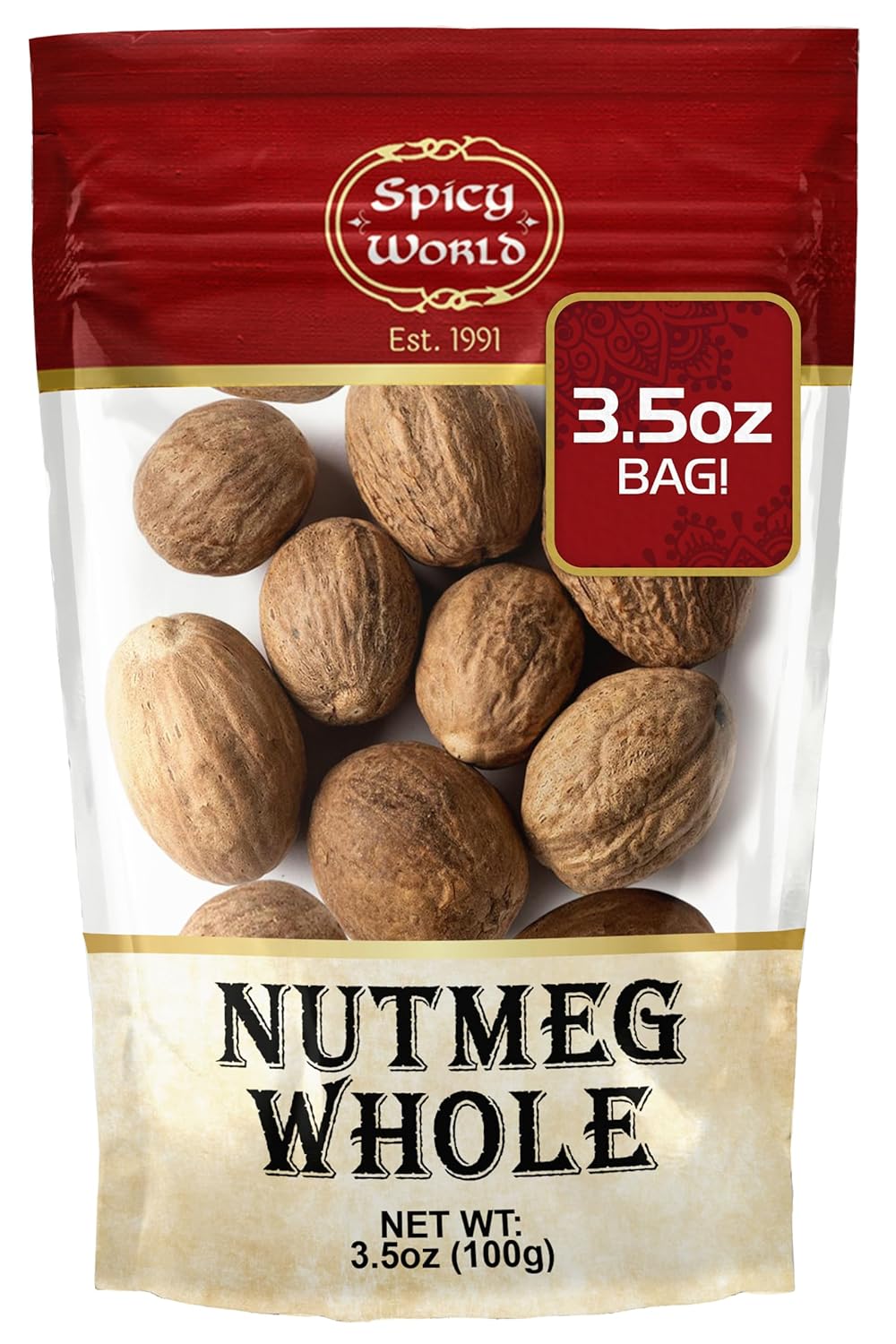
Spicy World has carved out a niche selling whole spices sourced with an eye toward South Asian cooking traditions, where whole nutmeg is used in everything from garam masala blends to biryani. This bag offers solid quality at a price point that makes it easy to keep a backup on hand.
Pros
- Very competitive price per ounce
- Good for spice-blend applications
- Decent aroma out of the bag
Cons
- Seeds run slightly smaller on average
- Not certified organic
Check Price on Amazon
4. iSpice Whole Nutmeg Spice for Cooking (5.5 oz) — Best Large Bag

For households that go through nutmeg quickly, or anyone who wants to buy once and not think about it again for a long while, iSpice’s 5.5-ounce bag is one of the largest whole nutmeg options widely available. The seeds are well-sized and the aroma holds up over months of storage when kept sealed.
Pros
- Largest bag size in this roundup
- Strong aroma retention over time
- Great value for bulk buyers
Cons
- Bag isn’t resealable — transfer to a jar
- Overkill for occasional users
Check Price on Amazon
5. Amazon Grocery, Ground Nutmeg (3.25 oz) — Best Ground for Everyday Baking

If you’d rather skip the grating step entirely, Amazon’s house Grocery line offers a straightforward, no-frills ground nutmeg that performs reliably in baking. It’s fine, consistent, and free of clumping, which makes it easy to measure precisely for recipes.
Pros
- Reasonably priced for a name-brand jar
- Fine, even grind with no clumps
- Shaker-top jar for easy measuring
Cons
- Aroma noticeably milder than whole, freshly grated nutmeg
- Best used within a few months of opening
Check Price on Amazon
6. Simply Organic Pure Ground Nutmeg — Best Organic Ground Nutmeg

Simply Organic is one of the most trusted names in certified organic spices, and their ground nutmeg lives up to that reputation. The grind is noticeably more aromatic than typical mass-market ground nutmeg, likely due to fresher sourcing and quicker turnover on shelves.
Pros
- USDA Certified Organic
- Fresher-tasting than most ground competitors
- Non-GMO Project Verified
Cons
- Higher price per ounce than conventional brands
- Smaller jar than some competitors
Check Price on Amazon
7. 365 by Whole Foods Market, Organic Nutmeg Ground — Best Value Organic

Whole Foods’ in-house 365 line consistently punches above its price point in the organic spice category, and the ground nutmeg is no exception. It’s a solid, no-nonsense option for anyone who wants organic certification without paying the premium some specialty brands command.
Pros
- Organic certification at a fair price
- Good, consistent flavor for baking
- Widely available
Cons
- Aroma fades faster than premium organic brands
- Basic packaging
Check Price on Amazon
8. True Organic Ceylon Nutmeg Powder — Best Specialty Origin

Ceylon-origin nutmeg (grown in Sri Lanka) tends to have a slightly sweeter, less pungent profile compared to Indonesian nutmeg, and this brand highlights that distinction clearly on the label. It’s a great pick for anyone curious about origin-specific spice flavor or who finds standard nutmeg a bit too sharp.
Pros
- Distinct, sweeter Ceylon flavor profile
- Certified organic
- Interesting option for spice enthusiasts
Cons
- Harder to find than mainstream brands
- Flavor difference may be subtle to casual users
Check Price on Amazon
9. Geo-Fresh Organic Nutmeg Ground Powder — Best for Bulk Baking

Geo-Fresh focuses on offering larger quantities of organic spices at prices that make sense for households, bakeries, or anyone doing a lot of holiday baking in one stretch. The nutmeg powder is fine and consistent, holding up well in high-volume recipes like spice cake batches or eggnog production.
Pros
- Great cost-per-ounce for organic ground nutmeg
- Fine, consistent texture
- Good for bulk seasonal baking
Cons
- Best used up within a season rather than stored long-term
- Packaging is basic for the quantity
Check Price on Amazon
Quick Comparison Table
| Product | Type | Best For | Rating |
|---|---|---|---|
| Premium Whole Nutmeg Pods | Whole | Best overall | 5.0 |
| The Spice Way Nutmeg Whole (4 oz) | Whole | Mid-size bag | 4.5 |
| Spicy World Nutmeg Whole 3.5oz | Whole | Budget pick | 4.0 |
| iSpice Whole Nutmeg (5.5 oz) | Whole | Bulk / large bag | 4.5 |
| Amazon Grocery Ground Nutmeg | Ground | Everyday baking | 4.0 |
| Simply Organic Pure Ground Nutmeg | Ground | Best organic ground | 4.5 |
| 365 by Whole Foods Ground Nutmeg | Ground | Value organic | 4.0 |
| True Organic Ceylon Nutmeg Powder | Ground | Specialty Ceylon origin | 4.5 |
| Geo-Fresh Organic Nutmeg Powder | Ground | Bulk baking | 4.0 |
How to Grate Whole Nutmeg
Grating whole nutmeg is far easier than most people expect, and once you get into the habit it adds only seconds to a recipe. Here’s the simplest reliable method:
- Choose your tool. A microplane-style zester is the classic choice — it produces a fine, fluffy grate that dissolves quickly into sauces and batters. The fine holes on a box grater work too, and dedicated nutmeg grinders (small mills similar to a pepper mill, often with a built-in storage compartment for the seed) are a popular gift item for serious home cooks.
- Hold the seed firmly. Nutmeg seeds are small and round, which makes them a little awkward to grip. Many cooks find it easiest to hold the seed between thumb and forefinger, or to use a specialty nutmeg holder/cage if they grate frequently.
- Grate in one direction with light, even pressure. Unlike garlic or ginger, nutmeg doesn’t require heavy pressure — the seed is fairly soft compared to something like cinnamon bark. A light touch prevents your fingers from getting too close to the grating surface.
- Measure as you go. Because whole nutmeg is more potent than pre-ground, start with about half the amount a recipe calls for if it was written with ground nutmeg in mind, then taste and adjust. A little goes a long way.
If you don’t own a microplane, our guide to grinding spices without a dedicated grinder covers several household alternatives that work in a pinch. And if you’re building out a proper spice station at home, it may be worth comparing dedicated tools in our best spice grinder roundup, which also touches on how a small electric grinder handles harder whole spices like nutmeg and cinnamon bark.
Dedicated Nutmeg Mills vs. a Simple Microplane
A surprising number of readers ask whether it’s worth buying a dedicated nutmeg grinder — a small hand-crank mill, often with a built-in storage chamber for the seed, similar in shape to a pepper mill. The honest answer is that it comes down to personal preference rather than any dramatic difference in flavor. A microplane is cheaper, easier to clean, and works just as well for most people. A dedicated nutmeg mill offers a bit more convenience if you keep it out on the counter and use nutmeg often, since the seed stays loaded and ready rather than needing to be fished out of a jar each time.
If you’d rather lean on an electric spice grinder for nutmeg alongside other whole spices, it helps to know how different models handle a dense, slightly oily seed like nutmeg compared to drier spices. Our hands-on reviews of the Cuisinart SG-10 and the Secura spice grinder both cover how each model performs on harder, oilier whole spices. If you cook a lot of Indian food and go through whole spices at a higher volume, our best grinder for Indian spices guide is worth a look, and if you prefer a manual, non-electric option, we’ve also rounded up the best manual spice grinders currently available.
Whichever tool you choose, a few good habits go a long way toward getting consistent results and avoiding common frustrations. Our spice grinder dos and don’ts guide covers the basics, and if you ever run into a grinder that leaves unexpected chunks in your nutmeg powder, a lid that won’t budge, or a motor that starts smelling hot after heavy use, our troubleshooting guides on grinders leaving chunks, a stuck grinder lid, and a grinder motor that smells like it’s burning can help you diagnose the problem before you consider replacing the whole unit. And when it’s finally time to clean up, our guide to whether you can wash a spice grinder covers what’s safe for different grinder types. If you’re shopping for a new grinder from scratch and durability is a top priority, our roundup of spice grinders that hold up over time is a good place to start.
How to Store Nutmeg Properly
Storage is where most of the flavor difference between whole and ground nutmeg actually plays out over time. Whole nutmeg’s essential oils are largely locked inside the seed until it’s grated, so exposure to air, light, and heat has a much smaller effect on flavor loss compared to ground nutmeg, where those same oils are already exposed across a much larger surface area.
- Keep it sealed. An airtight glass jar with a tight lid is ideal for both whole seeds and ground powder. If your nutmeg arrived in a resealable pouch, press out excess air before sealing each time.
- Store away from heat and light. A cabinet or drawer away from the stove is far better than an open rack near a sunny window. Heat and UV exposure accelerate the breakdown of the volatile oils responsible for nutmeg’s aroma.
- Avoid the refrigerator for whole seeds. Refrigeration can introduce condensation when the jar is opened and closed repeatedly, which risks moisture getting into the seeds. A cool, dry pantry shelf works better.
- Label your jars with a purchase date. Ground nutmeg loses noticeable potency after about six months; whole seeds can last well over a year if stored properly, but it still helps to track age.
If you’re managing more than just nutmeg — most home cooks eventually accumulate a fairly large spice collection — our guides on storing bulk spices, organizing spices in your kitchen, and labeling spice jars can help you set up a system that keeps everything fresher for longer. If your current spice rack is looking cramped, our best spice organizers roundup covers a range of drawer inserts, lazy Susans, and wall-mounted racks worth considering.
Best Uses for Nutmeg in Cooking & Baking
Nutmeg’s warm, slightly sweet, slightly peppery flavor makes it one of the most versatile spices in the pantry — equally at home in sweet and savory dishes, which isn’t true of most spices.
Sweet Applications
Pumpkin pie, spice cakes, eggnog, rice pudding, and French toast batter are the classic pairings, but nutmeg also shines in less obvious places: a small pinch in chocolate desserts deepens the flavor without reading as “spiced,” and a light grating over whipped cream or a latte adds a cozy finishing touch.
Savory Applications
Nutmeg is a traditional, near-essential addition to béchamel sauce, creamed spinach, and mashed potatoes, where a small amount rounds out the richness of dairy and butter. It also appears in many sausage and meatball recipes, particularly in Italian and German cooking traditions, and it’s a common component in warming spice blends used across South Asian and Middle Eastern cuisines.
Pairing Nutmeg With Other Warm Spices
Nutmeg rarely works alone — it’s typically part of a supporting cast alongside cinnamon, cloves, allspice, and ginger in classic “warm spice” blends like pumpkin pie spice or mulling spice mixes. If you’re building out your warm-spice collection, it’s worth comparing options in our best cinnamon for baking guide, and if you’ve ever wondered whether Ceylon or cassia cinnamon makes a real difference in a recipe, our Ceylon vs. cassia cinnamon comparison covers that in depth. For bakers who also lean on vanilla alongside their warm spices, we’ve reviewed the best vanilla bean brands and broken down the differences in our vanilla extract vs. vanilla bean paste guide.
Check Price on Amazon
Nutmeg vs. Other Warm Spices
It’s easy to lump all “warm” spices together, but nutmeg occupies a distinct flavor niche compared to its usual pantry neighbors.
| Spice | Flavor Profile | Common Uses |
|---|---|---|
| Nutmeg | Warm, sweet, slightly peppery | Baking, béchamel, eggnog |
| Cinnamon | Sweet, woody, floral | Baking, coffee, oatmeal |
| Allspice | Cinnamon + clove + pepper notes | Caribbean cooking, baking |
| Cloves | Intensely warm, slightly bitter | Mulled drinks, ham glazes |
| Cardamom | Citrusy, floral, slightly minty | Chai, Scandinavian baking |
For cooks stocking a well-rounded spice collection, it also helps to understand how nutmeg fits alongside the more colorful, aromatic spices used in savory global cuisine — our guides to the best turmeric powder, best smoked paprika, and best saffron brands round out a well-stocked pantry. And if you’ve recently bought saffron and aren’t sure whether it’s the real thing, our guide on how to tell if saffron is real is worth a read. Black pepper, meanwhile, pairs constantly with nutmeg in savory dishes like béchamel and roasted vegetables — see our best black peppercorns guide for recommendations there too.
Nutmeg Around the World
Few spices carry as much cultural weight relative to their size as nutmeg. In Grenada, the seed is such a defining part of national identity that it appears directly on the country’s flag, and Grenadian cuisine leans on nutmeg in everything from rum punches to savory stews to nutmeg-spiced ice cream sold from roadside stands. In the Netherlands, nutmeg is a near-mandatory ingredient in traditional dishes like stamppot (mashed potatoes with vegetables) and appears heavily in Dutch baking, a legacy of the Dutch East India Company’s centuries-long control over the Indonesian spice trade.
In South Asian cooking, nutmeg — often used alongside mace — is a common component of garam masala blends and appears in rich, slow-cooked dishes like biryani and korma, where its warmth rounds out layers of other spices without dominating the dish. Middle Eastern cuisines frequently pair nutmeg with lamb and rice dishes, while in the United States and much of Europe, nutmeg is most associated with autumn and winter baking, holiday drinks like eggnog and mulled wine, and creamy savory dishes like béchamel sauce and gratins.
This global spread is a big part of why nutmeg quality can vary so much between suppliers — different growing regions, harvesting practices, and drying methods all shape the final product differently, and a brand’s sourcing decisions matter more for nutmeg than for many other, more commoditized spices.
Recipe Ideas to Try With Fresh Nutmeg
If you’ve just picked up a bag of whole nutmeg and aren’t sure where to start beyond the obvious pumpkin pie, here are a handful of ways to put it to work right away:
- Classic béchamel: A small pinch of freshly grated nutmeg stirred into a butter-flour-milk base transforms a basic white sauce into something restaurant-quality — this is the move behind great lasagna, gratins, and creamed vegetable dishes.
- Homemade eggnog: Freshly grated nutmeg, both stirred into the base and dusted on top of each glass, is the difference between store-bought eggnog and the homemade version people actually ask for the recipe of.
- Spiced whipped cream: A light grating of nutmeg into fresh whipped cream elevates everything from pie to hot chocolate to coffee.
- Creamed spinach: Nutmeg is the traditional secret ingredient in steakhouse-style creamed spinach, cutting through the richness of the cream and butter.
- Spiced rice pudding: A pinch of nutmeg alongside cinnamon in a slow-cooked rice pudding adds real depth without needing a long ingredient list.
- Sausage and meatball seasoning: Many Italian and German meatball and sausage recipes call for a small amount of nutmeg to round out the fattiness of the pork and add warmth without reading as “sweet.”
- Autumn spice cake or muffins: Alongside cinnamon and cloves, freshly grated nutmeg adds noticeably more depth to spice cakes and muffins than the pre-ground version most box mixes rely on.
Nutmeg Safety & Dosage Notes
In everyday culinary use — the amount you’d grate over eggnog, mix into a spice cake, or stir into béchamel — nutmeg is simply a flavorful, well-tolerated spice with a long history of safe use across countless cuisines worldwide.
Frequently Asked Questions
How long does whole nutmeg last?
Stored in a sealed, airtight container away from heat and light, whole nutmeg seeds can maintain good flavor for 12 to 24 months, and they remain technically safe to use well beyond that — they simply lose aromatic intensity gradually rather than spoiling in the way perishable food does.
How much whole nutmeg equals one teaspoon of ground nutmeg?
One whole nutmeg seed typically yields roughly two to three teaspoons of freshly grated nutmeg, depending on seed size. Since freshly grated nutmeg is noticeably more potent than pre-ground, many cooks use slightly less than a recipe calls for and adjust to taste.
Can I grind whole nutmeg in a regular spice grinder or coffee grinder?
Yes, though nutmeg seeds are quite hard, so a sturdy electric grinder works better than a delicate one. Many people prefer a microplane or dedicated nutmeg mill for better texture control. If you’re curious whether a coffee grinder can pull double duty, our piece on using a spice grinder for coffee (and vice versa) explains the tradeoffs.
What’s the difference between Indonesian and Grenadian nutmeg?
Indonesian (East Indian) nutmeg tends to have a stronger, more intense aroma and higher essential oil content, while Grenadian (West Indian) nutmeg is generally milder and slightly sweeter. Both are high quality; the choice comes down to flavor preference.
Is ground nutmeg as good as whole nutmeg?
Ground nutmeg is more convenient but loses aromatic intensity much faster than whole seeds — often within a few months of grinding, even when stored properly. For occasional use, whole nutmeg generally delivers noticeably better flavor over time. For frequent, high-volume baking, a fresh jar of quality ground nutmeg used up within a few months can still perform very well.
Why does my ground nutmeg smell like almost nothing?
This is a sign the nutmeg has lost most of its volatile oils, either from age, poor storage, or exposure to heat and light. If a ground nutmeg jar has been open for more than six months, it’s likely time to replace it — a quick sniff test is the easiest way to check before you cook with it.
Can I substitute mace for nutmeg, or vice versa?
Yes, in a pinch. Mace and nutmeg come from the same fruit and share a similar flavor profile, though mace is generally more delicate and slightly citrusy. Use a similar quantity as a substitute, then adjust to taste since the intensity can differ.
Do I need a special tool to grate nutmeg, or will a regular grater work?
A standard box grater’s fine side will work, though a microplane zester produces a finer, fluffier texture that blends more smoothly into batters and sauces. Dedicated nutmeg grinders (small handheld mills) are also popular and often include built-in storage for the seed.
Is organic nutmeg worth the extra cost?
Organic certification mainly reflects growing practices rather than guaranteeing better flavor. That said, organic brands often turn over inventory faster and source more carefully, which can indirectly result in fresher, more aromatic product. If organic certification matters to you for other reasons, it’s a reasonable premium to pay.
Why did my whole nutmeg turn hard or feel dried out?
Whole nutmeg seeds are naturally hard — that’s normal and doesn’t indicate spoilage. If a seed feels unusually light, hollow, or crumbles too easily when grated, it has likely dried out excessively and lost much of its oil content; this can happen with age or improper storage.
What’s the best way to clean nutmeg residue out of a grinder or grater?
A dry brush or an old toothbrush works well for microplanes and box graters. If you use an electric spice grinder for nutmeg alongside other spices, our guide on cleaning a spice grinder and removing lingering odors covers the process step by step, and our broader spice grinder cleaning guide has more detail for tougher buildup.
Can whole nutmeg go bad or become unsafe to eat?
Properly dried and stored whole nutmeg essentially doesn’t spoil in the way perishable foods do — it simply loses potency over time. As long as it’s stored dry and shows no signs of mold or moisture damage, an older seed is safe to use, just less flavorful.
Should I use a mortar and pestle instead of a grater for nutmeg?
A mortar and pestle isn’t the most practical tool for a single hard, round seed like nutmeg — it tends to slip rather than crush cleanly. It’s much better suited to spices like cumin, coriander, or peppercorns. If you’re deciding what to add to your toolkit, our best mortar and pestle guide can help you choose one for those other applications, while a microplane or nutmeg mill remains the better choice for nutmeg specifically.
Does toasting nutmeg before use improve the flavor?
Toasting is more commonly applied to spices like cumin, coriander, or fennel seed, and it’s generally not necessary — or recommended — for nutmeg, since its flavor comes primarily from delicate volatile oils that can scorch rather than deepen with heat. If you regularly toast other whole spices as part of your cooking routine, our guide on toasting spices before grinding explains which spices benefit most from the technique.
My electric spice grinder isn’t producing a fine enough nutmeg powder — what’s wrong?
Whole nutmeg is dense and slightly oily, which can be tougher on small electric grinders than drier spices like coriander or cumin. If you’re running into this issue regularly, our troubleshooting guide on a spice grinder that isn’t grinding fine enough walks through common causes and fixes. For nutmeg specifically, a microplane will almost always give you a finer, more consistent result than a blade grinder.
Final Verdict
If you only take one thing away from this guide, let it be this: whole nutmeg, freshly grated at the moment you need it, delivers a meaningfully better flavor than pre-ground nutmeg that’s been sitting in a jar for who-knows-how-long. Our top overall pick, the Premium Whole Nutmeg Pods, offers the best combination of seed size, aroma, and value in this roundup, and a single bag will likely last most households the better part of a year. For anyone who genuinely prefers the convenience of pre-ground nutmeg, Simply Organic Pure Ground Nutmeg is the most consistently aromatic ground option we reviewed.
Whichever you choose, keep it sealed, keep it cool, and keep it out of direct sunlight — and your nutmeg will keep rewarding you with that warm, unmistakable flavor recipe after recipe.
Shop Our Top Pick on Amazon