Why These Rules Matter More Than You Think
A spice grinder is one of the hardest-working tools in your kitchen — and also one of the most misused. Most people load it up, hit the button, and move on. But the gap between a grinder that lasts three months and one that runs strong for years comes down almost entirely to habits: what you grind, how you grind it, and how you clean up afterward.
The same is true for flavor. Fresh-ground spices are dramatically more aromatic than anything pre-packaged, but only if they’re ground correctly. Overheat the bowl, overload the chamber, or skip the cleaning, and you end up with muddy, muted flavors and a machine that starts burning out its motor at the worst possible time.
This guide covers every dimension of spice grinder use — from the moment you fill the bowl to the moment you wipe it clean. Whether you’re just learning how to use a spice grinder for the first time or you’ve been grinding for years and want to sharpen your technique, these dos and don’ts apply to virtually every machine on the market.
If you’re also shopping for a new machine, our guide to the best spice grinder breaks down the top performers across every price range.
✔ The Golden Dos
- Fill chamber two-thirds full maximum
- Pulse in short, controlled bursts
- Toast spices before grinding
- Clean after every use
- Dry parts completely before reassembling
- Dedicate one grinder per flavor family
✖ The Cardinal Don’ts
- Never hold the button down continuously
- Never grind wet or fresh ingredients
- Never skip cleaning between spice families
- Never overfill the bowl
- Never submerge the motor unit in water
- Never grind large volumes in one run

Our top-rated electric blade grinder — powerful motor, removable stainless bowl, easy to clean.
Check Price on AmazonLoading Your Grinder Correctly
The way you fill your spice grinder determines almost everything that happens next: the texture of the grind, how evenly it finishes, and how much stress goes onto the motor. Most people either underfill (resulting in the blade spinning without catching much spice) or overfill (causing the machine to choke and leaving large chunks at the center).
The Two-Thirds Rule
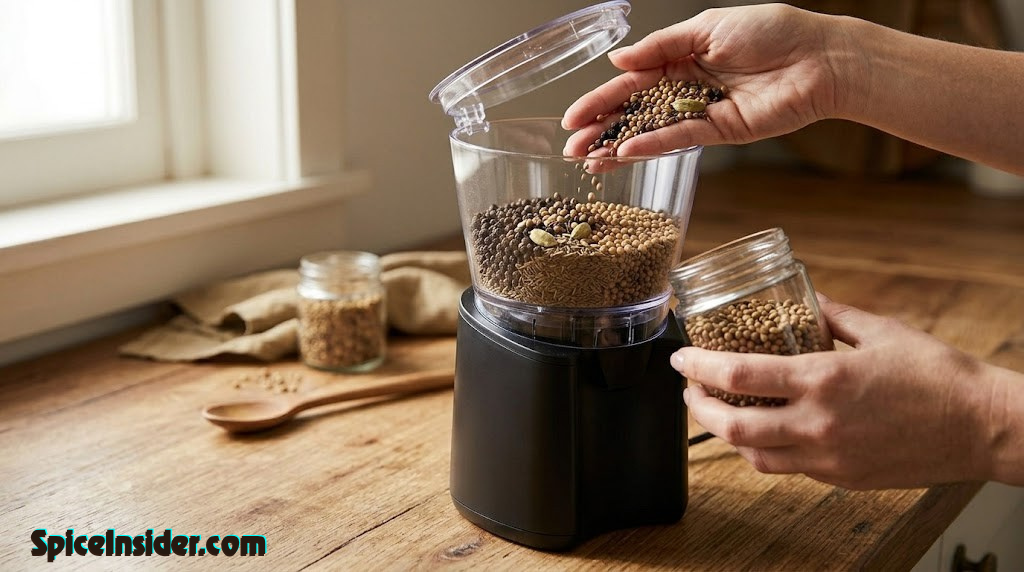
Fill your grinding chamber no more than two-thirds full. In a standard blade grinder with a 70–80g bowl, that’s roughly one to two tablespoons of whole spices, depending on their density. Dense spices like coriander seed and black pepper need a bit less room than lighter ones like dried chili flakes or fennel fronds.
The reason this matters: the blade doesn’t just chop spices — it creates a vortex that circulates ingredients through the cutting zone. If the bowl is packed too tightly, that circulation stops. You get spices at the bottom pulverized to dust while the ones on top stay completely whole.
Orientation and Distribution
Before you close the lid, give the bowl a gentle shake to distribute spices evenly across the base. If you’re grinding a mix of whole spices with very different sizes (say, cinnamon bark alongside fennel seeds), break the larger pieces into smaller chunks first by hand or against the counter. A mismatched load means some ingredients will over-grind while others barely get touched.
✔ DO When Loading
- Fill to 60–65% of bowl capacity
- Shake bowl gently to level the load
- Break oversized pieces down first
- Match quantities to your grinder’s rated capacity
- Add filler spice if grinding tiny amounts
✖ DON’T When Loading
- Never pack spices right to the rim
- Don’t mix radically different-sized pieces without pre-breaking
- Never grind quantities larger than the bowl’s max rating
- Don’t forget to check for residue from the last grind
Grinding Technique: Pulse vs. Hold
The single most transformative habit you can build around your spice grinder is switching from holding the button to pulsing it. This one change improves grind consistency, extends motor life, reduces heat buildup, and gives you dramatically more control over texture. It costs you about five extra seconds per grind and pays dividends every time you use the machine.
Why Continuous Running Damages Both Flavor and Machine
When you hold the trigger on a blade grinder for 30 or 60 seconds straight, two things happen simultaneously. First, the blade generates friction heat. This heats the oils inside your spices — the volatile aromatic compounds responsible for most of their flavor — and begins to degrade them. You end up with ground spice that smells and tastes flatter than it should.
Second, the motor runs hot. Electric blade grinders have small, efficient motors that aren’t designed for sustained, high-load operation. Running continuously for more than 10–15 seconds at a stretch without a break causes the motor windings to heat up. Do this repeatedly over time and you’ll notice a faint burning smell — an early warning that you’re shortening the machine’s life. If you’ve ever smelled something off during grinding, our article on spice grinder motor burning smell explains exactly what’s happening.
The Pulse Method
Pulse for 3–5 seconds, release, wait 1–2 seconds, repeat. After every few pulses, remove the lid and shake the bowl gently to redistribute spices. This achieves a few things: it prevents hot spots from developing, it moves unground pieces toward the blade, and it gives you a visual checkpoint to assess whether you’ve reached the texture you want.
✔ DO: Pulse Technique
- Pulse 3–5 seconds at a time
- Pause 1–2 seconds between pulses
- Shake bowl every 3–4 pulses
- Check texture at each milestone
- Stop as soon as desired texture is reached
✖ DON’T: Hold Technique
- Never hold button for 30+ seconds straight
- Don’t ignore the heat building in the bowl
- Don’t assume longer = finer (it often means scorched)
- Never run continuously until the machine stops on its own

High-torque motor, stainless bowl, and a pulse-friendly design — one of the best budget blade grinders going.
Check Price on AmazonWhat You Can (and Cannot) Grind
Not everything belongs in a spice grinder, and knowing where the limits are protects both your machine and your food. The broadest rule is simple: spice grinders are for dry, hard, plant-based ingredients. Step outside that boundary and problems follow fast.
Safe to Grind
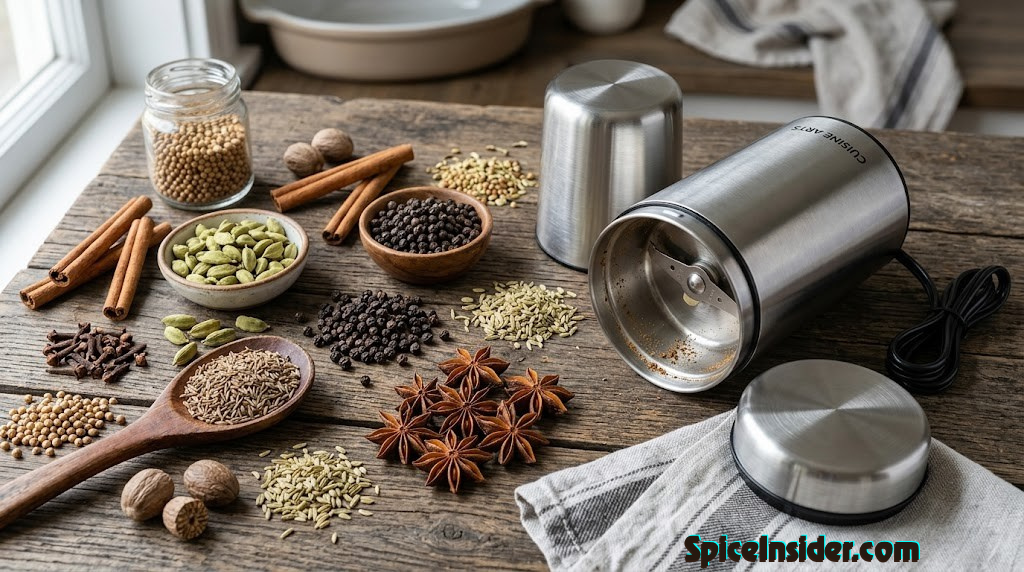
The vast majority of whole dried spices are completely safe for any blade or burr spice grinder: coriander, cumin, fennel, caraway, black pepper, white pepper, cardamom (remove pods first or leave whole — both work), dried chili, star anise, cloves, allspice, cinnamon sticks, dried turmeric root, dried galangal, mustard seeds, fenugreek, dried bay, and countless others.
Dried herbs — oregano, rosemary, thyme — can be ground to a finer powder than your fingers alone can manage, which opens up new uses in spice rubs and seasoning blends. Seeds like flaxseed, sesame, and poppy can be ground in a spice grinder, though sesame and flax release oils quickly and can turn pasty in larger volumes; keep batches small.
What to Avoid
Wet or fresh ingredients are the clearest category to avoid. Fresh ginger, garlic, lemongrass, or chilies will turn into a sticky paste that clogs the blade housing and introduces moisture that can corrode metal parts over time.
Very hard items like whole nutmeg can be ground in a powerful grinder, but they put more strain on the motor than softer spices. If your grinder struggles with nutmeg, pre-grate it on a microplane first. Cinnamon sticks — especially cassia bark — are dense and tough; break them into small pieces before loading, or your grinder will work significantly harder than it needs to.
On the question of grinding coffee: it’s physically possible, but there are real trade-offs around flavor transfer. Our detailed breakdown of whether you can grind coffee in a spice grinder walks through when it works and when it backfires.
| Ingredient | Safe to Grind? | Notes |
|---|---|---|
| Whole dried spices (cumin, coriander, pepper…) | ✔ Yes | Core use case; ideal |
| Dried herbs (rosemary, thyme…) | ✔ Yes | Keep batches small; herbs grind fast |
| Cinnamon sticks (cassia or Ceylon) | ✔ Yes | Break into 2–3 pieces first |
| Whole nutmeg | Caution | Hard on motor; pre-grate if grinder is underpowered |
| Sesame & flaxseeds | Caution | Grind small batches; oil releases quickly |
| Dried chili flakes / whole dried chilis | ✔ Yes | Remove stems first |
| Coffee beans | Caution | Flavor transfers; use dedicated grinder if possible |
| Salt (coarse) | Avoid | Abrasive; dulls blade fast; occasional use only |
| Sugar | Avoid | Caramelizes from heat; leaves sticky residue |
| Fresh ginger / garlic / lemongrass | ✖ No | Too wet; turns to paste; can damage motor |
| Nuts in large quantities | ✖ No | Very oily; creates paste; better suited to food processor |
| Whole dried chilis with thick skin | ✔ Yes | Toast first; seed if less heat is desired |
If you’re interested in understanding why whole spices beat their pre-ground counterparts in flavor, texture, and potency, read our comparison of grinding whole spices vs. pre-ground — the difference is larger than most cooks expect.
Moisture and Toasting Spices First
Moisture is the silent enemy of a clean, fine grind. Whole spices that have absorbed any humidity — from storage, from an improperly sealed jar, from being near a steaming pot — will resist the blade. Instead of breaking cleanly into powder, they compress and smear. The result is a gummy, clumping mess that sticks to the bowl walls and never reaches the fine texture you’re after.
The Dry-Toasting Step That Changes Everything
Dry-toasting spices before grinding is one of those steps that once you adopt, you never skip. A 60–90 second stint in a dry skillet over medium heat does three things: it drives off surface moisture (solving the texture problem), it begins to crack open the outer hull of the spice, and it activates the volatile oils inside through a Maillard-adjacent reaction. The result is a ground spice that smells more complex, tastes more vibrant, and reaches the correct texture faster in the grinder.
For the full technique — how long to toast each type of spice, how to tell when they’re done, and which spices shouldn’t be toasted — see our complete guide on how to toast spices before grinding.
Cooling Before Loading
One mistake people make after toasting: loading hot spices directly into the grinder. This seems intuitive — grind them while they’re warm and fragrant — but hot spices generate steam inside the enclosed grinding bowl. That steam condenses on the bowl walls and lid, making the interior damp and causing ground spice to stick. Always spread toasted spices on a plate or tray and let them cool completely (5–7 minutes) before grinding.
✔ DO With Moisture
- Toast before grinding to remove surface moisture
- Let toasted spices cool before loading
- Store whole spices in airtight containers away from steam
- Discard any whole spice that feels soft or smells flat — it’s past its prime
✖ DON’T With Moisture
- Never grind freshly toasted (still hot) spices
- Don’t store your grinder near the stovetop or above the kettle
- Don’t grind spices that have been near steam (open pot lids, dishwasher steam)
- Never neglect a spice jar that’s lost its tight seal
Controlling Grind Size Like a Pro
One of the most common frustrations people have with blade spice grinders is inconsistency — some runs produce a fine powder while others leave chunky, uneven pieces no matter what they try. The truth is that grind size control in a blade grinder is entirely a function of technique, not the machine itself. With the right approach, you can reliably hit coarse, medium, and fine textures from the same grinder.
Coarse: The Quick Pulse
For a coarse, cracked texture (ideal for spice rubs, cracked pepper, or toasted seeds you want visible in a dish), use just 2–3 pulses of 3 seconds each. Check, and stop as soon as the large pieces have broken down to roughly half their original size. You want chunks, not powder.
Medium: The Working Grind
A medium grind works for most everyday cooking — curry bases, spice blends, chili powders. Aim for 6–8 pulses of 4 seconds with shaking between every two pulses. The result should look like fine sand with occasional small flecks — not a uniform powder, but no recognizable whole pieces remaining.
Fine/Powder: The Long Sequence
A true fine grind takes patience and attention. Start with the medium sequence, then add 4–5 more pulses of 5 seconds, shaking between each and resting the motor for 10 seconds between every third pulse to prevent heat buildup. The finest commercial-grade powder from a blade grinder is still slightly coarser than what an industrial burr mill produces, but for home cooking it’s excellent.
If you consistently find that your spice grinder isn’t reaching fine enough results despite good technique, the problem may be the machine itself. Our guide on spice grinder not fine enough diagnoses the specific culprits and solutions.
| Grind Level | Pulse Count | Best For | Visual Check |
|---|---|---|---|
| Coarse / Cracked | 2–4 pulses × 3 sec | Spice rubs, cracked pepper, garnish | Irregular pieces, roughly halved in size |
| Medium | 6–9 pulses × 4 sec | Curry blends, chili powder, marinades | Fine sand texture, no whole pieces |
| Fine / Powder | 12–16 pulses × 4–5 sec | Baking, smooth sauces, spice pastes | Near-uniform powder, slight texture |

Removable grinding cup makes cleaning effortless. A consistent performer at an excellent price point.
Check Price on AmazonBlade vs. Burr Grinders: Different Rules Apply
The dos and don’ts for a blade grinder and a burr grinder overlap in many areas — don’t overload, keep things dry, clean regularly — but there are meaningful differences that affect how you use each type and what you can expect from them.
Blade grinders use a spinning metal blade, similar to a blender, that chops spices through impact and friction. They’re fast, affordable, and handle most spice types well, but produce a less uniform grind because the blade creates inconsistent impact forces across the bowl.
Burr grinders use two abrasive surfaces (burrs) that rotate against each other to crush spices into a consistent size. They produce a more uniform grind at a more consistent temperature, but they’re more expensive, require more cleaning, and don’t handle extremely oily or sticky spices well as those oils can gum up the burrs.
For a deep comparison of which type suits which cooking style, our guide to blade vs. burr grinders for spices covers the specifics in detail.
| Factor | Blade Grinder | Burr Grinder |
|---|---|---|
| Grind consistency | Variable (mix of fine + coarse) | Highly uniform |
| Heat generation | Higher (friction from impact) | Lower (gradual crushing) |
| Price | $15–$60 | $60–$300+ |
| Ease of cleaning | Simple (wipe or rinse bowl) | More involved (burr disassembly) |
| Handles oily spices | Adequately | Poorly (gums burrs) |
| Best for | Everyday home cooking | Precision spice work, blends |
| Max batch size | Small (2–4 tbsp) | Medium (4–8 tbsp) |
| Grind size control | By technique (pulse count) | By dial adjustment |
Burr Grinder-Specific Dos and Don’ts
✔ DO With Burr Grinders
- Use the grind size dial before loading
- Clean burrs after switching spice families
- Brush out fine powder between grinding sessions
- Run a small cleaning tablet or rice through occasionally
- Adjust grind size in small increments
✖ DON’T With Burr Grinders
- Never grind highly oily seeds in large quantities
- Don’t skip the disassembly clean — powder buildup damages burrs
- Never force the dial past its stops
- Don’t adjust grind size while motor is running
Cleaning Dos and Don’ts: The Rules Most People Get Wrong
Cleaning is the area where the most serious and most common mistakes happen. An uncleaned grinder doesn’t just carry flavor from one spice to the next — it harbors rancid oils that actively make your next grind taste worse, and it builds up compacted debris that adds resistance for the motor over time.
The good news is that cleaning a spice grinder correctly takes about 90 seconds. The bad news is most people do it wrong, either by not cleaning at all or by introducing water in ways that damage the machine.
The Quick Clean (After Every Use)
After every grinding session: unplug the grinder, remove the bowl (if removable), dump any remaining powder, and wipe all interior surfaces with a dry paper towel or microfiber cloth. Get into the corners and under the blade if possible. That’s it — this 60-second routine prevents 90% of flavor contamination and buildup problems.
The Deep Clean (Weekly or Between Spice Families)
For a thorough clean — especially after grinding pungent spices like fenugreek, cloves, or smoked paprika — add a tablespoon of dry white rice to the bowl and grind it for 20–30 seconds. The rice acts as an abrasive and absorbs residual oils and odors. Discard the powder, wipe clean, and repeat once more if needed. If you ever find stubborn odors lingering, our in-depth article on how to get smell out of a spice grinder using rice and bread covers every method that actually works.
For removable bowls, wash in warm soapy water, rinse thoroughly, and — this is critical — dry completely before reassembling. Water trapped in the bowl creates condensation inside the machine and can accelerate rust on blade edges.
Our dedicated guide to how to clean a spice grinder walks through every type of machine and every cleaning scenario, including how to handle a grinder with a non-removable bowl.
✔ DO When Cleaning
- Always unplug before cleaning
- Wipe dry after every single use
- Use rice or bread for deep deodorizing
- Hand-wash removable bowls in warm soapy water
- Dry all parts completely before reassembly
- Use a soft brush or toothbrush for blade crevices
- Clean between different spice families
✖ DON’T When Cleaning
- Never submerge the motor unit in water — ever
- Never put any part in the dishwasher
- Don’t leave water standing in the bowl
- Don’t use steel wool or abrasive pads on the bowl
- Never use cleaning products with bleach inside the grinding bowl
- Don’t reassemble while any component is still damp
One question that comes up often: is it safe to rinse your grinder under the tap? The answer depends on the model. Our article on whether you can wash a spice grinder explains which parts are water-safe on different grinder designs and how to do it without risk.

Stainless bowl, 200-watt motor, and a push-top design that makes one-handed pulsing effortless.
Check Price on AmazonStorage: What Happens After the Grind
The grinding process creates a product that’s dramatically more perishable than the whole spice it came from. When you crack open a whole spice, the essential oils inside begin to oxidize and evaporate. A whole cumin seed can retain its peak flavor for two years; ground cumin begins losing its punch within weeks. Everything you do from the moment grinding is complete affects how quickly that process happens.
Grind Small and Grind Fresh
The most important storage decision you can make is to grind only as much as you need right now, or at most what you’ll use within one to two weeks. Large pre-ground batches seem efficient but they sacrifice the very quality advantage you bought a spice grinder to get. Three tablespoons of freshly ground coriander made fresh for Tuesday’s curry will always beat three tablespoons you pre-ground ten days ago.
The Right Container
Store any pre-ground spices in small, airtight glass jars — not loose bags, not open bowls, and not the grinder itself. Glass is the best material because it doesn’t absorb oils and doesn’t transmit light. Keep jars away from heat and direct sunlight; a spice drawer or a closed cupboard away from the stove is ideal. Never store ground spices on a rack above the stovetop — the heat and steam will degrade them within days.
✔ DO For Storage
- Grind only what you need for immediate use
- Store in small, airtight glass jars
- Keep away from heat, light, and steam
- Label jars with the grind date
- Store whole spices in airtight containers before grinding
✖ DON’T For Storage
- Don’t pre-grind large batches to save time
- Never store ground spices in the grinder bowl
- Don’t keep spice jars on display above or near the stove
- Don’t use opaque plastic bags — they don’t seal tightly enough
- Never mix fresh and old pre-ground spice in the same jar
Motor and Machine Care: Making Your Grinder Last
Spice grinders are relatively simple machines — a motor, a blade, and a bowl — but the motor is the one component you cannot repair at home and cannot replace cheaply. Most premature grinder failures come down to avoidable motor stress: overheating from continuous running, strain from overloading, and corrosion from improper cleaning. Protect the motor and you protect the machine’s entire lifespan.
The Motor Rest Rule
For every 10–15 seconds of total running time, give the motor a 10-second rest. This is particularly important for grinding sessions that require many pulses — a fine powder grind involving 15+ pulses should have 2–3 deliberate pauses of 10–15 seconds built in to allow the motor windings to cool.
Load Matters More Than Run Time
A grinder running for 30 seconds with a correctly loaded bowl is under far less motor stress than a grinder running for 15 seconds with a packed, overfilled bowl. The motor works harder against resistance. This is why load control and pulse technique together are the two highest-leverage habits — both directly reduce the load on the motor in every single use.
If your machine has started emitting a faint smell during use, read our detailed breakdown of what causes spice grinder motor burning smell before the situation worsens — early intervention can save a machine that’s showing early warning signs.
Lid Sticking: Prevention and Response
One of the most frustrating operational issues — a lid that won’t open after grinding — is almost always caused by pressure buildup inside the bowl from fine powder getting into the lid seal. The fix is simple: always allow the motor to completely stop before trying to remove the lid, then try both clockwise and counterclockwise twisting with firm, even pressure. Never force the lid by striking it.
If your lid has already seized, our guide to dealing with a stuck spice grinder lid covers every release method safely.
✔ DO For Motor Care
- Rest motor for 10 sec after every 15 sec of run time
- Keep loads within the manufacturer’s stated capacity
- Store the grinder in a cool, dry location
- Let motor stop fully before opening lid
- Act immediately if you notice any burning smell
✖ DON’T For Motor Care
- Never run continuously past 15 seconds
- Never force the lid open while motor is still spinning
- Don’t operate with a cracked or broken bowl
- Don’t ignore grinding resistance — it signals a problem
- Never store with moisture inside the unit
If you’re looking for a machine built to withstand daily heavy use without the usual durability concerns, our picks for a spice grinder that doesn’t break focus specifically on long-term reliability.
Dealing With Lingering Odors the Right Way
Every spice grinder will eventually carry the ghost of a previous grind. The question is how strongly, and for how long. Pungent spice families — anything from the allium world, high-volatile aromatics like cloves and star anise, sulfurous spices like fenugreek and asafoetida — can leave their signature inside the grinding bowl for days if not addressed correctly.
The Problem With Skipping the Clean
Residual oils inside the bowl don’t just transfer smell — they go rancid. A bowl that last ground cloves three weeks ago and was only roughly wiped will have a thin film of oxidized clove oil in every crevice. The next batch of coriander you grind will pick that up and carry it into your dish. The flavor impact is subtle but cumulative: a spice blend made in a neglected grinder simply tastes muddier and less distinct than one from a clean machine.
Odor Removal Techniques That Work
The rice method is the most widely known and genuinely effective. A tablespoon of dry, uncooked white rice ground for 20–30 seconds acts as both a mechanical scrub and an absorbent matrix for aromatic oils. Discard, wipe clean, and for most everyday pungent spices you’re done.
For stubborn cases, move to the bread method. A small piece of stale white bread ground after the rice round absorbs odor compounds that rice doesn’t capture due to its different starch structure. Between the two rounds, even fenugreek and asafoetida usually clear out.
A third option some cooks use: grinding a neutral spice — plain white rice, or a mild, inexpensive spice like white pepper — as a “chaser” after grinding something pungent. The neutral grind lifts and carries residual aromatics out. Our complete spice grinder odor removal guide covers every method with step-by-step instructions.
✔ DO For Odor Control
- Run a rice grind after every pungent spice session
- Follow with bread for stubborn aromatics
- Wipe all surfaces dry after each cleaning round
- Dedicate a separate grinder to ultra-pungent spices if you use them often
✖ DON’T For Odor Control
- Don’t try to mask odors with scented cleaning products — they’ll contaminate future grinds
- Never use water alone to clean — it doesn’t dissolve spice oils
- Don’t leave a used grinder sitting for days before cleaning
- Never assume “it’ll grind out” if you just run the next spice — it won’t
Troubleshooting Common Mistakes
Even experienced cooks run into recurring problems with their spice grinders. Most of these issues have a specific cause and a specific fix. Here’s a concise troubleshooting guide for the problems that come up most often.
Problem: Grinder Leaves Big Chunks
The most common cause is overfilling — not enough room for the vortex circulation that gives the blade access to all the spice. Reduce the load and try again. If chunks persist, the spice may be too moist. Toast briefly and try again. For a deeper diagnosis, our article on why spice grinders leave chunks covers every possible cause.
Problem: Grinder Won’t Get Fine Enough
You may be using too few pulses, or your spices may need toasting first to break them down. If technique improvements don’t solve it, the blade may be dull. A blade grinder that’s been used heavily for over a year without ever being sharpened will produce a noticeably coarser grind. Our guide on spice grinder not getting fine enough explains how to test and address blade dullness.
Problem: Burning Smell During Use
A burning smell while grinding can mean one of two things: you’re overloading the motor (reduce load size and run shorter pulses) or there’s old, rancid spice debris heating up on the blade housing. A deep clean will address the latter; better technique addresses the former. If the burning smell persists even with a clean machine and correct loading, the motor windings may be compromised — time to consider replacing the unit. Full diagnostic in spice grinder motor burning smell.
Problem: Lid Won’t Open
Wait for the blade to fully stop spinning. Grip the bowl and lid separately and apply slow, firm rotational pressure — both clockwise and counter-clockwise depending on your model’s lock direction. A rubber jar opener wrapped around the lid greatly increases grip. Never strike the lid with force. Full method guide: stuck spice grinder lid.
Problem: Spice Grinder vs. Grinder-Without-a-Grinder Situation
If your grinder breaks mid-recipe and you need ground spice now, it’s worth knowing that solid alternatives exist. Our guide on how to grind spices without a grinder covers every technique from mortar and pestle to rolling pin to cast iron pressing.
| Symptom | Most Likely Cause | Quick Fix |
|---|---|---|
| Chunks remaining in grind | Overfilling, moist spices | Reduce load; toast spices first |
| Grind not fine enough | Too few pulses, dull blade, moist spices | More pulse cycles; toast; check blade condition |
| Burning smell | Motor overload or rancid buildup | Reduce load; deep clean the bowl |
| Lid won’t open | Powder in seal, motor still spinning | Wait; rubber grip; slow rotational pressure |
| Flavor contamination | Skipped cleaning between spice families | Rice + bread cleaning round before next use |
| Spices turning to paste | Too wet / too oily ingredients | Never grind fresh or very oily ingredients in a blade grinder |
| Machine vibrates excessively | Uneven load distribution | Shake bowl to level before running; reduce load size |
If you’ve tried everything and are still experiencing consistent problems, it may be time to invest in a more reliable machine. Our review of the Cuisinart SG-10 and the Secura spice grinder cover two of the most consistently reliable options at their respective price points.

Browse our curated list of the best spice grinders across every price range — with honest, in-depth reviews.
Shop Top Spice GrindersFrequently Asked Questions
How full should I fill my spice grinder?
Fill the grinding chamber no more than two-thirds full. Overfilling prevents spices from moving freely around the blade, resulting in uneven texture and extra stress on the motor. For very small quantities, add a neutral spice to give the blade enough material to work with.
Can I grind wet or oily spices in a blade grinder?
Avoid grinding very wet ingredients in a blade grinder. Oils and moisture can damage the motor, cause rust, and create a paste that clogs the blade housing. Burr grinders handle oily spices better, but even those should only process properly dried spices.
How long should I run my spice grinder at once?
Run the grinder in short pulse bursts of 3–5 seconds rather than holding the button down continuously. This prevents motor overheating, gives you better control over grind consistency, and extends the life of your machine. Give the motor a 10-second rest for every 15 seconds of total runtime.
Is it safe to grind coffee and spices in the same grinder?
You can use the same grinder for both, but flavors transfer. If you grind cumin or coriander in your coffee grinder, the next coffee batch may carry those aromas. It’s best to dedicate separate grinders to spices and coffee, or clean thoroughly between uses. Our full breakdown of grinding coffee in a spice grinder covers the trade-offs.
Can I wash my spice grinder in the dishwasher?
Most spice grinder bowls and lids are not dishwasher-safe. The high heat warps plastic components and can dull metal blades. Always hand-wash removable parts in warm, soapy water and dry immediately and completely before reassembling.
Why does my spice grinder leave chunks behind?
Chunks usually result from overfilling, using underdried spices, or not pulsing the grinder long enough. Try grinding smaller batches, toasting spices first to remove moisture, and using longer pulse sequences with shaking between each set of pulses. Our article on why spice grinders leave chunks covers every cause.
How do I remove strong smells from my spice grinder?
Grind a small amount of dry white rice to absorb residual odors, then wipe the bowl with a damp cloth and dry completely. For stubborn smells from spices like fenugreek or cloves, follow with a small piece of stale bread. The full method is in our spice grinder odor removal guide.
Do I need to toast spices before grinding them?
Toasting is optional but highly recommended. A quick dry toast removes surface moisture, unlocks volatile aromatic oils, and makes spices grind faster and more uniformly. Even 60–90 seconds in a dry pan makes a noticeable difference in flavor and grind texture. See our guide on how to toast spices before grinding for full technique.
What happens if I grind too much at once?
Grinding large batches at once causes heat buildup from friction, which degrades the essential oils that give ground spices their potency. Smaller batches stay cooler, grind more evenly, and produce more flavorful results. For most home blade grinders, two tablespoons of whole spice is about the ideal batch size.
How often should I clean my spice grinder?
Clean your spice grinder after every use with a dry wipe. Do a deep clean (rice grind followed by a wipe) after every pungent spice session and before switching between spice families. A full wash of removable parts can be done weekly if the grinder is used heavily. Our complete spice grinder cleaning guide walks through every scenario.
Can I grind salt and sugar in a spice grinder?
Salt can be ground in a spice grinder, but use caution — salt is extremely abrasive and will dull blades faster than almost any spice. Sugar is generally not recommended, as it can caramelize from the blade’s heat and leave a sticky residue inside the bowl that’s difficult to remove without water.
What is the biggest mistake people make with spice grinders?
The single most common mistake is never cleaning the grinder between uses. This allows old spice residue to go rancid, contaminate future grinds with stale flavors, and eventually cause motor strain from built-up debris. Regular cleaning — even just a 60-second dry wipe — is the single highest-leverage habit you can build around your grinder.
Final Thought: Good Habits Make Better Spice
A spice grinder is fundamentally simple, but like any tool, how you use it defines the results you get. The rules covered in this guide aren’t complicated — two-thirds full, short pulses, clean after every use, dry before reassembly — but they compound. A grinder used correctly and cleaned consistently will outperform a more expensive machine that’s neglected and abused, every time.
The flavor reward for fresh grinding is real and significant. The extra two minutes you invest in proper technique and post-grind cleaning pay back in every dish you make. Start with the habit that matters most for your current situation — whether that’s mastering the pulse, committing to a post-grind wipe, or finally toasting before grinding — and build from there.
Ready to find the right machine for your kitchen? Browse our full roundup of the best options available right now.
Shop Best Spice Grinders on Amazon