Spice Grinder Motor Burning Smell: What It Means & What to Do
That acrid, electric odor rising from your grinder is your machine trying to tell you something. Here’s how to decode the smell, fix the problem, and know when it’s time to stop.

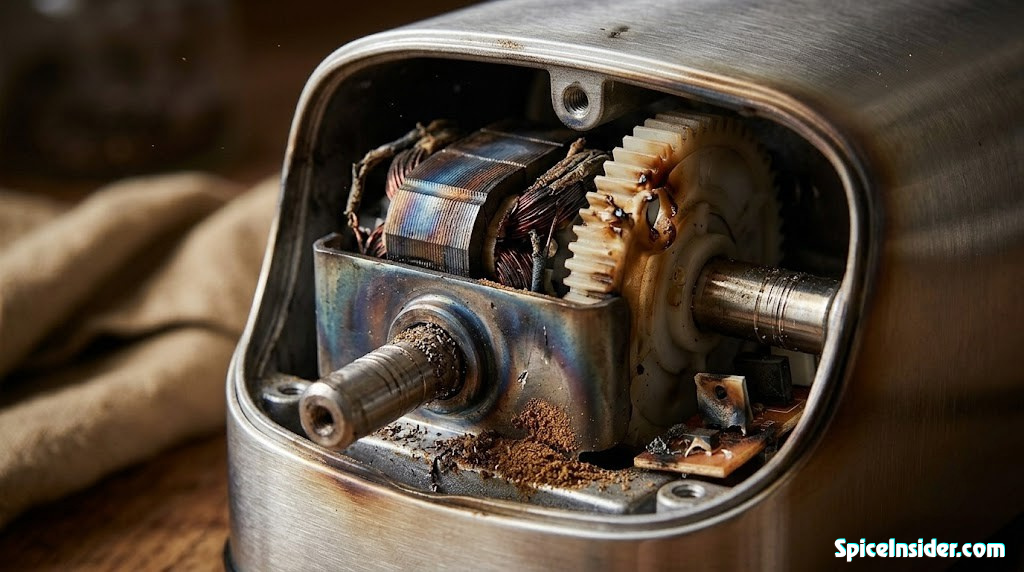
Why Your Spice Grinder Smells Like It’s Burning
A burning smell from a spice grinder is unsettling, but it’s also one of the more informative things a small appliance can do. Unlike a grinder that simply stops working, a burning odor gives you a window — sometimes brief — to intervene before permanent damage occurs, or before a genuinely dangerous situation develops.
The smell almost always originates from one of three places: the motor itself, the winding insulation inside the motor, or friction between moving parts. Electric motors generate heat as a byproduct of normal operation, and they’re designed to dissipate that heat efficiently within their duty cycle. When something goes wrong — whether it’s overloading, a mechanical jam, worn internal components, or years of accumulated debris — the motor generates more heat than it can shed, and the materials inside start to degrade and off-gas.
Understanding the source isn’t just satisfying from a technical standpoint. It determines whether you should clean the grinder, adjust your technique, stop using the machine entirely, or call it a loss and move on. If you’re also dealing with your grinder leaving chunks rather than grinding fine, a struggling motor is often the common thread connecting both problems.
Whenever you notice a burning smell from any small appliance, unplug it before inspecting. Running a machine past a warning smell can cause permanent motor failure, or in extreme cases, create a fire or shock hazard. Let it cool for at least 15 minutes before touching it.
There’s a wide spectrum of severity here. Some burning smells are completely benign — a brand-new grinder’s manufacturing residues burning off in the first few uses, or a brief moment of mechanical resistance that the motor quickly overcomes. Others are serious warnings that the motor is on its last legs. The sections below walk you through how to tell the difference.

Looking for a grinder built to last?
Before diagnosing your current grinder, it helps to know what a good motor should feel like. We’ve ranked the most durable options tested hands-on.
See Best Spice Grinders on Amazon →Types of Burning Smells — Decoded
Not all burning smells are created equal. The character of the odor — whether it’s sharp and electrical, acrid and plasticky, warm and smoky, or faint and slightly chemical — tells you a great deal about what’s actually happening inside the machine. Train your nose to notice these distinctions; they matter.
The key distinction to internalize is this: smells that are faint and only happen on first use or after a very long processing session fall into one category. Smells that are persistent, grow stronger with each use, or come with visible smoke or sparks fall into an entirely different, much more serious category. Never normalize a burning smell that keeps returning — it’s the machine telling you something is fundamentally wrong.
The Overloaded Motor: The Most Common Culprit
By far the most frequent reason a spice grinder starts smelling like burning is a motor that’s been pushed past its rated capacity. Electric motors in blade-style grinders — the kind that dominate the sub-$50 market — are relatively simple devices with a defined performance envelope. When you demand more than they can deliver, they respond by drawing more current, getting hotter, and eventually starting to self-destruct.
Overloading happens in several distinct ways, and understanding each one helps you avoid it without abandoning your favorite technique.
Grinding Too Long Without Breaks
Most compact spice grinders are duty-cycle appliances. They’re designed to run for 10 to 30 seconds at a time, with brief pauses in between. When you run one continuously for 60 seconds, 90 seconds, or longer, heat builds up in the motor faster than it can escape through the housing. The motor’s insulation begins to break down, and you get that characteristic sharp, electrical smell. Many people push through this, assuming the grinder just needs to work harder — but that’s exactly the wrong response. Stopping and resting is the correct move.
Loading Too Many Spices at Once
Overfilling creates mechanical resistance that the motor has to overcome with every blade revolution. A blade working against twice the recommended volume of whole peppercorns draws significantly more current than one working against the correct amount. Over time — sometimes in just one session — this elevated current draw heats the motor windings to the point where the insulation starts to break down.
Hard Spices Without Adequate Moisture Relief
Extremely dense spices like dried turmeric root, cinnamon quills, dried whole chilies, and raw cassia bark place enormous mechanical loads on small blade motors. The blade effectively stalls repeatedly against dense material, each stall producing a brief spike of current and heat. If you’re grinding the kind of whole spices you’d be better off with a purpose-built burr grinder, the standard blade grinder motor will struggle. You can read more about this dynamic in our piece on blade vs. burr grinders for spices — the motor design differences are substantial.
Continuous Running Over 30 Seconds
The single most damaging thing you can do to a blade grinder motor. Always pulse instead: 10–15 seconds on, 5–10 seconds off.
Overfilling Past the Max Line
Creates back-pressure that forces the motor to draw excess current. If there’s no fill line marked, fill no more than two-thirds full.
Very Dense or Moist Spices
Dried whole chilies, cinnamon sticks, nutmeg, and turmeric root are mechanically demanding. Pre-break large pieces before grinding.
Multiple Sessions Back-to-Back
Grinding three batches in a row without letting the motor rest can accumulate heat across sessions. Allow 2–3 minutes between large batches.
If you’re grinding large amounts of spices regularly, one of the most practical things you can do is read up on proper spice grinder technique — the correct batch sizes and pulsing rhythms extend motor life dramatically.

Cuisinart SG-10 — Built for Sustained Grinding
If your motor keeps overheating, a more robust machine is often the real fix. The SG-10 has a stronger motor with better heat management for regular use.
Read Our Full Review →Wrong Spices or Quantities: More Damage Than You’d Expect
People tend to think of all spices as essentially the same from a mechanical standpoint — they’re just dried plant material, right? In practice, the variation in density, oil content, moisture, and abrasiveness across common spice types creates a surprisingly wide range of motor strain.
Some spices are almost motor-friendly: fine-ground sea salt re-run through a grinder, fenugreek seeds, or already-partially-ground dried herbs place minimal load on the motor. Others, particularly resinous spices high in volatile oils — like star anise, dried clove, or coriander seed — not only work the motor harder but also deposit oil residues on the motor housing that eventually start to smell when they get hot enough. It’s a double problem: mechanical strain plus residue accumulation.
The Problem with Moisture-Heavy Spices
Fresh or semi-fresh plant material — fresh ginger, lemongrass, fresh curry leaves — absolutely should not go into a blade grinder designed for dry spices. The moisture can splash onto the motor ventilation slots, cause rust or corrosion over time, and create a paste that clogs the blade mechanism. When the blade stalls against this paste, the motor overheats rapidly. If you’ve been experimenting with fresh ingredients, that may explain both the burning smell and any mechanical sluggishness you’ve noticed.
For fresh aromatics, a mortar and pestle or a wet grinder designed for that purpose is the right tool. If you’re grinding spices that aren’t quite dry enough — like spices that absorbed humidity in storage — learn how to toast spices before grinding to drive out residual moisture, which both improves flavor and reduces motor strain.
The Whole Spice vs. Pre-Ground Question
Grinding whole spices from scratch requires significantly more motor work than regrinding or pulsing pre-ground spices. This is one of the core arguments made in the debate over grinding whole spices versus buying pre-ground. If your grinder is marginal in terms of motor power, the decision to always grind from whole can push it into a persistent overload state.
Spices That Are Hard on Small Motors
- Cinnamon sticks / cassia: Extremely dense and fibrous. Pre-snap into small pieces.
- Dried turmeric root: One of the hardest spices by density. Many home grinders struggle here.
- Dried whole chilies (especially Kashmiri or mulato): Large volume, tough skins, seeds resist blade.
- Whole nutmeg: Better grated manually — grinding whole nutmeg in a blade grinder is genuinely damaging.
- Raw star anise: Hard woody structure plus high resin content creates a double burden.
- Cloves: High oil content means heavy resin accumulation even at correct amounts.
First-Use and Break-In Smells: When Burning Is Normal
Here’s a genuinely reassuring piece of context for anyone who just purchased a new grinder: a faint burning smell during the first one to three uses is, for many machines, completely normal and expected. This doesn’t mean you should ignore it or push through if it’s strong — but a mild, faintly chemical smell that disappears after a few uses usually isn’t a sign of a defective or failing machine.
The smell during break-in comes from several sources:
- Manufacturing residues on the motor windings: Light machine oils, protective coatings, and lubricants used during assembly burn off during initial operation. This is extremely common with motors made in high-volume facilities.
- Plastic housing curing: Some polymer housings contain plasticizers or mold-release compounds that off-gas when the motor heats the interior to normal operating temperatures for the first time.
- Blade coating burn-off: Stainless blade edges sometimes have a thin factory coating or residue that burns off during the first few grinding sessions.
The distinguishing characteristic of a break-in smell versus a genuine problem smell is that it fades. After two or three normal-length grinding sessions, it should be gone entirely. If the same faint smell persists after five or more uses, it has moved out of break-in territory and into something worth investigating.
Run the empty grinder for 10 seconds. Notice any smell. Then grind a tablespoon of rice (which also helps clean the interior). If the smell fades with each use and is mild throughout, you’re experiencing normal break-in. If it gets stronger or persists beyond three uses, investigate further.
Worn Motor Brushes: The Internal Failure You Can’t See
Inside most universal electric motors of the kind used in small blade grinders, two small carbon components called brushes maintain electrical contact with the rotating armature. These brushes transfer current to the spinning part of the motor, and they do so by physically touching a copper ring (the commutator) while it spins at thousands of revolutions per minute.
The brushes wear down over time — this is by design and completely normal. What’s not normal is when they wear down to the point where they can no longer make reliable contact, or when they create excessive arcing (sparking). When a brush is near the end of its life, it produces an uneven, intermittent electrical connection. That arcing generates significant localized heat and produces a sharp, ozone-like electrical smell that’s distinctly different from a normal hot-motor smell.
Signs That Point to Brush Problems
- The burning smell is sharp and electrical in character, not just warm or hot
- You can sometimes see faint flickering or sparking through ventilation slots in a dark room
- The grinder’s performance has become inconsistent — sometimes fast, sometimes sluggish — without clear reason
- The smell comes on quickly, even during short grinding sessions
- The grinder is relatively old and has seen heavy use
In industrial motors, brush replacement is routine maintenance. In the small appliance world, however, it’s rarely practical — the motors in consumer-grade spice grinders are not designed for user serviceability, and replacement brushes are often impossible to source. If brush wear is the root cause, the machine is typically at end of life.
If you can see light flickering from inside the grinder’s vents when it’s running, stop using it immediately. Arcing brushes create localized temperatures high enough to ignite combustible materials. This is not a “push through it” situation.

Secura Spice Grinder — Motor That Outlasts the Competition
Our review found the Secura handles longer sessions with less heat buildup than most competitors at this price point.
Check Price on Amazon →Debris, Resin, and Oil Buildup: The Slow-Burn Problem
Even if you’ve been using your grinder perfectly — correct amounts, correct spices, pulsing technique, adequate rest time — there’s a gradual accumulation process happening inside the machine that eventually becomes a heat problem. Spice resins, volatile oils, and fine spice powder don’t all end up in your cooking. Some infiltrates every crevice of the grinder.
Over months and years of use, a thin film of polymerized spice oil builds up on the motor housing (the plastic or metal dome beneath the grinding chamber), around the blade shaft, and — in worst cases — on or near the motor ventilation openings. This film has a much lower thermal conductivity than clean plastic or metal. In other words, it acts as insulation around the very components that need to shed heat. The motor runs hotter than it should even when you’re doing everything right, because its natural heat escape routes are partially blocked.
When the accumulated residue gets hot enough from the motor operating beneath it, it starts to smell. This is the “smoky or woody” smell category — warmer and less alarming than an electrical burning smell, but still a signal that cleaning is overdue. Regular cleaning as described in our guide to how to clean a spice grinder is the most effective long-term prevention.
The Aromatic Residue Problem
Highly aromatic spices — cloves, cardamom, star anise, and especially whole dried chilies — leave behind particularly tenacious oil residues. These resins don’t just smell when they burn; they can also become sticky over time and cause the blade shaft to feel slightly sluggish, adding mechanical resistance that further loads the motor. If your grinder smells during use and is also slightly less efficient than it used to be, this combination strongly suggests residue buildup.
The good news is that this cause is entirely addressable through cleaning. The approach outlined in our guide to removing smells from a spice grinder using rice or bread handles both the olfactory and the coating problem simultaneously.
How to Fix a Burning-Smell Spice Grinder
The right fix depends entirely on the cause. Work through these in order — start with the safest, simplest interventions before moving to anything more involved.
-
Stop, unplug, and let it cool completely Before anything else, remove power and let the motor cool to room temperature. This takes at least 15 minutes for a machine that’s been running hot. Never inspect or clean a warm grinder — residual heat can cause secondary burns and distorts your ability to smell accurately.
-
Visually inspect the exterior Look for any discoloration, melted plastic, or deformation around the motor housing, vents, or blade area. Any visible physical damage is a sign to retire the machine rather than attempt repair. Also check for any debris jammed around the blade shaft.
-
Clean the grinding chamber and blade area Grind a tablespoon of raw white rice to a fine powder, then discard. This abrasive cleaning method scours residue from the blade and chamber walls. For stubborn oil residue, a dry paper towel wiped inside the (cooled, unplugged) bowl can help. Review our full guide on how to clean a spice grinder for the complete process.
-
Check and clear the ventilation slots The motor housing typically has small slots or holes to allow heat to escape. Use a dry toothbrush or can of compressed air to clear any packed spice dust from these openings. A clogged vent is a significant heat retention problem.
-
Test with a small, easy batch using pulsing technique After cooling and cleaning, grind a small amount of a low-demand spice (like fenugreek or ground coriander) using short 10-second pulses with 10-second rests. Monitor closely. If the smell returns mildly, it may be residual and will clear with a few cleaning cycles. If it returns strongly or immediately, the problem is internal to the motor.
-
Address odor-related buildup with the rice-and-bread method For machines where the smell seems to be from accumulated spice residue rather than a mechanical fault, running a few cleaning cycles using the rice or bread method — detailed in our spice grinder odor removal guide — can resolve the issue over several cleaning sessions.
✓ Fixable Situations
- First-use burn-off smell that fades
- Overheating from too-long continuous running
- Clogged vents from spice dust
- Resin/oil residue on housing
- Jam from overfilling — once cleared
✗ Usually Not Fixable
- Visible sparking or flickering from vents
- Smell persists after thorough cleaning and rest
- Motor runs audibly rougher than before
- Physical discoloration or melting of housing
- Smell worsens rather than fades with use

Can You Wash Your Spice Grinder?
Many people accidentally damage their grinder’s motor by washing it incorrectly. Find out exactly what’s safe to rinse, what to dry-clean, and what never to submerge.
Read the Guide →When to Stop Using It Immediately
There’s a meaningful difference between monitoring a situation and ignoring warning signs. These circumstances require you to unplug the grinder and not use it again:
Visible sparks or smoke from the grinder during operation. Any visible melting or deformation of the housing. A burning smell that grows stronger with each use rather than fading. Unusual buzzing, clicking, or grinding noises from the motor housing. The housing becoming hot to the touch. The grinder tripping your home circuit breaker. A smell that persists even when the grinder is just plugged in and idle (this suggests an internal short circuit).
Electric motor failures in small appliances don’t always announce themselves dramatically. Sometimes the progression is slow — a little more smell each week, slightly diminished grinding power, a motor that takes a few seconds to come up to speed. If you’ve noticed any trend toward these symptoms, the machine is telling you it’s nearing the end of its service life.
One useful litmus test: if you unplug the grinder, clean it thoroughly, leave it idle for 48 hours, and the first 10-second grinding session still produces a strong burning smell, the cause is almost certainly internal and progressive. The machine has crossed a threshold from which cleaning and technique adjustments won’t bring it back.
A Note on Fire Safety
Small appliance motors in the failure stage have been implicated in kitchen fires, not frequently, but it does happen. Never leave a grinder you have concerns about running unattended. Never store a grinder you suspect has a motor problem in a drawer with combustible materials nearby. When in doubt, the cost of a replacement grinder is trivially small compared to any alternative outcome. See our guide to the dos and don’ts of spice grinder use for the full safety picture.
Prevention: How to Never Have This Problem Again
The vast majority of burning-smell situations are entirely preventable with a consistent set of habits. None of these require significant extra effort — they’re primarily about learning the machine’s actual capabilities and working within them rather than against them.
The 10-Second Pulse Rule
This single habit eliminates the most common cause of motor overheating. Instead of holding the grinder button down and running continuously until your spices are ground, switch to a pulse technique: 10–15 seconds on, 5–10 seconds off, repeat until done. The brief rest allows the motor to dissipate heat and dramatically reduces peak temperature. Most spices grind just as efficiently — often more so, because the brief pauses allow the spice to redistribute in the bowl for more even grinding.
Fill Volume Discipline
If your grinder has a fill line, respect it without exception. If it doesn’t, make your own rule: never more than half to two-thirds of the grinding bowl’s volume. A lighter load means less mechanical resistance, less motor strain, and faster grinding — it’s not a tradeoff, it’s a strictly better approach on every metric.
Regular Cleaning Schedule
After every grinding session, knock out loose spice dust. Weekly for heavy users, monthly for light users: run the rice-cleaning cycle and wipe the interior dry. Every few months, check the ventilation slots for packed dust. Keeping the machine clean isn’t just an aesthetic preference — it’s what allows the motor to operate within its designed thermal range. Our guide to spice grinder odor removal covers this routine in detail.
| Habit | Frequency | Motor Benefit | Effort Level |
|---|---|---|---|
| Pulse grinding (10 sec on / off) | Every use | Prevents peak heat buildup | Very Low |
| Half-fill max load | Every use | Reduces current draw | Very Low |
| Rice cleaning cycle | Weekly (heavy users) | Clears residue from blade and housing | Low |
| Vent slot check and clearing | Monthly | Maintains heat dissipation pathway | Low |
| Pre-break hard spice pieces | As needed | Reduces mechanical load spikes | Medium |
| Toast spices to reduce moisture before grinding | As needed | Prevents paste formation and blade stalls | Medium |
| Full rest between batch sessions | Batch grinding days | Allows motor to return to ambient temperature | Low |
If you want to go deeper on the “correct technique” side of the equation, our comprehensive overview of how to use a spice grinder walks through all of these habits and more in a practical, step-by-step format.
When to Replace Rather Than Repair
There’s a certain reluctance many people feel about replacing an appliance they’ve used for years — and it’s completely understandable. But spice grinders exist in an interesting economic category: even good ones rarely exceed $60 to $80 at retail, and the motor is the one component that can’t reasonably be user-serviced or replaced at the consumer level. When the motor goes, the machine goes.
Honest Assessment Framework
Ask yourself three questions. First: has the burning smell persisted across multiple uses even after thorough cleaning and a 48-hour rest? If yes, the cause is internal and progressive. Second: is the grinder’s grinding performance noticeably diminished from when it was new — slower, less efficient, leaving more chunks? If yes, the motor is degraded. Third: is the machine more than two to three years old with heavy use? If yes, it has likely passed its reasonable service life for the use it’s seen.
If you answered yes to any two of those three, the most cost-effective and safest course is replacement. If you answered yes to all three, replacement isn’t a question of whether but when — and when should be now.
Should You Replace Your Burning Grinder?
The repair-vs-replace math on small blade grinders almost always favors replacement once the motor shows genuine failure signs. A new machine from a quality brand costs $25–$60. Factor in the time, hassle, and genuine safety risk of continuing with a failing motor, and the calculus is clear.
- If smell is from first use or brief overload: clean, rest, adjust technique. Keep it.
- If smell is from residue buildup: clean thoroughly. Keep it.
- If smell returns after cleaning and rest: replace.
- If there’s any sparking or visible damage: replace immediately.
- For a machine that doesn’t break down: see our guide to the spice grinder that doesn’t break.
When shopping for a replacement, the motor power rating (in watts) is the primary indicator of how well a machine will handle real workloads without overheating. Grinders under 150W are best suited for occasional light use. Machines in the 200–250W range are genuinely capable of handling regular whole-spice grinding sessions. Our complete guide to the best spice grinders breaks down the full range with hands-on testing behind every recommendation.
Also worth considering: if you’re finding yourself regularly reaching for alternative methods — a mortar and pestle, a rolling pin, or improvised techniques — it might be worth reading through our roundup of how to grind spices without a grinder. Sometimes the right answer for your actual usage pattern isn’t another blade grinder at all.
Find Your Next Grinder
Our editors tested 14 grinders across three months. The ones that made the final list have motors specifically evaluated for heat management and longevity.
See Top Picks on Amazon →Frequently Asked Questions
These are the most common questions we hear about spice grinder burning smells, answered directly and without the runaround.
The Final Word: Listen to Your Grinder
A burning smell from a spice grinder is never something to tune out or learn to live with. It’s a signal — sometimes minor, sometimes urgent — and the right response depends on reading that signal accurately rather than ignoring it or panicking unnecessarily.
The vast majority of burning smells from spice grinders have completely addressable causes: a first-use burn-off, an overloaded motor from a session that ran too long, accumulated spice resin blocking heat dissipation, or clogged ventilation slots. In all these cases, correcting technique and cleaning the machine resolves the problem completely.
The minority of cases — sharp electrical smells, smells that return immediately after rest and cleaning, visible sparking, or melting housing — describe a machine that has crossed into failure territory. In those cases, the conversation isn’t about fixing the grinder; it’s about replacing it safely and promptly.
The habit that prevents most of this entirely: respect the machine’s duty cycle. Pulse-grind, don’t run continuously. Half-fill the bowl, don’t pack it. Clean it regularly. Rest it between heavy sessions. These aren’t complex techniques — they’re minor adjustments that extend a grinder’s useful life from one year to five or more.
Ready to find a grinder that handles real workloads?
If your current machine has passed the point of no return, or if you simply want something built to handle daily grinding without overheating concerns, our full testing rundown is the place to start.
- Best Spice Grinders — tested for heat management and motor longevity
- Spice Grinders That Don’t Break — built for heavy use
- Master Spice Grinder Technique — avoid overloading your machine
- Full Dos and Don’ts Guide — the complete safety and longevity reference

See Our #1 Spice Grinder Pick
The best spice grinders are built to last for years of daily use. Our top pick balances motor power, build quality, ease of cleaning, and value better than any other machine we’ve tested.
Check Current Price on Amazon →