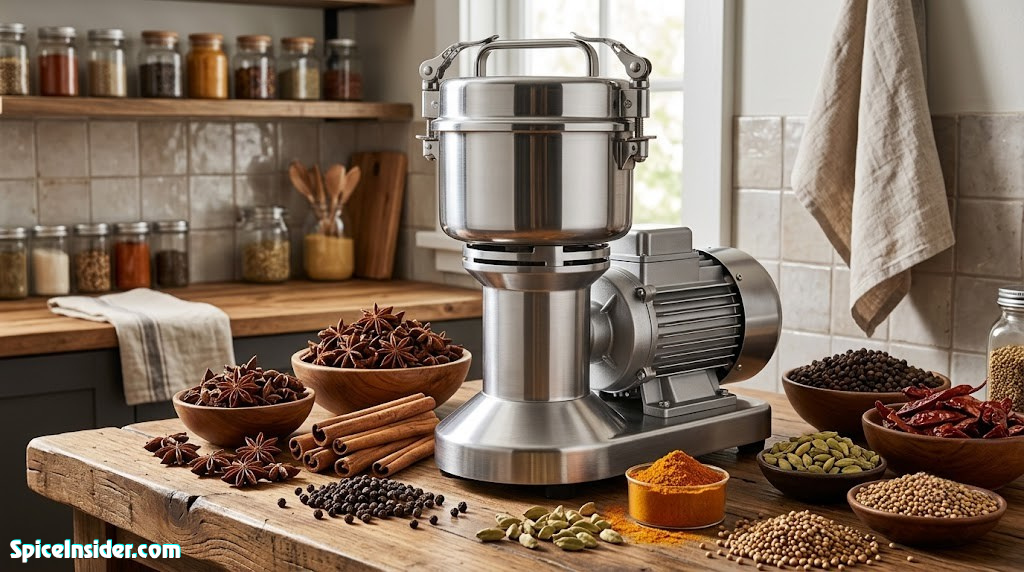
The Spice Grinder That Doesn’t Break: A Real Buying Guide for People Done Replacing Grinders Every Year
If your last three grinders all died the same way, this is the article that explains why — and exactly which models actually hold up.
Somewhere in your kitchen right now there’s probably a dead spice grinder. Maybe it’s in a drawer you keep meaning to clean out, or maybe it’s already in the trash, replaced by a backup that’s quietly making the same grinding noise it made on day one — for now. If you’ve bought two, three, or even four grinders in the last few years and watched each one fail in roughly the same way, you’re not unlucky. You’re buying into a category where most products are engineered to be cheap first and durable second, if at all.
This guide exists because “spice grinder that doesn’t break” is a search a lot of frustrated cooks type into Google after their second or third grinder dies, and the honest truth is that almost nobody writes content for that specific moment of exhaustion. Most buying guides rank grinders by grind fineness or price. We’re doing something different here: ranking and explaining grinders purely through the lens of what actually fails, why it fails, and which designs sidestep those failure points entirely.
We pulled apart owner reviews spanning years of real daily use, cross-referenced common failure complaints across multiple electric models, and looked closely at the manual alternatives that some households have used for decades without a single repair. If you want the short version: the grinders that survive long-term use share a small number of traits, and the ones that die early share an equally small number of weaknesses. Let’s get into both.
Why Most Spice Grinders Die Young
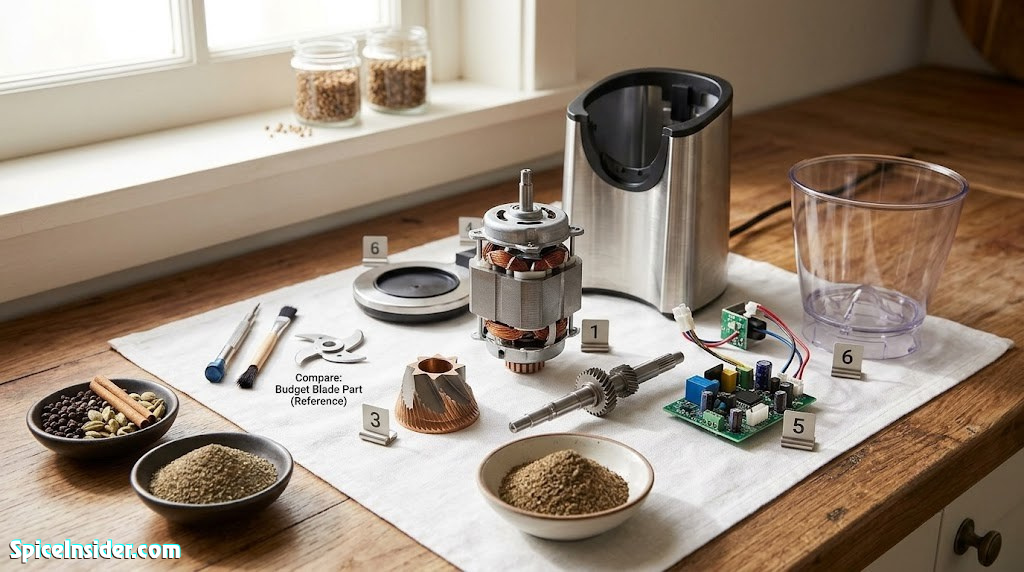
Before recommending anything, it’s worth understanding what actually kills a spice grinder, because the answer is more specific than “cheap parts.” Across hundreds of owner accounts, the same three failure points show up again and again, almost like a script.
1. Motor burnout from continuous grinding
Small electric grinders use compact motors designed for short bursts, not sustained runtime. When that limit gets ignored — by running the unit for 30, 60, or 90 seconds straight on something stubborn like cinnamon sticks or whole cardamom pods — the motor overheats, the thermal protection trips, and in a lot of cases it never recovers. One especially telling account described a grinder dying belly-up after just fifteen minutes of total lifetime use, with the internal blade assembly literally coming loose from the motor shaft. That’s not a fluke; it’s a pattern repeated across multiple budget and mid-range electric models.
2. Plastic components fatiguing under repeated stress
Even grinders marketed as “stainless steel” often hide a plastic coupling, gear, or locking ring somewhere in the assembly — usually exactly where the blade meets the motor. Plastic doesn’t fail all at once; it fatigues. Every grind cycle puts a tiny bit of stress on that joint, and after enough cycles, it cracks. One long-term owner of a popular dual-bowl grinder put it plainly: the stainless construction looked durable, but the plastic fused to the blades was “just a matter of time” before fatigue failure set in.
3. Bowls and jars that simply aren’t replaceable
This one doesn’t kill the motor, but it kills the product. A huge number of “broken grinder” complaints aren’t motor failures at all — they’re a cracked grinding bowl, a stripped locking ring, or a jar that finally gave out, paired with the discovery that the manufacturer doesn’t sell that specific part separately. The appliance becomes e-waste over a five-dollar component.
If you want a deeper breakdown of the most common ways grinders go wrong day to day, our guide on why a spice grinder isn’t grinding fine enough and our troubleshooting piece on spice grinder motor burning smell both dig into early warning signs worth watching for before a full failure happens.
What Actually Predicts Durability (And What Doesn’t)
Price is a weak predictor of how long a grinder survives. We found expensive grinders with the exact same plastic-coupling weakness as fifteen-dollar models, and we found twenty-dollar manual grinders still going strong after seven years of daily use. So if price isn’t the signal, what is?
Signals That Actually Predict Longevity
- 304 food-grade stainless steel in the bowl and the blade-to-motor coupling, not just the visible housing
- Removable, dishwasher-safe grinding bowls sold as standalone replacement parts
- Built-in overheat shutoff that activates automatically, rather than relying on the user to time short bursts
- A simple mechanical design with few moving parts — fewer parts means fewer failure points
- A warranty of at least two years, which signals the manufacturer expects the unit to survive that long
Signals That Don’t Predict Longevity
- A high price tag alone, with no mention of the internal coupling material
- Wattage by itself — a high-wattage motor paired with a plastic coupling still fails at the same weak point
- Brand reputation built on a different product category (a brand known for blenders isn’t automatically good at grinder motors)
- Aesthetic finish — brushed steel housings can hide plastic internals just as easily as plain plastic ones
This is also where the grind method matters more than people expect. If you’re trying to decide between approaches entirely, our comparison of blade vs. burr grinders for spices covers how the grinding mechanism itself changes the failure profile, separate from build quality.

Secura Electric Coffee & Spice Grinder
304 stainless steel bowls and blades, copper-wound motor with automatic overheat shutoff at 200°F, and a two-year warranty — the combination that owners report surviving 4+ years of daily grinding.
Check Price on AmazonElectric vs. Manual: Which One Actually Lasts Longer?
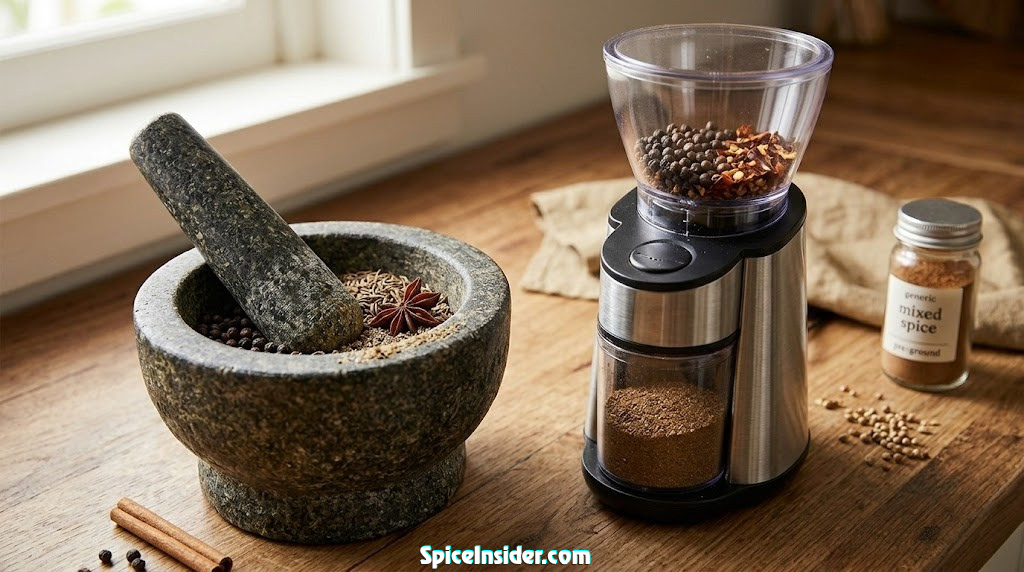
This is the question that matters most if you genuinely want a grinder you’ll still be using in a decade, and the honest answer is: it depends what kind of “doesn’t break” you’re chasing.
Electric grinders fail at the motor or the plastic coupling, almost always within the first one to three years if there’s a design weakness. When they fail, they fail completely and usually can’t be repaired at home, since most manufacturers don’t sell internal motor parts. Manual grinders — mortar and pestles, hand-crank mills, and mechanical pepper-style grinders adapted for spices — have no motor to burn out and no electronic components to fail. Their failure points are almost entirely physical: a dropped granite mortar can chip, a wooden mill can crack if it dries out, and a cheap mechanism with thin metal gears can wear down. But there’s nothing to “burn out,” which is why so many owners report using the same manual grinder for fifteen, twenty, even forty-plus years.
| Factor | Electric Grinders | Manual Grinders |
|---|---|---|
| Primary failure point | Motor burnout, plastic coupling fatigue | Dropped/chipped material, worn gears |
| Typical lifespan if well-built | 3–7 years | 10+ years, often decades |
| Repairability | Low — sealed motors, few spare parts sold | High — mechanical parts are simple and often replaceable |
| Speed and convenience | Seconds per batch | 1–2 minutes of manual effort |
| Best suited for | Daily, fast, hands-off grinding | Cooks who don’t mind effort in exchange for permanence |
Neither answer is universally “right.” If your priority is genuinely never replacing the tool again, a well-made manual grinder or mortar and pestle is the closest thing to a lifetime purchase in this category. If you want speed and consistency and you’re willing to accept a multi-year lifespan in exchange for convenience, the right electric model — chosen specifically for its durability traits — is still a reasonable bet. For more on the manual route specifically, see our guide on how to grind spices without a grinder.
The Most Durable Spice Grinders, Ranked
These picks are ranked specifically by durability evidence — owner-reported lifespan, build material at the failure points we outlined above, and warranty strength — not by grind fineness alone. If pure performance is your priority instead, our broader best spice grinder roundup covers that angle in more depth.
1. Secura Electric Coffee & Spice Grinder — Best Overall for Durability
The Secura earns the top spot because it directly eliminates the two biggest electric-grinder failure points: its bowls and blades are made of 304 food-grade stainless steel rather than the plastic-and-steel hybrid construction common in this price range, and its motor includes a copper-wound design with automatic overheat protection that shuts the unit down at 200°F before damage occurs. Owners testing it specifically against pricier burr grinders have praised the ability to fully remove and wash the stainless bowls — a feature that, beyond convenience, also means there’s a replaceable part instead of a sealed unit when something does eventually wear out.
It isn’t flawless. Some owners have reported the wet-grinding bowl cracking after extended use, and replacement bowls can be hard to track down for older model variants. But for the price point, it has one of the strongest multi-year track records of any electric grinder we found, with verified owners reporting 4+ years of daily use without motor failure.
Pros
- 304 stainless steel bowls and blades resist staining and odor transfer
- Automatic overheat shutoff protects the motor from burnout
- Dual-bowl system separates dry spices from wet pastes
- Strong multi-year track record in owner reviews
Cons
- Wet-grinding bowl is a reported weak point on some units
- Replacement bowls can be difficult to source for older variants
- Small capacity per batch compared to larger food processors

Secura Electric Coffee & Spice Grinder
Our top durability pick — stainless internals, overheat protection, and a track record of multi-year daily use.
Check Price on Amazon2. ChefSofi Granite Mortar & Pestle — Best for a True Lifetime Purchase
If you want a tool that has effectively zero chance of “breaking” in the conventional sense, an unpolished granite mortar and pestle is the closest thing to a permanent kitchen fixture. There’s no motor, no blade, no plastic coupling, and no electronics — just dense stone that’s heavy enough to do the work for you once it’s seasoned. Independent testing that pitted electric grinders against a granite mortar and pestle found it was one of only two tools in the entire test group capable of grinding whole cloves and cinnamon sticks, spices that frequently jam or strain electric blade assemblies.
The tradeoff is effort and time: grinding a batch of cumin or cardamom by hand takes one to two minutes versus a few seconds in an electric unit, and the initial seasoning process (grinding rice and a garlic-cumin-salt mixture to clear granite dust) takes some patience before first real use. But once seasoned, there’s essentially nothing left to wear out beyond accidental chipping from a hard drop.
Pros
- No motor or electronics to fail — ever
- Handles tough spices like cloves and cinnamon that jam many electric blades
- Heavy, dense stone construction resists everyday wear indefinitely
- Doubles as a tool for pastes, guacamole, and pesto
Cons
- Requires an initial seasoning process before first use
- Slower per batch than electric grinding
- Heavy — not ideal if counter space or mobility is a concern
- Can chip if dropped on a hard surface

ChefSofi Granite Mortar & Pestle Set
The closest thing to a tool that physically cannot suffer a motor failure — dense, unpolished granite built to last generations.
Check Price on Amazon3. Cuisinart SG-10 Spice & Nut Grinder — Best If You Use It in Short Bursts
The Cuisinart SG-10 is a genuinely split-personality product in the review data. Some owners report it dying within the first fifteen minutes of total use, with motor burnout the most frequently cited cause. Other owners, including one account of five years of regular use covering everything from cloves to dried mushrooms, report zero motor issues whatsoever. The difference, based on cross-referencing complaint patterns, almost always comes down to runtime per session: this unit is explicitly not designed for commercial-style continuous grinding, and short, deliberate pulses rather than long continuous runs appear to be the difference between a unit that lasts years and one that dies in its first week.
If you’re consistent about pulsing in short bursts and letting it rest between batches, it’s a capable, easy-to-clean grinder with a heavy-duty motor housing and stainless blades. If you tend to run kitchen gadgets hard and long without thinking about it, this is probably not the most forgiving option on this list.
Pros
- Stainless steel blades and a removable, dishwasher-safe bowl
- Built-in safety interlock prevents operation unless the lid is locked
- Some owners report 5+ years of reliable use
- Easy to clean between different spices
Cons
- Motor burnout is a frequently reported failure mode if overused in long sessions
- Only an 18-month limited warranty
- Not designed for continuous, back-to-back grinding

Cuisinart SG-10 Spice & Nut Grinder
A capable grinder for short, deliberate bursts — read our full breakdown before deciding if it fits your habits.
Check Price on AmazonWe’ve also written a dedicated breakdown of this exact model, including more owner feedback and longevity data, in our full Cuisinart SG-10 review. And if you’re trying to decide between this and the Secura specifically, our Secura spice grinder review covers the comparison in detail.
4. Zassenhaus-Style Cast Iron / German Hand Mill — Best for Decades of Service
Old-fashioned hand-crank mills built on a cast-iron mechanism are the dark horse of durability in this category, mostly because almost nobody buys them anymore — but the people who already own one tend to keep using the same unit for 60-plus years. One long-time owner described running a mid-century model daily for spice grinding with no plans to replace it, while a separate owner noted their burr coffee grinder of the same general engineering style lasted fifteen years before any issue. These mills use simple mechanical adjustment screws and metal grinding mechanisms rather than electric motors or plastic couplings, which removes both major failure points covered earlier in this guide.
The catch: vintage units in this style are increasingly expensive and harder to find new, and the grind tends to be slightly coarser than what an electric blade grinder produces. If ultra-fine powder consistency matters more to you than multi-decade durability, this isn’t the pick. If you want a tool you genuinely expect to hand down, it might be the best one on this entire list.
Pros
- All-mechanical design with no motor or electronics to fail
- Documented multi-decade lifespans in long-term owner accounts
- Adjustable coarseness via a simple mechanical screw
- No power outlet required — useful for travel or power outages
Cons
- New units in this exact style can be expensive
- Slower than electric grinding for large batches
- Coarser maximum fineness than a dedicated blade grinder
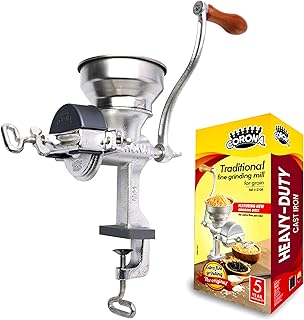
Cast Iron Hand-Crank Spice Mill
A purely mechanical tool with the longest documented owner lifespans of anything in this guide.
Check Price on AmazonSide-by-Side Durability Comparison
Here’s the full lineup compared directly on the factors that actually predict whether a grinder survives long-term, rather than on grind speed or price alone.
| Model | Key Material | Main Failure Point | Warranty | Best For |
|---|---|---|---|---|
| Secura Electric Coffee & Spice Grinder | 304 stainless steel bowls/blades | Wet bowl on heavy use | 2 years | Daily electric grinding |
| ChefSofi Granite Mortar & Pestle | Unpolished granite | Accidental chipping if dropped | Varies by seller | True lifetime ownership |
| Cuisinart SG-10 | Stainless blades, plastic housing | Motor burnout if overused | 18 months | Short, controlled bursts |
| Cast Iron Hand-Crank Mill | Cast iron mechanism | Wear over decades, not failure | Varies by maker | Multi-generational use |
Related Reading on SpiceInsider
The Mortar & Pestle Case: Is “No Motor” the Ultimate Durability Hack?
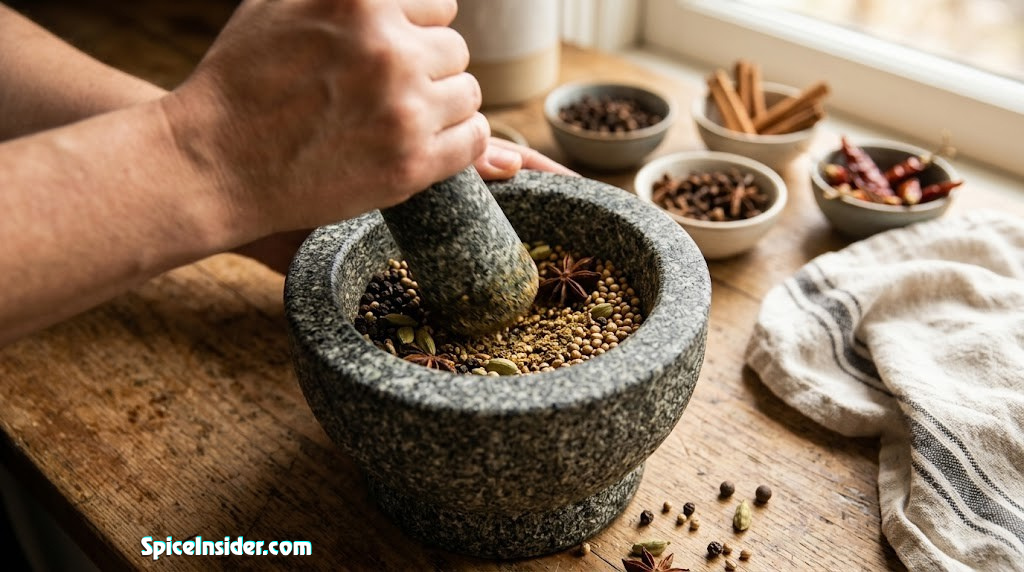
It’s worth dwelling on this a little longer, because the mortar and pestle solves the durability question in a fundamentally different way than every electric model on this list. Electric grinders try to out-engineer their weak points — better motors, better overheat protection, better materials at the coupling. A mortar and pestle simply removes the weak points from existence. There’s no motor to overheat, no blade to dull or jam, no plastic gear to fatigue, and no circuit board to fail after a power surge.
That’s not a knock against electric models — speed and convenience are real, legitimate priorities for a lot of home cooks, especially anyone grinding spices daily for multiple dishes. But if “doesn’t break” is genuinely your top priority above all else, including above speed, a quality granite or heavy ceramic mortar and pestle is hard to beat on pure mechanical simplicity. The pestle does need to be heavy enough to do real work without excessive arm effort, and the bowl needs to be a material dense enough not to absorb oils and flavors between uses — which is exactly why unpolished granite outperforms softer stones or porous ceramics in long-term testing.
For a deeper look at how this compares to other no-electricity options, our piece on grinding spices without a grinder walks through several manual methods, while our breakdown of whole spices vs. pre-ground spices explains why grinding fresh — by any method — tends to produce noticeably better flavor regardless of which tool you use.
How to Avoid Motor Burnout (If You Go Electric)
If you’ve decided convenience matters enough to stick with an electric grinder, motor burnout is the single biggest threat to its lifespan — and the good news is that it’s almost entirely preventable with a few habit changes.
Grind in short pulses, not long runs
The single most common cause of early motor failure across every brand we reviewed is running the unit continuously for 30 seconds or more. Most small grinder motors are designed for five-to-ten-second bursts with rest in between. Pulsing in short bursts — even if it takes a few extra pulses to reach your desired fineness — puts dramatically less cumulative stress on the motor.
Let it cool between batches
If you’re grinding multiple batches back to back (say, prepping a spice blend with five different ingredients), give the motor 30 to 60 seconds of rest between each one. Models with automatic overheat shutoff will do this for you by force; models without it rely entirely on your own restraint.
Avoid grinding the hardest spices in full-size batches
Whole cinnamon sticks, dried turmeric root, and whole cloves are consistently flagged as the spices most likely to strain a small grinder motor or jam a blade. If your grinder doesn’t explicitly advertise the ability to handle these, break them into smaller pieces first or grind smaller quantities at a time. Our guide on toasting spices before grinding also covers how toasting can make tough spices brittle and easier on the motor, rather than fighting it whole and raw.
Don’t overfill the bowl
Every grinder has a max-fill line for good reason. Overfilling forces the blade to push through more resistance than the motor was designed for, which is one of the fastest ways to trigger an overheat shutdown or, on units without that protection, outright burnout.
Blade vs. Burr: Which Mechanism Survives Longer?
Most dedicated spice grinders use a spinning blade, similar to a small blender. Burr grinders — more commonly associated with coffee — use two grinding surfaces that crush material between them rather than chopping it with a spinning edge. Each mechanism fails differently.
Blade grinders are mechanically simpler, which usually means fewer parts that can break, but the blade itself can dull over years of grinding hard spices, and the motor has to work against more resistance with each pass since it’s chopping rather than crushing. Burr grinders distribute force more evenly and tend to produce a more consistent grind, but the burrs themselves are a precision part that’s more expensive to replace if they wear down or get damaged by an accidental hard object.
For pure spice grinding specifically — as opposed to coffee — blade mechanisms remain the more common and more field-tested choice, largely because most spices grind down quickly enough that blade dulling isn’t usually the limiting factor; motor and coupling durability is. If you want the complete mechanical breakdown of how these two systems compare beyond just durability, our dedicated blade vs. burr grinder comparison covers grind consistency, noise, and cost differences in full.
Maintenance Habits That Add Years to Any Grinder
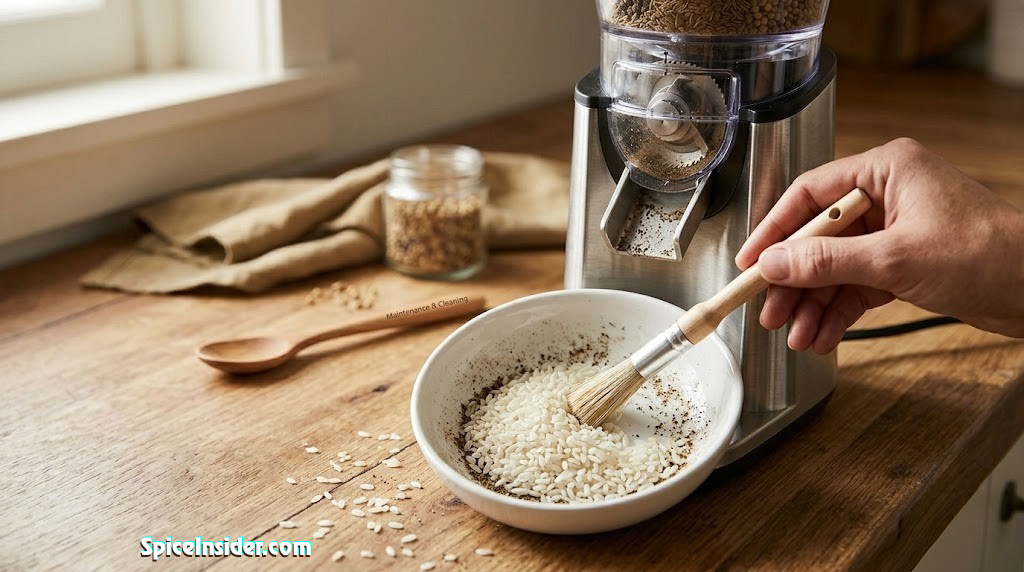
Even the most durable model on this list will fail early if it’s neglected. A handful of maintenance habits make a measurable difference in how long any grinder — electric or manual — actually lasts.
Clean between uses, not just occasionally
Residue buildup inside the grinding chamber doesn’t just cause flavor cross-contamination; it also adds friction the motor has to work against on every subsequent use. A quick wipe-down or a rinse of a removable bowl after each session keeps resistance — and therefore motor strain — low. Our full how to clean a spice grinder guide covers the process step by step.
Use the rice-grinding trick for stuck residue
Grinding a small handful of raw rice through an electric grinder is a widely recommended way to scrub out stuck spice oils and odor without ever needing to submerge the motor housing in water. It’s gentle, doesn’t require disassembly, and is one of the most repeated pieces of advice from long-term owners. For more detail on this exact method, see how to get smell out of a spice grinder using rice or bread.
Never submerge the motor base
This is one of the fastest ways to cause irreversible electrical failure on any electric unit. Only the removable bowl, blade assembly, or lid (if explicitly marked dishwasher-safe) should ever get wet. If you’ve ever wondered whether it’s safe to fully wash your unit, our piece on can you wash a spice grinder covers exactly what’s safe to submerge and what isn’t.
Store it dry and don’t force a stuck lid
Moisture left inside a closed unit invites both odor and corrosion on metal blades over time. And if a lid ever feels stuck, forcing it can crack the locking mechanism that many electric grinders require to even power on. Check out what to do when a spice grinder lid is stuck for a safer way to handle that specific problem.
Address chunky or uneven grinds immediately
If your grinder starts leaving chunks instead of a fine, even powder, that’s often an early sign of a dulling blade, a loosening locking ring, or debris interfering with the mechanism — not something to just push through with longer run times, which only adds more motor strain. Our article on why a spice grinder leaves chunks walks through the most common causes.
Warranty Length as a Durability Signal
Warranty length isn’t just a safety net — it’s also one of the more honest signals a manufacturer gives about how long they actually expect their own product to survive. A grinder backed by an 18-month limited warranty is implicitly telling you the company isn’t confident it’ll outlast that window by much. A grinder backed by a two-year or longer warranty, especially from a brand that also sells replacement bowls and parts separately, is signaling the opposite.
It’s also worth checking, before you buy, whether a manufacturer sells individual replacement bowls, blades, or jars on their own product page or through their own storefront. If they do, that’s a strong sign the company designed the product to be repaired rather than replaced outright when one component eventually wears out — which, as we’ve covered, is usually a bowl or jar issue rather than a true motor failure anyway.
Common Mistakes That Kill Grinders Early
Beyond motor overuse, a handful of everyday habits show up repeatedly in failure reports — often from people who genuinely thought they were using the grinder correctly.
| Mistake | Why It Causes Failure | Better Habit |
|---|---|---|
| Running the motor 30+ seconds straight | Exceeds the duty cycle the motor was engineered for | Pulse in 5–10 second bursts with rest between |
| Grinding wet ingredients in a dry-only bowl | Moisture can seep into the motor coupling and corrode it | Use a dedicated wet/chopping bowl if one is included |
| Forcing a stuck lid or locking ring | Cracks the safety interlock mechanism | Clean and gently work the lid free instead of forcing it |
| Submerging the motor base to clean it | Causes irreversible electrical damage | Only submerge removable, dishwasher-safe bowls |
| Overfilling past the max line | Forces the motor to push through excess resistance | Grind smaller batches more frequently |
For a broader running list of habits to adopt and avoid across the entire category, our spice grinder do’s and don’ts guide covers ground we don’t have room for here.
Capacity, Power, and What “Durable” Actually Feels Like Day to Day
It’s worth setting realistic expectations here: even the most durable electric spice grinder on this list is still a small kitchen appliance with a modest motor, not an industrial machine. Most run in the 150- to 300-watt range and hold somewhere between two and four-and-a-half ounces of spice per batch at the max fill line. That’s intentional — a smaller motor working a smaller batch is part of what keeps these units from overheating in the first place.
If your household grinds spices constantly throughout the day, in large batches, for things like a busy home restaurant-style operation, even the most durable consumer-grade grinder is going to feel undersized eventually, and a manual mortar and pestle or a hand-crank mill might genuinely serve you better long-term simply because there’s no motor duty cycle to exceed at all. For typical home cooking — even cooking that leans heavily on freshly ground spices most days of the week — any of the picks above, used the way we’ve described, should comfortably hold up for years.
If you’re someone who occasionally needs to grind something other than spices entirely, it’s also worth knowing that most spice grinder blades aren’t built for coffee’s oil content over repeated use. Our piece on whether you can grind coffee in a spice grinder explains why occasional crossover use is usually fine, but daily dual-duty use can shorten a unit’s lifespan faster than spices alone would.
Frequently Asked Questions
What is the most durable type of spice grinder overall?
Purely mechanical tools with no motor — granite mortar and pestles and cast-iron hand-crank mills — have the longest documented lifespans, often a decade or more, because there’s no motor or plastic coupling to fail. Among electric options, models with 304 stainless steel bowls, blades, and automatic overheat protection hold up the longest.
Why does my electric spice grinder keep overheating?
Overheating is almost always caused by running the motor continuously for too long in a single session, grinding overly hard spices like whole cinnamon or cloves in full batches, or overfilling past the max line. Short pulses with rest in between dramatically reduce this risk.
Is a mortar and pestle really more durable than an electric grinder?
In terms of having fewer failure points, yes. A mortar and pestle has no motor, no electronics, and no plastic gears to wear out, so the only realistic way it fails is physical damage like dropping and chipping it. Electric grinders introduce more components that can fail over time, even when well made.
Can a spice grinder motor be repaired once it burns out?
Usually not economically. Most consumer-grade grinder motors are sealed units, and manufacturers rarely sell individual motor parts separately. In most cases, a burned-out motor means replacing the entire unit rather than repairing it.
Does a higher wattage motor mean a more durable grinder?
Not necessarily. Wattage affects grinding power and speed, but durability depends more on the materials at the blade-to-motor coupling and whether overheat protection is built in. A high-wattage motor paired with a weak plastic coupling can still fail early.
How long should a good electric spice grinder last?
A well-built electric spice grinder used correctly, with short pulses and proper maintenance, can reasonably last three to seven years or more. Models with stronger materials and overheat protection tend to land at the higher end of that range.
What’s the single biggest cause of spice grinders breaking?
Motor burnout from running the unit continuously for too long in one session is the single most frequently reported cause of failure, followed by plastic components fatiguing at the blade-to-motor coupling over repeated use.
Are stainless steel spice grinders always more durable than plastic ones?
Not automatically. Many grinders marketed as stainless steel still use plastic at the critical blade-to-motor coupling. True durability requires checking whether the internal coupling and locking mechanism are also metal, not just the visible exterior housing or bowl.
Does grinding whole spices wear out a grinder faster than pre-ground spices?
Whole, hard spices like cinnamon sticks, cloves, and whole peppercorns put more strain on a motor and blade than pre-ground spices, since there’s nothing to grind with pre-ground products. If you grind primarily whole hard spices, choosing a model explicitly rated for them matters more.
Should I buy a grinder with a longer warranty even if it costs more?
Generally, yes, if durability is your priority. A longer warranty signals the manufacturer expects the product to last that long, and it gives you recourse if a motor or component fails within that window. An 18-month warranty versus a two-year-plus warranty is a meaningful difference in manufacturer confidence.
Can I prevent motor burnout on a grinder I already own?
In many cases, yes. Switching to short pulses instead of continuous runs, letting the unit cool between batches, avoiding overfilling, and not grinding the hardest whole spices in large quantities can meaningfully extend the life of a grinder you already have, even if it lacks built-in overheat protection.
The Bottom Line
A spice grinder that doesn’t break isn’t really about luck or spending more money — it’s about understanding exactly where these tools tend to fail and choosing accordingly. If you want speed and don’t mind a multi-year lifespan, the Secura’s stainless internals and overheat protection make it the strongest electric pick we found. If you want something closer to a true lifetime purchase and don’t mind a little extra hand effort, a granite mortar and pestle sidesteps the entire category of motor and electronic failure altogether. And whichever route you choose, the maintenance habits in this guide — short pulses, regular cleaning, never submerging the motor base — will add real years to whatever you end up buying.
Ready to stop replacing grinders every year? Start with one of the durability-focused picks above, and bookmark our spice grinder do’s and don’ts guide so the next one actually goes the distance.
See Our #1 Durability Pick on Amazon