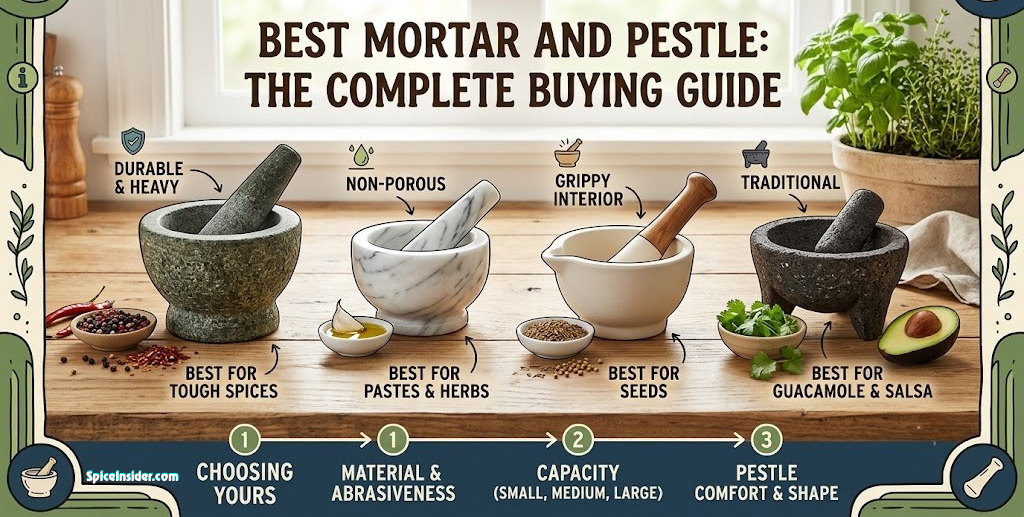
Best Mortar and Pestle: The Complete Buying Guide
No motor, no plastic, no shortcuts — just stone, pressure, and real control over texture. Here’s how to pick the mortar and pestle that actually earns a permanent spot on your counter.

There’s a reason the mortar and pestle has survived essentially unchanged for thousands of years while almost every other kitchen tool around it has been reinvented a dozen times over. Nothing else does quite what it does: turning garlic, chilies, toasted spices, and fresh herbs into a cohesive, oily, deeply aromatic paste through nothing but pressure and friction. A food processor shreds. A blender liquefies. A mortar and pestle bruises and crushes, gradually, which is exactly the mechanism that releases flavor compounds the way recipes from Thailand to Mexico to India have always depended on.
If you’ve spent any time comparing mechanical options, you’ve probably already looked at our best manual spice grinder guide, which covers hand-crank mills and ratchet grinders built for dry, repeatable grinding. A mortar and pestle solves a different, often more demanding problem: wet pastes, fibrous aromatics, and textures that a mill simply isn’t built to handle.
This guide breaks down seven of the best mortar and pestle sets available right now, from heritage-style molcajetes to compact granite sets built for daily use. We’ll cover exactly what separates a genuinely good one from a disappointing one, what “seasoning” actually means before first use, and the small habits that keep stone performing well for decades instead of months.
For the broader grinding category, including mechanical mills and electric options, our best spice grinder hub page rounds out the full picture.
One important note before diving into specific products: shopping for a mortar and pestle online is trickier than it looks, because photos rarely convey scale, weight, or surface texture — the three things that matter most. A mortar that looks substantial in a product photo can turn out to be surprisingly light and thin-walled once it arrives, and a smooth, polished interior that photographs beautifully can actually perform worse than a rough, matte one that looks less refined. We evaluated each of these picks against real kitchen tasks — crushing whole spices, building a guacamole base, pounding a Thai-style curry paste, and grinding toasted cumin and coriander into a fine powder — rather than relying on listing photos or star ratings alone.
Why Use a Mortar and Pestle? The Real Advantages
It’s tempting to file a mortar and pestle under “traditional, but not necessarily better.” That undersells it. There are specific, practical reasons this tool still outperforms more modern alternatives for certain jobs.
It Makes Pastes, Not Just Powders
This is the headline advantage, and it’s worth dwelling on. A blade chops and a blender liquefies by shearing ingredients apart at high speed, which tends to aerate and thin a mixture rather than concentrate it. A pestle works by repeated, controlled crushing, which breaks down cell walls gradually and releases oils into the mixture itself rather than flinging them onto the sides of a jar. The result for something like a Thai curry paste or an Indian wet masala is a denser, more cohesive, more intensely flavored base than the equivalent ingredients run through a food processor.
You Feel the Texture as It Changes
Just like a manual spice mill, a mortar and pestle gives you direct tactile feedback. You can feel garlic shift from whole cloves to a chunky mash to a smooth paste, and stop at exactly the texture a recipe calls for, rather than guessing based on a blender’s pulse count.
Nothing to Break, Charge, or Replace
There’s no motor, no blade to dull, no battery to charge. A solid stone mortar and pestle, properly cared for, can realistically outlast every appliance in your kitchen. That’s a meaningfully different ownership experience than an electric grinder that needs motor maintenance concerns or eventual replacement.
It Handles Ingredients Mills Simply Can’t
Fresh herbs, citrus zest, soft chilies, garlic, ginger, and toasted nuts for things like dukkah or pesto are all poor fits for a mechanical mill, which is built around dry, hard, uniform ingredients. A mortar and pestle handles wet, soft, and irregular ingredients without complaint, which is exactly why so many global cuisines built entire flavor bases around it.
Types of Mortar and Pestle Sets
Not every mortar and pestle is built the same way, and the differences go well beyond just looks. Understanding the main categories will help you read between the lines of a product listing rather than relying on photos alone.
Granite Mortars
Carved or cast from dense igneous rock, granite mortars are the most common premium option. Done well, they combine a heavy, stable base with a textured interior surface that grips ingredients rather than letting them slide. Quality varies enormously here — some “granite” listings use a composite stone material rather than solid quarried granite, which tends to be lighter, less stable, and more prone to surface wear.
Volcanic Stone Molcajetes
The traditional Mexican molcajete is carved from volcanic basalt, which has a naturally rough, porous texture that’s even more aggressive at gripping and crushing than polished granite. This makes molcajetes especially well suited to salsas, guacamole, and other wet, fibrous mixtures, though that same porosity means they typically need a more thorough seasoning process before first use.
Marble Mortars
Marble is denser and smoother than granite, which gives it an elegant look but generally less grip for crushing whole, hard ingredients. Marble mortars tend to suit lighter tasks — crushing herbs, making a small amount of pesto — better than heavy daily spice grinding.
Wood and Ceramic Mortars
Lighter and often less expensive, but they trade off durability and grip. Wood can absorb oils and odors over time the way stone doesn’t, and ceramic mortars can chip or crack under the kind of firm, repeated pressure that stone shrugs off without issue.
Our Top 7 Mortar and Pestle Picks
We evaluated each of these on stability, interior grinding surface, bowl capacity, and how well they held up through repeated paste-making and spice-crushing sessions. A few are general-purpose granite sets; a few are traditional molcajete-style bowls built specifically with salsa and guacamole in mind.
1. ChefSofi Mortar and Pestle Set

The ChefSofi set is a heavy, unglazed granite mortar and pestle built for serious daily use rather than decorative display. The rough interior surface creates the friction needed to break down whole spices, garlic, and fibrous herbs without requiring excessive force, and the base weight keeps it firmly planted through aggressive pounding.
It’s equally comfortable handling a quick crushed-garlic job and a longer session building a full curry paste base from scratch, which is part of why it tops this list as the most well-rounded single option.
The bowl depth is one of the more underrated details here. A shallow mortar lets ingredients escape over the rim the moment you apply real pressure, which is a common and frustrating problem with smaller or cheaper sets. ChefSofi’s deeper bowl keeps garlic cloves, chili flakes, and toasted seeds contained even under firm pounding, which is exactly when a shallow bowl tends to fail.
The pestle has a comfortably rounded, slightly bulbous head that spreads pressure across a wider contact area than a thin, rod-shaped pestle would. That shape difference becomes obvious during longer sessions — building a full batch of garam masala or a curry paste base from raw ingredients takes sustained effort, and a poorly shaped pestle can leave your palm sore well before the job is done. This one doesn’t.
Where it earns the top spot is paste-making specifically. Crushed garlic and ginger release oils almost immediately against the rough granite, and there’s enough surface area in the bowl to fold and re-crush ingredients rather than just mashing them in place, which is the technique that produces a smoother, more developed paste than simply pulverizing everything in one pass.
Who Should Buy the ChefSofi Set
This is the right pick if pastes, marinades, and whole-spice crushing make up a meaningful part of your cooking, and if you have a dedicated spot for it on the counter.
2. Gorilla Grip Non-Scratch Unpolished Molcajete

Gorilla Grip’s molcajete leans into the traditional unpolished surface that makes volcanic-style mortars so effective for wet, fibrous mixtures. The “non-scratch” branding refers to a smoothed exterior base designed to protect countertops, while the interior grinding surface stays appropriately rough for actual crushing performance.
It’s built with a wide, shallow bowl profile compared to some of the deeper sets on this list, which actually works in its favor for guacamole and salsa — there’s more surface area to work ingredients against, rather than them pooling at the bottom of a narrow well.
| Feature | Detail |
|---|---|
| Bowl style | Wide, shallow molcajete profile |
| Surface | Unpolished, rough interior texture |
| Base | Smoothed underside, counter-safe |
| Best for | Guacamole, salsa, wet aromatics |
The wide bowl shape genuinely changes how the tool feels in use. Instead of pounding straight down into a deep well, you’re working ingredients across a broader, flatter surface, which mimics how guacamole and chunky salsa are traditionally made — mashing and folding rather than just crushing in place. For anyone whose main use case is genuinely guacamole night rather than fine spice work, this shape is arguably more practical than a deeper, narrower mortar.
As with most unpolished volcanic-style mortars, expect a seasoning period before the surface stops shedding loose grit into your food. This isn’t a manufacturing flaw — it’s the nature of an authentically rough, unfinished stone surface, and a few rounds of grinding plain rice or grain (covered later in this guide) resolves it quickly.
Who Should Buy the Gorilla Grip Molcajete
Choose this one if guacamole, salsa, and other wet, chunky mixtures are your primary use case rather than fine spice grinding.
3. Vasconia Granite Molcajete Mortar

Vasconia has a long history manufacturing traditional Mexican kitchenware, and this molcajete reflects that heritage in both shape and proportions. It follows the classic three-legged-bowl silhouette, with a wide, deep grinding surface and a substantial pestle (called a “tejolote” in traditional terminology) sized for real leverage.
The tripod base isn’t just decorative — it provides genuine stability on a flat counter, distributing weight across three contact points rather than relying on a single flat base that can rock if the surface isn’t perfectly even.
This is a noticeably heavier set than most of the others on this list, and that weight is the entire point. Traditional molcajetes are sized to handle aggressive, sustained pounding for things like a full batch of guacamole or a roasted tomato salsa, and the mass keeps the bowl from sliding or tipping even under that kind of force. If you’ve ever used a lighter mortar that skitters across the counter the moment you really lean into it, the difference here is immediately obvious.
The grinding surface has a naturally rough, granular texture characteristic of volcanic-adjacent granite construction, which means it grips ingredients aggressively from the first use, though like most rough stone mortars it benefits from an initial seasoning pass to remove loose surface particles before regular cooking use.
Who Should Buy the Vasconia Molcajete
This is the pick for anyone who wants the genuine traditional molcajete experience and proportions, particularly for Mexican cooking, salsas, and larger-batch guacamole.
4. Guacamole Mortar and Pestle Set

This set is purpose-built around exactly what its name suggests: a stone bowl wide and shallow enough to comfortably mash whole avocados, diced onion, chili, and lime into guacamole without the cramped feeling of a narrower mortar. The grinding surface still has enough texture to handle whole spices and aromatics, but the bowl shape is clearly optimized for volume over precision crushing.
The wider rim and shallower depth also make it easier to serve directly from, which is a small but genuinely useful detail if you’re making guacamole to bring straight to the table rather than transferring it to a separate serving bowl.
Pros
- Wide bowl handles avocado-based dishes comfortably
- Doubles as a rustic serving bowl at the table
- Stone surface still grips garlic and chili effectively
Cons
- Less ideal for fine spice powder than a deeper mortar
- Wider shape takes up more counter and cabinet space
- Best suited to soft, wet ingredients over hard dry spices
Who Should Buy This Guacamole-Focused Set
If guacamole and similarly chunky, avocado-forward dishes are the main reason you’re buying a mortar and pestle at all, this shape-optimized set will feel more purpose-built than a general all-purpose mortar.
5. Velaze Granite Mortar and Pestle

At roughly 6.5 inches, the Velaze set sits comfortably between the bulkier traditional molcajetes and the smallest novelty-sized mortars, making it a practical middle-ground choice for kitchens that want real grinding capability without dedicating a large permanent spot on the counter.
The natural, unpolished granite surface delivers the grip and friction that polished stone often lacks, and the compact footprint means it’s genuinely easy to store in a cabinet between uses rather than needing to live out on display.
| Feature | Detail |
|---|---|
| Size | Approximately 6.5 inches |
| Surface | Natural unpolished granite |
| Best for | Small to medium batches, everyday use |
| Storage | Compact enough for cabinet storage |
The mid-size profile makes this a sensible “one mortar for most things” option if you don’t want to commit to either the smaller, more limited capacity of a budget granite mortar or the larger footprint of a full molcajete. It handles a few cloves of garlic, a modest spice blend, or a single-serving guacamole comfortably, without feeling oversized for smaller daily tasks.
As with other unpolished granite mortars, give it a proper seasoning pass before regular use — a few rounds of grinding plain rice or another discardable grain will clear away any loose mineral particles left over from the manufacturing process.
Who Should Buy the Velaze Set
This is a strong pick for anyone who wants genuine granite grinding performance in a size that doesn’t dominate counter or cabinet space.
6. IMUSA Granite Molcajete

At 8 inches, the IMUSA molcajete is one of the larger options on this list, built for households that regularly make bigger batches rather than single servings. IMUSA has a long track record in Latin kitchenware, and this model reflects that practical, no-frills design philosophy — a wide, deep bowl and a substantial pestle, without unnecessary decorative flourishes.
The extra capacity matters more than it might seem. A larger bowl means you can build a full batch of salsa or guacamole for a gathering in one session rather than working in smaller rounds, which is a real time savings when you’re cooking for more than two or three people.
Pros
- Large 8-inch capacity suited to bigger batches
- Substantial pestle provides strong leverage
- Practical, durable granite construction
Cons
- Takes up significant counter and storage space
- Heavier to lift and maneuver than smaller sets
- Overkill for single-serving or occasional use
Who Should Buy the IMUSA Molcajete
Pick this one if you regularly cook for a larger household or entertain often, and want enough capacity to make a full batch of salsa, guacamole, or paste in a single pass.
7. Cole & Mason Granite Mortar and Pestle

Cole & Mason is better known for grinding mechanisms and kitchen design than for traditional stoneware, and this granite mortar and pestle reflects that sensibility — a cleaner, more refined silhouette than a rustic molcajete, while still relying on genuine unpolished granite for the interior grinding surface.
It strikes a reasonable middle ground between performance and presentation, which makes it a sensible pick if the mortar is going to live out on the counter as a visible, regularly used tool rather than tucked away in a cabinet.
| Feature | Detail |
|---|---|
| Style | Refined, design-forward silhouette |
| Surface | Unpolished granite interior |
| Best for | Counter display plus everyday use |
| Brand focus | Kitchen design and grinding tools |
Despite the cleaner exterior styling, the actual grinding performance comes down to the same fundamentals as every other granite mortar on this list: a rough, gritty interior surface and enough base weight to stay stable under pressure. Cole & Mason doesn’t cut corners on either of those fundamentals just to achieve a more polished look, which is the detail that matters most once you’re actually using it rather than just looking at it on a shelf.
Who Should Buy the Cole & Mason Set
This is a good fit if you want a mortar and pestle that looks intentional sitting out on the counter, without sacrificing the rough-surfaced performance that makes granite mortars effective in the first place.
Side-by-Side Comparison
Here’s how all seven picks stack up across the factors that matter most for everyday cooking.
| Product | Style | Best For | Size | Notes |
|---|---|---|---|---|
| ChefSofi Mortar & Pestle | Granite, all-purpose | Pastes & whole spices | Standard/large | Best overall balance |
| Gorilla Grip Molcajete | Unpolished molcajete | Salsa & guacamole | Wide, shallow | Counter-safe smoothed base |
| Vasconia Molcajete | Traditional molcajete | Heavy-duty salsa/paste | Large, tripod base | Classic three-legged design |
| Guacamole Mortar Set | Wide stone bowl | Avocado-based dishes | Wide, shallow | Doubles as serving bowl |
| Velaze Granite | Granite, compact | Everyday small batches | 6.5 inch | Easy to store |
| IMUSA Molcajete | Granite, large | Bigger batches | 8 inch | Best for entertaining |
| Cole & Mason Granite | Granite, design-forward | Counter display + daily use | Standard | Refined silhouette |
How to Choose the Right Mortar and Pestle
The “best” mortar and pestle depends heavily on what you’ll actually be making in it most often. Work through these questions before buying.
1. Are you mostly making pastes, or crushing dry spices?
If curry pastes, marinades, and crushed aromatics are the main job, prioritize bowl depth and a rough interior surface over sheer size. If dry whole-spice crushing is more common, a slightly smaller, deeper bowl concentrates the ingredients under the pestle more effectively.
2. How much volume do you typically need at once?
A compact set like the Velaze is plenty for a single serving or a small spice blend. If you regularly cook for a household of four or more, or entertain with guacamole and salsa, a larger option like the IMUSA or Vasconia will save you from working in multiple batches.
3. Do you want a traditional molcajete shape, or a more refined design?
Traditional molcajetes like the Vasconia and Gorilla Grip lean into a rustic, wide, shallow bowl ideal for salsa and guacamole. More refined sets like the Cole & Mason or ChefSofi suit a broader range of tasks and tend to look more intentional sitting out on a counter.
4. How much counter or storage space do you actually have?
Larger molcajete-style bowls are genuinely heavy and bulky. If storage space is tight, a compact granite mortar in the 5 to 6.5 inch range covers most everyday tasks without dominating a cabinet shelf.
5. Are you comfortable seasoning a new stone mortar before first use?
Most rough granite and volcanic stone mortars need a brief seasoning process to clear loose grit before they’re fully ready for food. If that extra step feels like a dealbreaker, look specifically for listings that mention pre-seasoning or a smoother factory finish.
Materials Explained: What Actually Matters
Material names get thrown around loosely in product listings, so here’s what each one practically means for performance.
Granite
Dense, non-porous, and naturally textured for grip when left unpolished. Granite mortars don’t absorb oils or smells the way wood can, which means garlic one day won’t bleed into cardamom the next. Genuine solid granite has noticeable heft for its size; if a mortar feels surprisingly light, it may be a composite stone rather than true quarried granite.
Volcanic Basalt
The traditional molcajete material, basalt has a naturally rough, porous surface that’s even more aggressive at gripping fibrous ingredients than polished granite. This makes it especially effective for tomatoes, chilies, and herbs in salsa, though the porosity means it generally needs a more thorough seasoning process and slightly more careful drying after washing.
Marble
Denser and smoother than granite, marble looks elegant but provides less grip for crushing whole, hard ingredients. It’s a reasonable choice for lighter tasks like herbs or a small amount of pesto, but it’s not the strongest performer for heavy daily spice work.
Wood and Ceramic
Lighter and often less expensive, but both trade off some durability. Wood can absorb oils and odors over time in a way stone doesn’t, and ceramic can chip or crack under firm, repeated pressure that stone handles without issue.
Seasoning a New Mortar and Pestle
Most new granite and volcanic stone mortars come with loose mineral grit left over from the carving or molding process, even after the manufacturer has rinsed them. Skipping the seasoning step means that grit ends up in your first few batches of food, which is unpleasant and occasionally a genuine choking hazard with larger particles.
The standard method is straightforward: add a handful of plain, discardable raw rice or another dry grain to the bowl, and grind it firmly with the pestle for several minutes, working it around the entire interior surface rather than just the center. Discard the resulting powder, which will likely look gray or gritty on the first pass. Repeat with a fresh handful of rice two or three more times, until the ground result comes out clean and pale rather than discolored.
Once the rice grinds come out clean, rinse the mortar thoroughly with water, scrub gently with a stiff brush, and let it air-dry completely before its first real use. This process typically takes 15 to 20 minutes total and only needs to happen once, right after purchase — not on an ongoing basis.
Care and Maintenance Tips
A stone mortar and pestle is about as low-maintenance as kitchen tools get, but a few habits will keep it performing well for decades rather than degrading quietly over time.
- Scrub directly with water and a stiff brush after each use — there are no moving parts or electronics to damage.
- Avoid dish soap on porous, unsealed stone, since it can be absorbed into the surface rather than rinsing away cleanly.
- Let the mortar air-dry completely before storing it; trapped moisture against stone can encourage mildew smell in a sealed cabinet over time.
- Avoid sudden extreme temperature changes, like moving a mortar straight from a hot dishwasher cycle to a cold countertop, which can stress natural stone over many repeated cycles.
- Don’t use metal utensils to scrape the bowl clean — a metal spoon or knife can scratch the surface and create rough spots that trap residue more stubbornly than the original texture did.
- If strong ingredients like turmeric or beet leave a stain, a paste of baking soda and water scrubbed gently into the stain often lifts it without needing harsh chemicals.
If you also own a mechanical mill for dry spices, the maintenance routines diverge quite a bit — our guides on how to clean a spice grinder and can you wash a spice grinder cover that mechanical-specific care in detail, since a mill generally shouldn’t be submerged the way a stone mortar safely can be.
Common Mistakes That Shorten a Mortar’s Life
Stone mortars are remarkably forgiving, but a handful of habits can still cause avoidable problems over time.
- Skipping the seasoning step. Using a new granite or volcanic mortar straight out of the box without grinding away loose grit means gritty residue in your first several batches of food.
- Storing it damp. Stone holds onto moisture longer than it looks like it should, and trapping that moisture against a wooden shelf or inside a closed cabinet can lead to a musty smell over time.
- Using metal tools to scrape it clean. This can scratch the interior surface and create rough spots that hold onto residue more stubbornly than the original texture.
- Dropping it on a hard floor. Stone is durable under pressure but brittle under a sharp impact; a drop onto tile or stone flooring can chip or crack even a heavy-duty mortar.
- Assuming it can replace every grinding task. A mortar and pestle isn’t built for a perfectly fine, uniform powder the way a dedicated mill is — see our spice grinder not fine enough guide if you’re chasing that specific texture instead.
Mortar and Pestle vs Manual Spice Grinder
These two tools solve overlapping but genuinely different problems, and a lot of well-equipped kitchens end up owning both rather than treating it as an either-or decision.
| Factor | Mortar and Pestle | Manual Spice Grinder |
|---|---|---|
| Best for | Pastes, wet aromatics, whole spices | Fine, repeatable dry powder |
| Texture consistency | Variable, hand-controlled | Uniform, mechanism-controlled |
| Handles wet ingredients | Yes, this is its strength | No, built for dry spices only |
| Speed for small jobs | Moderate | Fast |
| Maintenance | Very low, just rinse and dry | Periodic cleaning of mechanism |
If your cooking regularly involves both — say, a curry that starts with a pounded wet paste and finishes with a pinch of freshly cracked pepper — owning both tools genuinely makes sense rather than trying to force one to do the other’s job. Our best manual spice grinder guide covers the mill side of that pairing in detail, and our breakdown of grinding whole spices vs pre-ground explains why fresh-ground, regardless of which tool you use, consistently outperforms pre-ground jars on flavor.
Choosing a Mortar and Pestle Based on How You Cook
Beyond the general buying questions above, it helps to think in terms of the specific dishes you make most often. Different culinary traditions favor noticeably different mortar shapes and sizes.
If You Cook Mexican Food Regularly
A traditional molcajete like the Vasconia or Gorilla Grip is purpose-built for salsa, guacamole, and roasted-vegetable pastes, with the wide, rough surface and tripod stability that this style of cooking depends on.
If You Cook Thai, Vietnamese, or Indonesian Curries
These cuisines depend on pounding lemongrass, chilies, garlic, and shrimp paste into a cohesive curry base, which favors a deeper, narrower bowl like the ChefSofi over a wide, shallow molcajete shape.
If You Cook Indian or South Asian Food
Wet masalas and ground spice blends benefit from a mortar with enough depth to contain whole spices during the initial crushing stage before they’re worked into a paste. Our dedicated guide on the best grinder for Indian spices covers this specific use case, including where a mechanical mill might complement a mortar for dry spice blends.
If You Mainly Want It for Guacamole Night
A wide, shallow bowl like the dedicated guacamole set or the Gorilla Grip molcajete will feel more natural than a deep, narrow mortar designed primarily for spice pastes.
If You’re Cooking for a Crowd
Capacity matters more than surface texture once you’re making large batches regularly. The IMUSA’s 8-inch bowl or the Vasconia’s traditional proportions will save you from working in multiple smaller rounds.
Frequently Asked Questions
What is the best material for a mortar and pestle?
Unglazed granite is widely considered the best material because it’s dense, non-porous, and naturally textured enough to grip spices and aromatics without absorbing oils or odors. Volcanic stone molcajetes offer similar performance with an even rougher grinding surface, while marble and wood are better suited to light use than daily heavy grinding.
Is a heavier mortar and pestle always better?
Generally yes for stability. A lightweight mortar tends to slide or rock on the counter the moment you apply real pressure, which makes crushing harder and less controlled. A base-heavy design in dense stone, like granite or volcanic rock, stays planted while you work.
Do I need to season a new granite mortar and pestle before using it?
Yes, most granite and volcanic stone mortars benefit from an initial seasoning process that removes loose grit and smooths out the interior surface slightly. This typically involves grinding a batch of plain, discardable ingredients like raw rice or dry grains several times until the resulting powder comes out clean rather than gritty. See our full walkthrough above for the exact steps.
What’s the difference between a mortar and pestle and a molcajete?
A molcajete is technically a specific style of mortar and pestle made from volcanic basalt rock, traditionally used in Mexican cooking for salsas and guacamole. Functionally, it works the same way as any other mortar and pestle but typically has a rougher, more porous grinding surface than polished granite.
Can a mortar and pestle replace a spice grinder?
For many tasks, yes. A mortar and pestle handles whole spices, pastes, and crushed aromatics extremely well, often better than a mechanical mill for wet ingredients. Where it falls short is producing a very fine, uniformly powdered texture quickly. For that specific need, a dedicated mill may still be worth owning alongside it, as covered in our best manual spice grinder guide.
How do I clean a mortar and pestle?
Stone mortars can typically be scrubbed directly with water and a stiff brush since there are no moving parts or electronics to damage. Avoid soap on porous, unsealed stone since it can be absorbed into the surface; rinse thoroughly and air-dry fully before storing.
Why does my mortar and pestle leave gritty bits of stone in my food?
This is common with new, unseasoned granite or volcanic stone mortars. Loose mineral grit on the surface needs to be ground away before the tool is fully food-safe for daily use. Running several batches of raw rice or grain through the mortar and discarding each batch typically resolves this within a few sessions.
Can I put a granite mortar and pestle in the dishwasher?
It’s generally safer to hand wash a stone mortar and pestle rather than risk dishwasher detergent and high heat affecting unsealed or porous stone surfaces over time. Hand washing with water and a stiff brush is usually sufficient since there’s no mechanism or electronics involved.
What size mortar and pestle should I buy?
For small daily tasks like crushing garlic or a pinch of whole spices, a compact 4 to 5 inch mortar is usually enough. For making guacamole, salsa, or curry pastes in real quantities for a household, a larger mortar in the 6 to 8 inch range gives you the room to work without ingredients spilling over the rim.
Is granite or volcanic stone better for a molcajete?
Both work well, but they suit slightly different tasks. Volcanic stone, the traditional molcajete material, has a naturally rougher and more porous surface that excels at crushing fibrous ingredients like tomatoes, chilies, and herbs for salsa. Polished granite is denser and slightly smoother, which makes it a strong all-purpose choice for spices, garlic, and pastes.
Can a mortar and pestle be used for guacamole?
Yes, this is one of the most common uses for a wider, bowl-style mortar and pestle. The rough interior surface helps break down avocado, onion, chili, and lime into a textured guacamole far more effectively than a smooth bowl and fork would.
How long does a granite mortar and pestle last?
With basic care, a solid granite or volcanic stone mortar and pestle can realistically last for decades since there are no moving parts, motors, or seals to fail. The main risks to longevity are dropping it on a hard floor or repeated extreme temperature swings, not normal grinding wear.
Should I buy a mortar and pestle or a manual spice grinder?
If pastes, salsas, and whole-spice crushing make up most of your needs, a mortar and pestle is the more versatile choice. If you mainly want fast, fine, repeatable grinding for things like peppercorns, a dedicated mill may suit you better. Our best manual spice grinder guide compares both styles in more detail.
Final Thoughts
There isn’t a single universal “best” mortar and pestle — there’s a best one for the dishes you actually cook. If your kitchen revolves around curry pastes, marinades, and crushed aromatics, a deep, all-purpose granite set like the ChefSofi will serve you longer and more flexibly than a wide molcajete ever could. If salsa, guacamole, and Mexican-style cooking are the priority, the traditional proportions of the Vasconia or the practical wide bowl of the Gorilla Grip and dedicated guacamole sets are the smarter buy.
Whichever style fits your habits, the underlying reason to choose stone over anything mechanical stays the same: real tactile control, no moving parts to wear out, and a tool that genuinely improves with use rather than degrading. For a full overview of every grinding tool we recommend, including manual and electric spice mills, visit our best spice grinder hub page.
Ready to Upgrade Your Kitchen?
Our top overall pick, the ChefSofi Granite Mortar and Pestle Set, combines stability, versatility, and durability in one tool that earns its space on your counter.
Check ChefSofi Price on Amazon