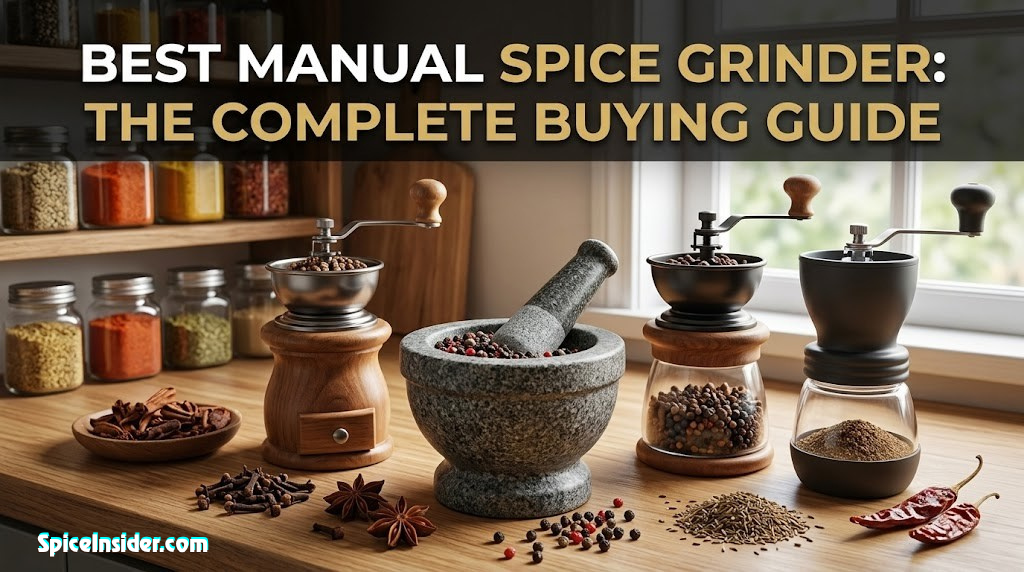
Best Manual Spice Grinder: The Complete Buying Guide
No motor, no batteries, no shortcuts — just real control over how your spices taste. Here’s how to pick the manual grinder that actually fits the way you cook.

There’s a specific kind of disappointment that comes from opening a jar of pre-ground cumin and getting almost no smell at all. That dusty, flat aroma is the reason so many home cooks eventually go looking for a manual spice grinder instead of relying on store-bought powders. Grinding whole spices yourself, right before they hit the pan, captures essential oils that start evaporating the moment a spice is crushed.
Manual grinders have quietly become the preferred tool for a lot of serious home cooks, and not just because of nostalgia for old-world kitchen tools. They give you direct control over texture, they don’t rely on a motor that can burn out, and they tend to outlast almost every electric grinder on the market. If you’ve already compared blades and burrs in our blade vs burr grinder for spices breakdown, you already know that grind mechanism matters as much as power source.
This guide walks through five of the best manual spice grinders on the market right now — from heavy-duty granite mortars to precision hand-crank mills — and breaks down exactly which one fits your cooking style, your kitchen counter, and your patience level. We’ll also cover the buying factors that actually matter, the materials worth paying for, and the small mistakes that wear out even a well-built grinder early.
For a wider view of the entire grinder category, including electric options, our best spice grinder hub page rounds up every style we recommend.
One thing worth saying upfront: shopping for a manual spice grinder online is genuinely harder than shopping for almost any other kitchen tool. Product photos rarely show scale, listings rarely mention the actual grinding mechanism inside, and “spice grinder” gets used loosely to describe everything from a stone bowl to a pepper mill with a fancy label. That ambiguity is exactly why we evaluated these picks against real cooking tasks rather than spec sheets alone — toasting and crushing cumin seed, working garlic and chili into a wet paste, cracking whole peppercorns at the table, and running each unit through several cleaning cycles to see how the materials actually held up over repeated use.
We also paid close attention to something that rarely shows up in marketing copy: how a grinder behaves when it’s not being used. Does the lid seal well enough to sit in a cabinet without leaking grit? Does the wood swell or warp if it’s stored near a stove with ambient humidity? Does the stone start to look stained and dingy after a few weeks of turmeric and paprika? These are the details that separate a grinder you’ll still be using in five years from one that quietly migrates to the back of a cupboard after a few months.
If you’re brand new to this category, it helps to think of a manual spice grinder less as a single gadget and more as a small family of tools that solve overlapping but distinct problems. A mortar and pestle solves the “I need a paste, not a powder” problem. A hand-crank mill solves the “I need this exact same fine texture every single time” problem. A ratchet grinder solves the “I’m doing this at the table, with one hand, mid-meal” problem. None of them is a strictly superior version of the others — they’re specialized, and the rest of this guide is built around helping you match the tool to the task rather than chasing a single “best” answer that doesn’t really exist.
Why Go Manual? The Real Advantages
It’s easy to assume manual tools exist purely as a budget alternative to electric ones, but that’s not really accurate here. A well-made manual spice grinder offers a few genuine advantages that have nothing to do with price, and a couple of them only become obvious once you’ve used one for a few months.
Grind Control You Can Feel
With a motorized grinder, you’re guessing at texture based on how long you hold a button down. With a manual mill or mortar, you feel the resistance change as spices break down, and you can stop the instant you hit the texture you want — whether that’s a rough crack for a steak crust or a fine dust for a curry base. This tactile feedback loop is honestly the single biggest reason serious cooks gravitate toward manual tools. There’s no screen, no timer, no overshooting a fine grind into a scorched-tasting dust because the motor kept running for two extra seconds.
This becomes especially noticeable with spices that don’t grind evenly to begin with. Whole cloves, for example, have a hard stem and a softer bulb, so an electric blade tends to pulverize the bulb into dust while the stem survives mostly intact. A manual mill or mortar lets you apply graduated pressure and work through that unevenness by feel, rather than relying on raw speed to brute-force a consistent result.
No Batteries, No Burnout
Electric grinders are convenient until the motor overheats from grinding something too hard, too dry, or for too long. We’ve covered this exact failure point in our piece on spice grinder motor burning smell. A manual unit has no motor to fail in the first place, which is part of why cast iron mills and stone mortars can realistically last for decades rather than years. It’s also worth pointing out that a manual grinder doesn’t care if the power goes out, doesn’t need a battery replacement at an inconvenient moment, and doesn’t slowly lose torque the way some cordless electric models do as their battery ages.
Better for Pastes, Not Just Powders
A mortar and pestle in particular can do something no mechanical mill can: turn garlic, ginger, chilies, and whole spices into a cohesive paste rather than a dry powder. That’s essential for a huge range of global cuisines, from Thai curry pastes to Indian masalas to North African chermoula. The pounding-and-grinding motion of a pestle bruises cell walls in a way that releases aromatic oils gradually, rather than shredding them all at once the way a fast-spinning blade does. Many cooks who’ve used both report a noticeably rounder, more layered flavor from a hand-pounded paste compared to the same ingredients run through a food processor.
Quieter Kitchens, Smaller Footprint
It’s a small thing, but worth naming: a manual grinder makes essentially no noise beyond the mechanical click or grind itself, and it doesn’t need a dedicated outlet, a charging dock, or a designated spot near a plug. For small kitchens, RVs, or anyone who cooks early in the morning without wanting to wake the rest of the house with a buzzing motor, that quietness is a real, practical benefit rather than a nostalgic one.
Types of Manual Spice Grinders
Not every “manual spice grinder” works the same way. Before comparing specific products, it helps to understand the three main mechanical categories you’ll run into while shopping, because the category matters more than the brand name when it comes to picking the right tool.
Mortar and Pestle Sets
The oldest and most versatile option, and arguably the original spice grinder, predating mechanical mills by thousands of years. A heavy bowl (the mortar) paired with a club-shaped tool (the pestle) lets you crush, grind, and mash through direct pressure and rotation. These work for whole spices, pastes, and even guacamole or pesto. The defining trait of a good mortar and pestle is mass — the heavier and more stable the base, the less energy you waste fighting the bowl instead of the ingredients inside it. Material also plays a bigger role here than with mills, since the mortar’s interior surface texture directly affects how quickly spices break down.
Hand-Crank or Ratchet Mills
These look similar to a pepper mill but are built specifically for hard spices like peppercorns, coriander seed, or whole allspice. A grinding mechanism — usually ceramic, carbon steel, or cast iron — sits inside a turning or ratcheting head. The spices sit in a hopper above the mechanism and feed down by gravity as you turn or squeeze, getting sheared between two textured surfaces rather than crushed under weight. This produces a more uniform texture than a mortar typically can, which is why mills tend to be the better choice when consistency matters more than versatility.
Adjustable Burr Grinders
A step up from basic mills, these include a dial that changes the gap between grinding burrs, letting you switch from a coarse cracked texture to a fine powder using the same unit. This adjustability comes from a threaded mechanism at the base or top of the mill that physically moves one burr closer to or further from the other. The tradeoff is usually a bit more mechanical complexity, which can mean more parts that eventually need cleaning or, in rare cases, replacing.
Specialty and Hybrid Designs
A handful of manual grinders blend categories — for instance, a mortar-shaped base with a built-in grinding wheel, or a mill with a wide enough chamber to double as a small mortar for light crushing. These hybrids can be convenient if counter space is extremely limited, but they rarely outperform a dedicated tool at either job. If you only have room for one item, a quality mortar and pestle is usually the more flexible single purchase, since it can approximate a coarse grind even though it can’t replicate a mill’s fine, even texture.
Our Top 5 Manual Spice Grinder Picks
We looked at build material, grind consistency, ease of cleaning, and long-term durability to narrow this down to five standout options. Each one serves a slightly different cooking style, so read through the use cases rather than just picking the highest-rated.
1. ChefSofi Mortar and Pestle Set

The ChefSofi set is a heavy, unglazed granite mortar and pestle built for serious daily use rather than decorative display. The rough interior surface is what makes granite mortars effective — it creates the friction needed to break down whole spices, garlic, and fibrous herbs without needing excessive force.
What stands out most is the base weight. A wobbly mortar fights you every time you apply pressure, but this one stays planted on the counter through repeated grinding and crushing. It’s equally comfortable making a rough black pepper crust for steak or working spices down into a fine curry paste base.
In day-to-day use, the bowl depth turns out to matter just as much as the weight. A shallow mortar lets ingredients escape over the rim the moment you apply real pressure, which is a frustrating, messy problem with smaller or cheaper sets. The ChefSofi’s deeper bowl keeps garlic cloves, chili flakes, and toasted seeds contained even when you’re leaning into the pestle with some force, which is exactly when a shallow bowl tends to fail you.
The pestle itself has a comfortable, slightly bulbous head that distributes pressure across a wider surface than a thin, rod-like pestle would. That shape makes a real difference during longer grinding sessions — building a full batch of garam masala from whole spices, for instance, takes a couple of minutes of sustained work, and a poorly shaped pestle can leave your palm sore well before you’re done. This one doesn’t.
Where it’s genuinely best-in-class is paste-making. Crushed garlic and ginger release their oils almost immediately against the rough granite surface, and there’s enough surface area in the bowl to actually fold and re-crush ingredients rather than just mashing them in place. If you cook a lot of Southeast Asian or South Asian dishes that start with a pounded aromatic base, this is the texture and control a food processor simply can’t replicate.
Who Should Buy the ChefSofi Set
This is the right pick if pastes, marinades, and whole-spice crushing make up a meaningful part of your cooking, and if you have a permanent spot for it on the counter rather than needing to tuck it away in a drawer between uses.
Pros
- Heavy, stable granite base resists sliding
- Unglazed interior grips spices for faster crushing
- Works for pastes, not just dry powders
- No motor or moving parts to wear out
Cons
- Heavier and bulkier to store than a mill
- Slower for small, repetitive grinding tasks
- Stone can stain with strong spices like turmeric
2. Microplane Spice Mill

Microplane built its reputation on precision zesting tools, and that same engineering attention shows up in this spice mill. The stainless steel grinding mechanism produces a notably finer, more even texture than most hand-crank competitors, which matters a lot for spices like cinnamon or dried chili that tend to clump.
The compact clear chamber also lets you see exactly how much spice remains and roughly how fine it’s gotten, which removes a lot of the guesswork compared to opaque wooden mills.
The size is worth calling out specifically, because it’s genuinely one of the smallest dedicated mills in this category that doesn’t sacrifice grind quality to get there. That makes it a strong fit for kitchens where drawer space is tight, or for anyone who wants a second, dedicated mill just for a single spice — say, peppercorns at the table — without giving up much storage room. A lot of cooks end up keeping two or three of these around for exactly that reason: one for pepper, one for a favorite spice blend, one for dried chili flakes, all stored without needing a whole shelf.
Grinding action is a simple twist motion rather than a ratchet, which feels familiar if you’ve ever used a basic pepper mill. The resistance is consistent throughout the turn rather than getting harder near the end, which is a small but noticeable quality difference compared to cheaper mills that bind up as the hopper empties. Refilling is straightforward thanks to a wide-mouth top, though you do need to twist the base to open and close the dispensing mechanism, which takes a couple of uses to get used to.
The one real limitation is texture range. This mill is tuned for fine, even output, and while that’s exactly what you want for something like cinnamon or finely ground chili, it’s not the tool to reach for if you’re after a rough, cracked pepper texture for finishing a dish. For that kind of coarse control, the adjustable mills further down this list are the better fit.
Who Should Buy the Microplane Spice Mill
Choose this one if you mainly want a small, precise tool dedicated to a single spice or blend, and you consistently prefer a fine, dust-like texture over a coarse, cracked one.
| Feature | Detail |
|---|---|
| Mechanism | Stainless steel grinding mechanism |
| Best for | Fine, even powders (cinnamon, dried chili, peppercorns) |
| Chamber | Clear, see-through fill window |
| Cleaning | Wipe-clean, not dishwasher safe |
Pros
- Produces a very fine, consistent grind
- Compact and easy to store in a drawer
- Clear chamber shows fill level
Cons
- Not ideal for making wet pastes
- Smaller capacity than mortar-style tools
- Requires occasional disassembly for deep cleaning
3. Kuhn Rikon Performance Ratchet Grinder
Most hand-crank mills rely on a twisting motion, but Kuhn Rikon’s ratchet design uses a squeeze-and-release motion instead, similar to a one-handed pump. It sounds like a small difference, but it dramatically reduces hand fatigue if you’re grinding peppercorns at the table multiple times during a meal.
The ceramic grinding mechanism inside resists corrosion from acidic spices and stays sharp far longer than soft metal alternatives, which matters if this is going to see daily use rather than occasional holiday cooking.
The ratchet action deserves a bit more explanation, because it’s the feature that sets this grinder apart from nearly everything else in this list. Instead of rotating your wrist in a full circle the way you would with a traditional pepper mill, you squeeze the handle and release it, and an internal ratchet converts that motion into the rotation needed to turn the grinding burrs. For anyone with wrist strain, arthritis, or simply a dislike of repetitive twisting motions, this is a meaningfully more comfortable way to grind, especially if you’re doing it standing at the table in front of guests rather than prepping quietly in the kitchen.
It’s also genuinely fast. A few squeezes produce more output than the equivalent twisting motion on a comparable mill, which matters if you’re grinding a generous amount of pepper over a large dish or finishing several plates at a table setting. The tradeoff is that the mechanism is a bit more complex internally than a basic twist mill, which in theory means more components that could eventually wear, though the ceramic core is specifically chosen to resist the kind of corrosion and dulling that would shorten its life.
The adjustable dial at the base offers a genuinely useful range, from a coarse, visibly cracked texture good for finishing a steak, to a much finer grind suited to incorporating into a sauce or dressing. Adjustments are made by twisting the base ring, and the dial holds its setting reliably between uses rather than drifting, which is a complaint we’ve seen with cheaper adjustable mills.
Who Should Buy the Kuhn Rikon Ratchet Grinder
This is the strongest choice if you want a grinder for table-side use, especially if repetitive twisting motions bother your wrist, or if you simply want faster output per stroke than a standard hand-crank mill provides.
Pros
- Ratchet action reduces wrist strain
- Ceramic mechanism resists corrosion
- Adjustable grind setting at the base
- Comfortable for one-handed table use
Cons
- Ratchet motion takes a little practice
- Not designed for wet pastes
- Replacement parts can be harder to find
4. Zassenhaus Cast Iron Spice Grinder

Zassenhaus has been making grinding mechanisms since the late 1800s, and this cast iron model reflects that legacy of pure mechanical durability. The carbon steel burr inside is the same style used in their coffee mills, which means it’s engineered to handle genuinely hard materials without dulling quickly.
The wood housing has a classic look that doesn’t try to chase trends, and the adjustable grind dial at the base gives you real range, from a rough cracked texture to something close to a fine powder.
What separates this mill from most modern alternatives is the sheer mass and precision of the grinding mechanism itself. Burr mills built for coffee are engineered to handle a harder, more abrasive material than most spices, which means a coffee-grade burr dropped into a spice mill has a lot of headroom before it ever shows wear. Whole peppercorns, allspice berries, and dried juniper — some of the hardest things you’ll ever put through a manual grinder — barely register as a challenge for this mechanism.
The trade-off for that mechanical overbuild is weight and footprint. This is a noticeably heavier, taller mill than something like the Microplane, and the solid wood housing means it needs a bit more care than a stainless or plastic body would. Specifically, you don’t want to leave it sitting in direct sunlight for long periods, or near a stovetop where steam and heat cycle through regularly, since repeated humidity swings can eventually cause wood to crack or the joinery to loosen.
The grind adjustment dial sits at the base and uses a simple threaded mechanism to bring the burrs closer together or further apart. Unlike some adjustable mills where the dial feels vague or imprecise, this one has enough resistance in the threading that you can dial in a specific texture and trust that it’ll stay there through normal use, rather than drifting coarser or finer on its own after a few grinding sessions.
Who Should Buy the Zassenhaus Cast Iron Grinder
If your priority is sheer mechanical longevity and you regularly grind hard whole spices rather than delicate ones, this is the pick that’s built to outlast almost anything else on this list, provided you’re willing to give the wood housing basic care.
| Feature | Detail |
|---|---|
| Burr material | Carbon steel, cast iron housing |
| Grind range | Adjustable, coarse to fine |
| Body | Solid wood exterior |
| Best for | Hard spices like peppercorns, allspice, coriander |
Pros
- Carbon steel burr handles hard spices well
- Wide adjustable grind range
- Classic build quality meant to last for years
Cons
- Pricier than basic plastic mills
- Wood housing needs to stay dry
- Bulkier than compact stainless mills
5. Granite Mortar and Pestle

If the ChefSofi set above feels like more mortar than you need, a standard granite mortar and pestle covers the same core use case at a lower price point and in a smaller footprint. It’s the option most often recommended for cooks who mainly want to crush garlic, toasted seeds, and small spice batches rather than process large volumes.
Granite remains the gold standard material here because it doesn’t absorb oils or odors the way porous stone or wood can, and it won’t crack under firm pressure the way some ceramic mortars eventually do.
Because “granite mortar and pestle” covers a wide range of products from different sellers, it’s worth knowing what to actually look for when browsing this category rather than treating every listing as identical. The interior surface should look genuinely rough and matte, not polished — a smooth, glossy interior looks nicer in photos but provides far less friction, which means more effort and more slipping while you grind. Run a finger across the bowl in product photos if you can; you want visible texture, not a mirror-like finish.
Size matters more than it seems like it should. A mortar that looks generously sized in a product photo can turn out to be barely large enough for a single clove of garlic and a pinch of peppercorns once it arrives. If you regularly make pastes in any real quantity — enough for a family meal, not a single serving — look for listings that specify bowl diameter and capacity in ounces or cups rather than relying on photos alone.
The other detail worth checking is base stability. Some budget granite mortars are cut with a slightly uneven base that causes a subtle rock or wobble on the counter, which becomes obvious and annoying the moment you apply real pressure with the pestle. Reviews that specifically mention stability are usually a more reliable signal than star ratings alone, since a five-star average can still hide this kind of inconsistency between batches.
Who Should Buy a Granite Mortar and Pestle
This is the right entry point if you want to try the mortar-and-pestle style of grinding without committing to a premium set, or if your kitchen genuinely doesn’t have room for a larger model like the ChefSofi.
Pros
- Affordable entry point into stone mortars
- Doesn’t absorb odors or oils
- Handles both pastes and whole spices
Cons
- Smaller capacity than premium sets
- Surface texture varies between sellers
- Heavier than it looks for its size
Side-by-Side Comparison
Here’s how all five picks stack up across the factors that matter most for everyday cooking.
| Product | Type | Best For | Grind Range | Maintenance |
|---|---|---|---|---|
| ChefSofi Mortar & Pestle | Stone mortar | Pastes & whole spices | Coarse to medium | Hand wash, may stain |
| Microplane Spice Mill | Hand-crank mill | Fine, even powder | Fine only | Wipe clean |
| Kuhn Rikon Ratchet Grinder | Ratchet mill | Table-side peppercorns | Adjustable | Wipe clean |
| Zassenhaus Cast Iron | Hand-crank mill | Hard whole spices | Coarse to fine | Keep dry, wipe only |
| Granite Mortar & Pestle | Stone mortar | Budget paste/crushing | Coarse to medium | Hand wash, may stain |
How to Choose the Right Manual Spice Grinder
The “best” manual spice grinder isn’t a single universal answer — it depends on what’s actually in your spice rack and how you cook. Walk through these questions before buying, and you’ll land on the right category far more reliably than by comparing star ratings alone.
1. Are you grinding mostly hard seeds or making pastes?
If your spice rack leans toward peppercorns, cumin, coriander, and allspice, a hand-crank or ratchet mill will serve you better. If you regularly make curry pastes, pesto, or guacamole, a mortar and pestle is the more versatile tool. Be honest with yourself here rather than buying for the cooking you imagine you’ll do — a beautiful mortar that sits unused because you actually just want consistent pepper at dinner is a waste of counter space.
2. How much counter or drawer space do you have?
Mortars are heavier and bulkier to store than slim hand-crank mills. If kitchen space is tight, a compact mill like the Microplane will fit more easily into a drawer. If you have a permanent spot on the counter near your prep area, a larger mortar becomes much more convenient, since the friction of having to dig it out of a cabinet every time is often what causes a great tool to go unused.
3. Do you want adjustable texture, or one consistent grind?
Adjustable mills like the Zassenhaus give you a dial to switch between coarse and fine. Fixed mills like the Microplane are built around one specific, very fine output. If you genuinely use a range of textures — coarse for finishing, fine for blending into a sauce — the adjustable option saves you from needing two separate tools. If you always want the same fine result, the simplicity of a fixed mill is one less thing to think about.
4. How often will you actually use it?
For daily, heavy use, invest in cast iron, ceramic, or stone — they’re built to handle repeated wear. For occasional use, a budget granite mortar or compact mill is plenty. There’s no real benefit to overbuying durability for a tool that comes out twice a year, just as there’s no benefit to underbuying for a tool you’ll reach for every single night.
5. Will more than one person in the household be using it?
This one rarely comes up in buying guides, but it matters. A ratchet mechanism like the Kuhn Rikon’s is noticeably easier for anyone with reduced grip strength, including kids learning to cook or anyone managing arthritis or wrist pain. A heavy stone mortar, by contrast, can be genuinely difficult for some people to use comfortably, since it depends on sustained downward pressure rather than a simple repeated motion.
Materials Explained: What Actually Matters
Marketing copy tends to throw around material names without explaining why they matter. Here’s the practical difference, and why the same word can mean very different quality depending on the listing.
Granite and Stone
Dense, non-porous, and naturally textured for grip. Granite mortars don’t absorb oils or smells the way wood can, which means garlic one day won’t bleed into cardamom the next. Not all “granite” listings are equal, though — some budget mortars are cast from a composite stone material rather than solid quarried granite, which can be lighter, less stable, and more prone to surface wear over time. Genuine solid granite has a noticeable heft for its size; if a mortar feels surprisingly light, it’s worth double-checking what it’s actually made from.
Cast Iron and Carbon Steel
Found inside hand-crank mills, these mechanisms resist dulling far longer than soft aluminum or plastic burrs. They’re the reason heritage brands like Zassenhaus can sell mills designed to last for decades. The downside is weight and, occasionally, a need to keep the mechanism dry, since carbon steel can develop surface rust if it’s left damp after grinding something with residual moisture.
Ceramic Mechanisms
Increasingly common in modern mills because ceramic resists corrosion from acidic or oily spices and holds an edge well without rusting, unlike some uncoated steel parts. Ceramic burrs are also generally lighter than cast iron equivalents, which is part of why ratchet-style mills like the Kuhn Rikon can use a lighter, more ergonomic housing without sacrificing grinding performance.
Stainless Steel
Common in compact mills like the Microplane, stainless steel mechanisms are lightweight, resist corrosion well, and are generally easier to clean than cast iron, since there’s no risk of surface rust if a little moisture gets in. The tradeoff is that stainless burrs can dull slightly faster than cast iron or ceramic when used constantly on very hard spices, though for typical home use this difference is unlikely to matter within any reasonable ownership period.
Wood Housings
Mostly cosmetic and ergonomic rather than functional for grinding itself, but wood housings need to stay dry to avoid warping or cracking over time. A light coat of food-safe mineral oil applied every few months can help keep wood from drying out and cracking, particularly in kitchens with a wood-burning stove, gas range, or otherwise dry ambient air.
Care and Maintenance Tips
A manual grinder’s biggest advantage — no motor — also means there’s less to maintain. But a little care goes a long way toward keeping grind quality consistent and extending the life of the mechanism or stone surface for years rather than months.
- Never submerge wood-housed mills in water; wipe the exterior with a barely damp cloth instead.
- Run a small handful of dry rice through hand-crank mills occasionally to absorb leftover oils and odors — see our full method in how to get smell out of a spice grinder using rice or bread.
- Stone mortars can be scrubbed directly with water and a stiff brush since there’s no mechanism to damage.
- Avoid grinding wet, oily, or sticky ingredients in mechanical mills — they’re built for dry, hard spices.
- Let a mortar fully air-dry before storing it, since trapped moisture against stone can encourage mildew in a sealed cabinet over time.
- If a mill mechanism starts turning more stiffly than usual, that’s often the first sign it needs a cleaning cycle rather than a sign of mechanical failure — don’t force it.
- If you’re unsure whether your unit can go anywhere near a sink, check our breakdown on can you wash a spice grinder before testing it yourself.
It’s also worth building a light maintenance habit rather than waiting for a problem to show up. A quick rice-and-bread cleaning cycle once every few weeks for a mechanical mill, and a rinse-and-dry routine after any particularly oily or pungent ingredient for a mortar, keeps both tool types performing the way they did on day one. Skipping this for months at a time is usually what leads to the stuck mechanisms, lingering odors, and stained stone that eventually push people toward troubleshooting guides instead.
For a deeper full-process walkthrough that covers every grinder type, our dedicated guide on how to clean a spice grinder and the odor-specific advice in how to clean spice grinder odor removal are both worth bookmarking.
Common Mistakes That Shorten a Grinder’s Life
Most manual grinder problems aren’t manufacturing defects — they’re avoidable habits that quietly cause damage over weeks and months rather than all at once. A few of the most common ones:
- Overfilling the chamber. Packing a hand-crank mill too full puts excess strain on the mechanism and produces uneven grinding, since spices near the bottom get pulverized while spices near the top barely move.
- Forcing a jammed mill. If turning suddenly feels stuck, stop. Forcing it can damage the burr permanently — our guide on a spice grinder lid stuck covers safe ways to free it.
- Grinding spices with leftover moisture. Damp seeds gum up mechanisms and lead to clumping instead of a clean powder, and the residue can be genuinely difficult to fully clean out afterward.
- Ignoring an inconsistent grind. If your output is regularly chunky or inconsistent, don’t just live with it — our troubleshooting piece on spice grinder not fine enough walks through the likely causes.
- Storing a damp mortar in a sealed cabinet. Stone holds onto moisture longer than it looks like it should, and trapping that moisture against a wooden shelf or inside a closed drawer can lead to mildew smell over time.
- Using metal utensils to scrape a stone mortar clean. A metal spoon or knife can scratch the interior surface and create rough spots that trap residue more stubbornly than the original texture did.
For a complete reference list, our spice grinder dos and don’ts guide collects every major mistake worth avoiding in one place.
Manual vs Electric: Which Should You Actually Buy?
It’s worth being honest here: manual grinders aren’t strictly “better” in every scenario, just better suited to certain habits. Plenty of excellent home cooks use both, switching between them depending on the task at hand rather than treating it as an either-or decision.
| Factor | Manual Grinder | Electric Grinder |
|---|---|---|
| Control over texture | Excellent, felt in real time | Limited, time-based guessing |
| Longevity | Very high, no motor to fail | Lower, motor can burn out |
| Speed for large batches | Slower | Faster |
| Power source needed | None | Battery or outlet |
| Noise | Minimal, mechanical only | Noticeable motor whine |
| Best use case | Daily, controlled grinding | Quick, large-volume jobs |
The practical answer for most kitchens is that a manual grinder makes sense as the primary daily tool, especially for pepper, small spice batches, and pastes, while an electric grinder earns its place for bigger jobs — grinding a large batch of toasted spice blend for the freezer, for instance, where speed actually matters more than tactile control. If you only have room or budget for one, the use-case questions in the buying guide above should point you toward the right single purchase rather than leaving you to default to whichever looks more impressive in a kitchen showroom.
If you’re still weighing this decision, our full breakdown in blade vs burr grinder for spices goes deeper into mechanism-level differences that apply to both manual and electric models.
Choosing a Manual Grinder Based on How You Cook
Beyond the general buying questions above, it helps to think about your grinder choice in terms of the actual cuisines and dishes you cook most. Different cooking traditions lean on noticeably different grinding techniques, and matching your tool to that tendency will save you from buying something that looks great but never quite fits your routine.
If You Cook a Lot of Indian or South Asian Food
Whole-spice roasting and grinding is central to dishes built around garam masala, sambar powder, or a fresh curry base, and a sturdy mortar and pestle or a heavy-duty mill handles both whole-spice grinding and wet masala paste duty. Our dedicated guide on the best grinder for Indian spices goes deeper into this specific use case if it matches your kitchen.
If You Cook Mediterranean or Middle Eastern Food
Za’atar, dukkah, and many spice rubs in this tradition rely on a coarser, more textured grind rather than a fine powder, which makes a mortar and pestle or an adjustable mill set to a coarser setting the better fit over a mill tuned purely for fine output.
If You Mainly Want Table-Side Pepper and Salt
For this narrower use case, a dedicated ratchet or twist mill like the Kuhn Rikon or Microplane is more practical day to day than a mortar, simply because it’s faster, cleaner, and purpose-built for that single repetitive task.
If You Cook Southeast Asian Curries and Pastes
Thai, Vietnamese, and Indonesian curry pastes depend heavily on pounding lemongrass, chilies, garlic, and aromatics into a cohesive base, which is squarely a mortar-and-pestle job. A mechanical mill simply isn’t built to handle wet, fibrous ingredients the way a deep stone bowl can.
Frequently Asked Questions
What is the best manual spice grinder for everyday cooking?
For most home cooks, a hand-crank mill or a ratchet-style grinder offers the best balance of grind consistency and ease of use. A mortar and pestle set is the better pick if you regularly crush whole spices, make pastes, or want maximum control over texture rather than fine, uniform grounds.
Is a mortar and pestle better than a mechanical manual grinder?
It depends on the task. A mortar and pestle excels at crushing whole spices, making spice pastes, and releasing essential oils through bruising rather than slicing. A mechanical hand mill is faster for repetitive grinding jobs like peppercorns at the table, but it can’t replicate the paste-making versatility of a heavy mortar.
What material is best for a manual spice grinder?
Granite and unglazed stone mortars hold up best for heavy daily crushing because they resist staining and don’t absorb oils. For mechanical mills, cast iron or ceramic grinding mechanisms outlast steel blades when grinding hard spices like peppercorns, cumin seed, or whole cloves.
Are manual spice grinders better than electric ones?
Manual grinders give you more control over grind size, don’t rely on batteries or power outlets, and tend to last longer because there’s no motor to burn out. Electric grinders are faster for large batches but can overheat spices and dull their aroma. See our blade vs burr grinder comparison for a deeper look.
Can a manual spice grinder be used for coffee too?
Some hand-crank mills with adjustable burrs can technically grind coffee beans, but the flavor oils from coffee will carry over into future spice batches unless the unit is dedicated and cleaned thoroughly. We cover this in detail in can you grind coffee in a spice grinder.
How do I clean a manual spice grinder?
Most wooden and mechanical mills should never be submerged in water. Wipe out residue with a dry brush, run a handful of plain rice or stale bread through the mechanism to absorb oils and odors, then wipe the exterior with a barely damp cloth. Stone mortars can be scrubbed with water since they don’t have moving parts to rust. Full steps are in how to clean a spice grinder.
Why does my manual grinder leave chunky, uneven spice instead of a fine powder?
Uneven grinding is usually caused by an adjustment dial set too coarse, overfilling the hopper, or grinding spices that still have moisture in them. Toasting spices lightly beforehand helps them break down more evenly. See why does my spice grinder leave chunks for a full troubleshooting checklist.
Do manual spice grinders wear out or stop working?
Quality manual grinders with ceramic or stainless mechanisms can last for many years with basic care, but cheaper models with soft metal burrs can dull or seize over time. If yours feels stuck, check spice grinder lid stuck before assuming the mechanism has failed.
What’s the difference between grinding whole spices and buying pre-ground?
Whole spices retain their essential oils far longer than pre-ground versions, which start losing aroma and potency within weeks. Grinding just before use, even with a basic manual grinder, produces noticeably more vibrant flavor. Full comparison in grinding whole spices vs pre-ground.
Should I toast spices before using a manual grinder?
Toasting whole spices like cumin, coriander, or fennel seed in a dry pan before grinding brings out deeper aromatic compounds and makes brittle seeds easier to crush evenly. Let them cool fully before grinding, since warm spices can gum up a mechanical mill. Instructions in how to toast spices before grinding.
Is a heavier mortar and pestle always better?
Generally yes for stability. A lightweight mortar tends to slide or rock on the counter when you apply pressure, which makes crushing harder and less controlled. Look for a base-heavy design in dense stone, like granite, that stays put while you work.
What should I avoid doing with a manual spice grinder?
Avoid overfilling the chamber, forcing a jammed mechanism, submerging wooden or mechanical units in water, and grinding wet or oily ingredients that can gum up the gears. Our spice grinder dos and don’ts list covers the most common mistakes that shorten a grinder’s lifespan.
Final Thoughts
There isn’t a single “best” manual spice grinder — there’s a best one for how you actually cook. If your kitchen revolves around curry pastes, marinades, and crushed garlic, the granite mortars on this list will serve you longer than any mill ever could. If you mostly need fast, fine, repeatable grinding for table use, a ratchet or hand-crank mill like the Kuhn Rikon or Zassenhaus is the smarter buy.
Whichever style fits your habits, the underlying reason to go manual stays the same: fresher spice, more control, and a tool that doesn’t depend on a motor to keep working for years. For a full overview of every spice grinder we recommend, including electric picks, visit our best spice grinder hub page.
Ready to Upgrade Your Spice Game?
Our top overall pick, the ChefSofi Granite Mortar and Pestle Set, combines stability, versatility, and durability in one tool that earns its space on your counter.
Check ChefSofi Price on Amazon