How to Tell If Saffron Is Real: The Complete Buyer’s Test Guide
Seven kitchen-tested methods to spot fake saffron before it ruins your paella, your budget, and your trust in that “too good to be true” listing.


Why Saffron Fraud Is So Common
Saffron has been called the world’s most expensive spice for good reason. A single pound of genuine dried threads can require more than 70,000 hand-picked crocus flowers, each one blooming for just a week or two out of the entire year. That kind of scarcity drives prices into the hundreds of dollars per pound, and wherever a product commands that kind of premium, counterfeiters follow close behind. Saffron has quietly become one of the most adulterated food products on the planet, sitting alongside olive oil and honey on food-fraud watchlists compiled by researchers and customs agencies.
The fakes range from clumsy to genuinely convincing. On the clumsy end, you’ll find dyed corn silk, shredded paper, or safflower petals (sometimes sold outright as “Mexican saffron,” which is not saffron at all). On the more convincing end, unscrupulous sellers blend a small amount of real saffron with dyed plant fibers, coat threads in glycerin or vegetable oil to add artificial weight and shine, or use turmeric and food coloring to imitate saffron’s signature golden stain. Some operations even go so far as reusing spent saffron threads that have already given up their color and flavor in a previous dish, drying them, and reselling them as fresh.
The financial incentive is enormous. A vendor who dilutes a kilogram of real saffron with even 20 to 30 percent filler can sell the “stretched” batch at full price while multiplying their profit margin. Multiply that across an entire supply chain that often passes through several unregulated middlemen before reaching a retail shelf or an online marketplace listing, and it becomes clear why independent testing matters so much for anyone who cooks with saffron regularly rather than buying it once and hoping for the best. You cannot always rely on packaging claims, country-of-origin labels, or even price alone, because sophisticated counterfeiters price their fakes just below the going rate for real saffron specifically to look legitimate.
Food-fraud researchers who study spice supply chains consistently rank saffron near the very top of adulteration risk, right alongside olive oil, honey, and vanilla. What makes saffron particularly vulnerable is the sheer number of hands it passes through before reaching a home cook: farmers, local aggregators, exporters, importers, wholesalers, repackagers, and finally retailers or marketplace sellers. Any single link in that chain can introduce dilution, and because dried saffron threads all look roughly similar in a shipping bag, tampering can happen without any obvious visual change until the product is tested directly. This is very different from, say, a counterfeit handbag, where a fake is usually detectable through branding or stitching; saffron fraud is deliberately engineered to be invisible to casual inspection.
There’s also a historical dimension worth understanding. Saffron adulteration is not a new phenomenon born from online marketplaces; it dates back centuries. Medieval European guilds in cities like Nuremberg once enforced brutal penalties, including public burning of adulterated batches and heavy fines, specifically because saffron fraud was already a widespread problem in the 1400s. What has changed in the modern era is scale and distance. A shopper today is far more likely to be buying saffron shipped from overseas through a marketplace listing they cannot physically inspect beforehand, which is exactly why the at-home testing methods in this guide have become essential consumer skills rather than a niche curiosity.
The good news is that saffron’s chemistry makes it remarkably easy to test at home. The compounds responsible for its color (crocin), aroma (safranal), and bitterness (picrocrocin) behave in specific, observable ways when threads meet water, heat, or a pinch of baking soda. None of the tests below require lab equipment. All you need is a glass of water, your own senses, and about ten minutes. If you’re also shopping for other pantry staples, our guide to the best turmeric powder covers a spice that shares saffron’s golden reputation but a fraction of its price, which is exactly why turmeric is one of the most common saffron adulterants.
Real vs Fake Saffron: At a Glance
Before diving into the step-by-step tests, here is a quick reference table you can keep open on your phone while you’re standing in a spice shop or scrolling a marketplace listing.
| Characteristic | Genuine Saffron | Fake or Adulterated Saffron |
|---|---|---|
| Thread shape | Trumpet-shaped, flared at one end, thin and irregular | Uniform width, flat blades, or perfectly straight strands |
| Color | Deep red body with an orange to yellow tip | Uniform bright red or orange throughout, no color gradient |
| Water test | Slow, gradual golden-yellow bleed over 10-15 minutes | Instant, intense red bleed within seconds |
| Aroma | Sweet, hay-like, slightly metallic and honeyed | Little to no smell, or a chemical/dusty odor |
| Taste | Bitter, slightly medicinal, warming aftertaste | Bland, sweet, or artificially fruity |
| Texture | Brittle, snaps cleanly, slightly rough | Bendable, soft, waxy or greasy to the touch |
| Price | Consistently expensive, rarely discounted heavily | Suspiciously cheap for the stated weight |
Keep in mind that no single test is bulletproof on its own; a clever counterfeiter can fool one or two of these checks. That’s exactly why the rest of this guide walks through seven independent tests. Running even three or four of them together gives you a confidence level that’s hard to fake.
Think of these seven tests as layers rather than a single pass/fail checkpoint. A dyed corn silk fake might pass a casual visual glance under dim lighting, but it will almost certainly fail the water test within the first minute. A cleverly coated real-but-diluted batch might pass the smell test reasonably well, since some genuine saffron is actually present, but it will fail the texture test due to its greasy coating, or show a weaker-than-expected color bloom because the real saffron content has been stretched with filler. Layering tests this way closes the gaps that any individual method leaves open, and it takes less than fifteen minutes total once you’ve done it a couple of times.

Skip the guesswork on your next batch
See vetted, lab-tested saffron brands that consistently pass every test in this guide.
Shop Genuine Saffron on AmazonUnderstanding Saffron Grades and Origins
Part of learning to spot fake saffron is understanding what “real” actually looks like across different grades, because genuine saffron itself varies quite a bit depending on where it was harvested and how carefully it was processed. Saffron comes almost entirely from the dried stigmas of the Crocus sativus flower, and the major producing regions include Iran (which supplies the large majority of the world’s saffron), Spain, Kashmir in India, Afghanistan, Greece, Morocco, and small emerging producers elsewhere.
The ISO 3632 Grading System
Commercial saffron is graded using an international standard, ISO 3632, which measures three specific compounds using a spectrophotometer: crocin (color strength), picrocrocin (bitterness/flavor), and safranal (aroma). Based on these readings, saffron is sorted into Category I, II, III, or IV, with Category I representing the most potent, purest threads. Kashmiri Mongra and Iranian Sargol are two of the most prized Category I varieties, often called “negin” or “super negin” grade because the stigmas are cut cleanly without any of the yellow style attached.
Why Grade Matters for Authenticity Testing
Lower-grade genuine saffron, which includes some yellow style material or a higher proportion of broken threads, can sometimes look less impressive than a well-faked premium product. This is exactly the trap counterfeiters exploit: they know that a shopper expecting “perfect” uniform red threads may reject genuine, lower-grade saffron while accepting a dyed fake that looks more polished. Understanding grading helps you separate “this looks slightly less premium” from “this is not saffron at all.” If you want a deeper breakdown of trusted producers and grades, our roundup of the best saffron brands compares verified Category I options side by side.
It’s also worth noting that saffron is frequently confused with, or deliberately marketed alongside, other golden spices. Turmeric, for instance, produces a similar yellow stain in cooking but has an entirely different flavor profile, and some low-effort scammers will simply sell turmeric-dusted threads as “budget saffron.” If you’re curious how the two compare on flavor, cost, and use cases, it’s worth reading about turmeric powder as its own ingredient rather than a saffron substitute.
How Saffron’s Origin Affects What “Real” Looks Like
Because saffron is grown across several distinct regions, genuine threads can look and behave slightly differently depending on where they were harvested, and it helps to know what to expect from each before you assume something is fake.
Iranian saffron makes up the vast majority of global supply, and the prized Sargol and Negin varieties consist of pure red stigma tips with the yellow style trimmed away entirely. These threads tend to be shorter, deeply colored, and very consistent in width, which ironically means an Iranian Negin sample can look almost “too uniform,” so don’t mistake that particular uniformity for a red flag; context matters.
Spanish saffron, especially the La Mancha protected designation of origin, is typically sold with a bit more of the yellow style still attached, giving bundles a slightly more varied, textured look compared to trimmed Iranian Negin. Spanish saffron is also frequently sold in longer, less broken threads because of how it’s traditionally hand-sorted.
Kashmiri saffron (Mongra) is famous for an unusually deep, almost maroon-red color and a notably strong, more intense aroma than saffron from other regions, a difference attributed to Kashmir’s high-altitude growing conditions. Kashmiri saffron also commands one of the highest prices in the world, so listings claiming to be genuine Kashmiri Mongra at bargain prices deserve extra scrutiny.
Afghan and Greek saffron have grown rapidly in international reputation over the past decade, often earning high ISO 3632 scores that rival or exceed some Iranian grades, though they remain less familiar to many Western shoppers, which unfortunately makes buyers less equipped to judge authenticity by sight alone.
The 7 Home Tests to Verify Real Saffron
Each of the following tests targets a different physical or chemical property of genuine saffron threads. Work through them in order, starting with the free, instant visual check before moving on to the water-based tests, which take a bit longer but are the most reliable.
STEP 1Visual Inspection: Check Thread Shape and Color Gradient
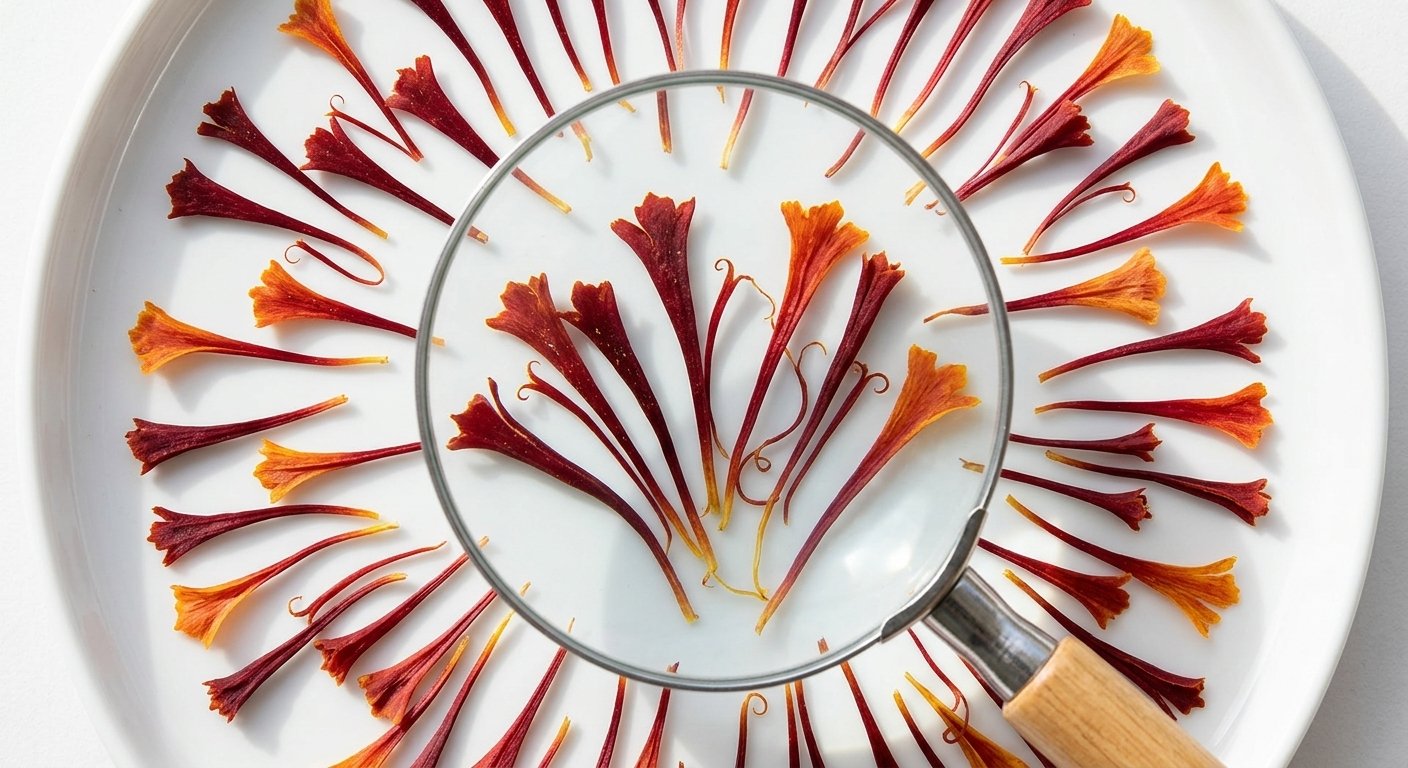
Start by pouring a small pile of threads onto a white plate or a sheet of white paper under good lighting. Genuine saffron threads are not uniform. Real stigmas are trumpet-shaped or funnel-shaped, narrow at one end and slightly flared at the other, where the stigma once attached to the flower’s style. The body of the thread should be a deep, almost brick-red color that gradually lightens to orange or pale yellow at the flared tip. This color gradient is one of the hardest things for a counterfeiter to replicate convincingly, because dyeing a fiber tends to produce uniform color from end to end.
Look closely for any threads that are perfectly straight, flat like a blade of grass, or identical in width to their neighbors. These are red flags for corn silk, shredded plastic, or paper strands, all of which have been used in documented saffron fraud cases. Also check for any yellow “style” threads mixed in; a small amount is normal and even expected in mid-grade saffron, but style material is duller and yellow, not red, so it shouldn’t be dyed to match the rest.
If the visual inspection leaves you uncertain, don’t treat that as a failure; treat it as a reason to move on to the water test next. Visual inspection is best used to catch obviously bad fakes quickly, not to render a final verdict, since photographs and even in-person glances can be deceiving under artificial lighting. A magnifying glass or your phone’s macro camera mode can help here, since it makes the trumpet shape and color gradient much easier to confirm than the naked eye alone, especially if your eyesight isn’t perfect or the lighting in the room is dim or yellow-tinted.
Step 2: The Cold Water Test
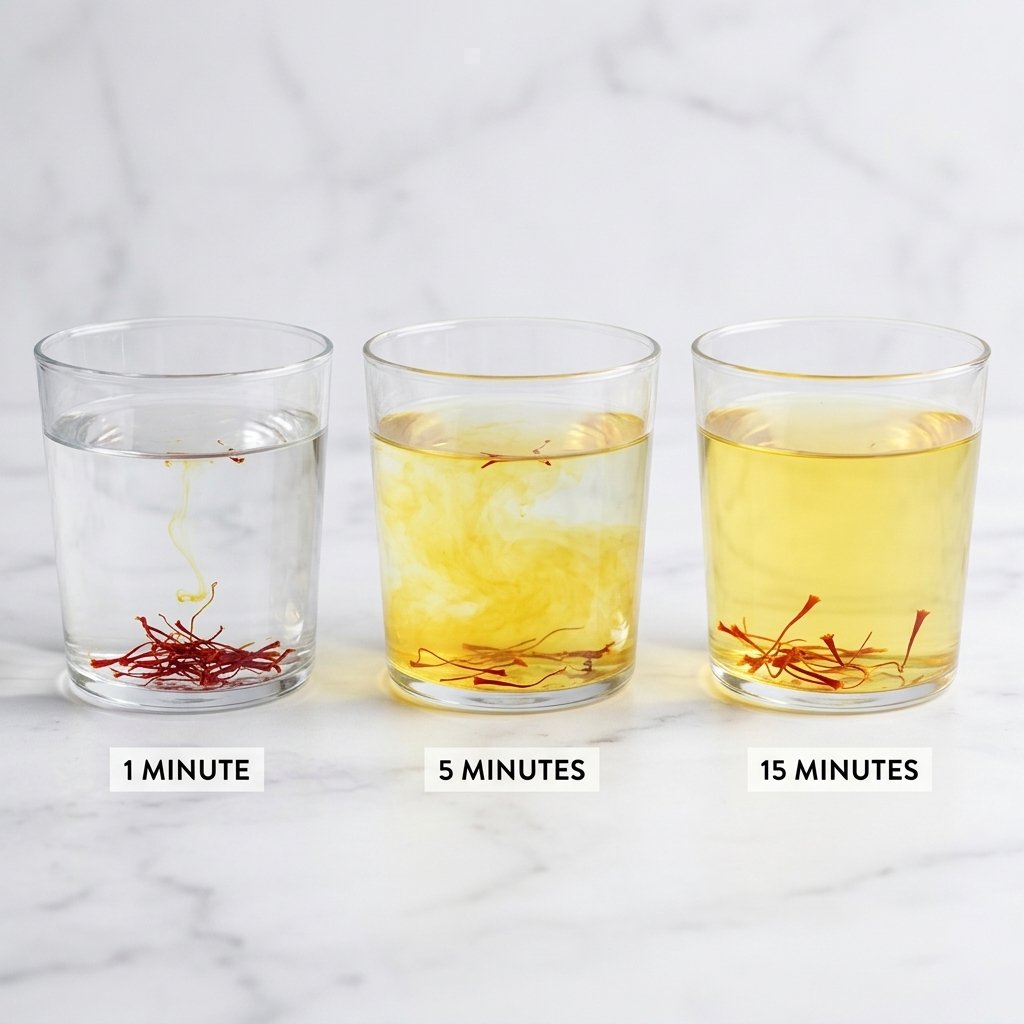
This is the single most popular home test, and for good reason: it’s fast, requires nothing but a glass of room-temperature water, and directly tests saffron’s most famous chemical property, its crocin-driven color release. Drop three to five threads into a small glass of cold or lukewarm water and simply watch, without stirring or disturbing the glass.
Genuine saffron releases its color slowly. You should see the water gradually turn a warm golden-yellow over the course of 10 to 15 minutes, with the threads themselves staying mostly intact and only slowly fading. If you’re testing real saffron, the threads will still be visibly red even after 15 minutes of soaking, because the compound responsible for the golden color, crocin, diffuses out gradually rather than dumping all at once.
Fake or dyed saffron behaves very differently. Threads made from dyed corn silk, paper, or plastic fiber will bleed color almost immediately, often turning the water a deep red or orange within the first 30 to 60 seconds. That instant, intense color release is the biggest tell in this entire guide, because it means the coloring agent is a surface dye rather than a compound diffusing from within a biological structure.
A useful nuance here: even genuine saffron threads will eventually turn the water a fairly deep gold if you leave them soaking for an hour or more, so the timing of the color release matters far more than the final intensity. If you’re unsure whether what you’re seeing counts as “slow” or “instant,” try timing it with your phone. Anything that noticeably tints the water within the first 60 seconds should be treated with suspicion, while a gradual build that’s still developing at the ten-minute mark is a good sign you’re working with the real thing.
Step 3: The Warm Milk or Warm Water Bloom Test
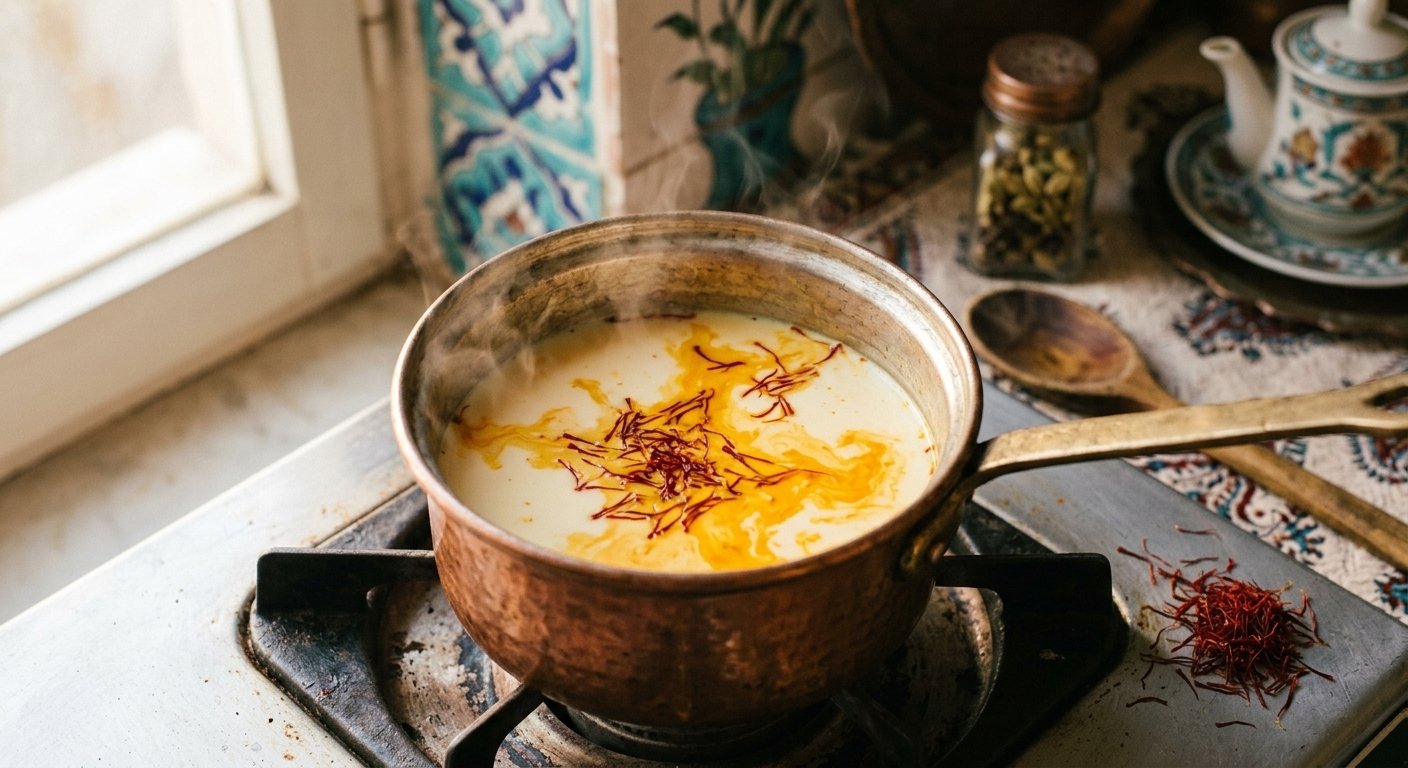
This variation on the water test is especially useful if you plan to use the saffron in a milk-based dish like a kheer, a saffron latte, or a rice pudding, because it tests exactly how the spice will behave in your actual recipe. Warm (not boiling) a small amount of milk or water to roughly 100 to 120 degrees Fahrenheit, just warm to the touch, and add a small pinch of threads.
Genuine saffron will slowly infuse the liquid with a soft golden-orange hue over 5 to 10 minutes, and you’ll typically notice the aroma reaching your nose before the color fully develops. Fake saffron, particularly threads dyed with synthetic food coloring like Sudan red or metanil yellow, will often produce an artificially vivid orange or red that looks almost neon compared to saffron’s naturally warm, slightly muted gold. If the color looks like it belongs on a highlighter rather than in a dessert, treat that as a serious warning sign.
Step 4: The Touch and Texture Test
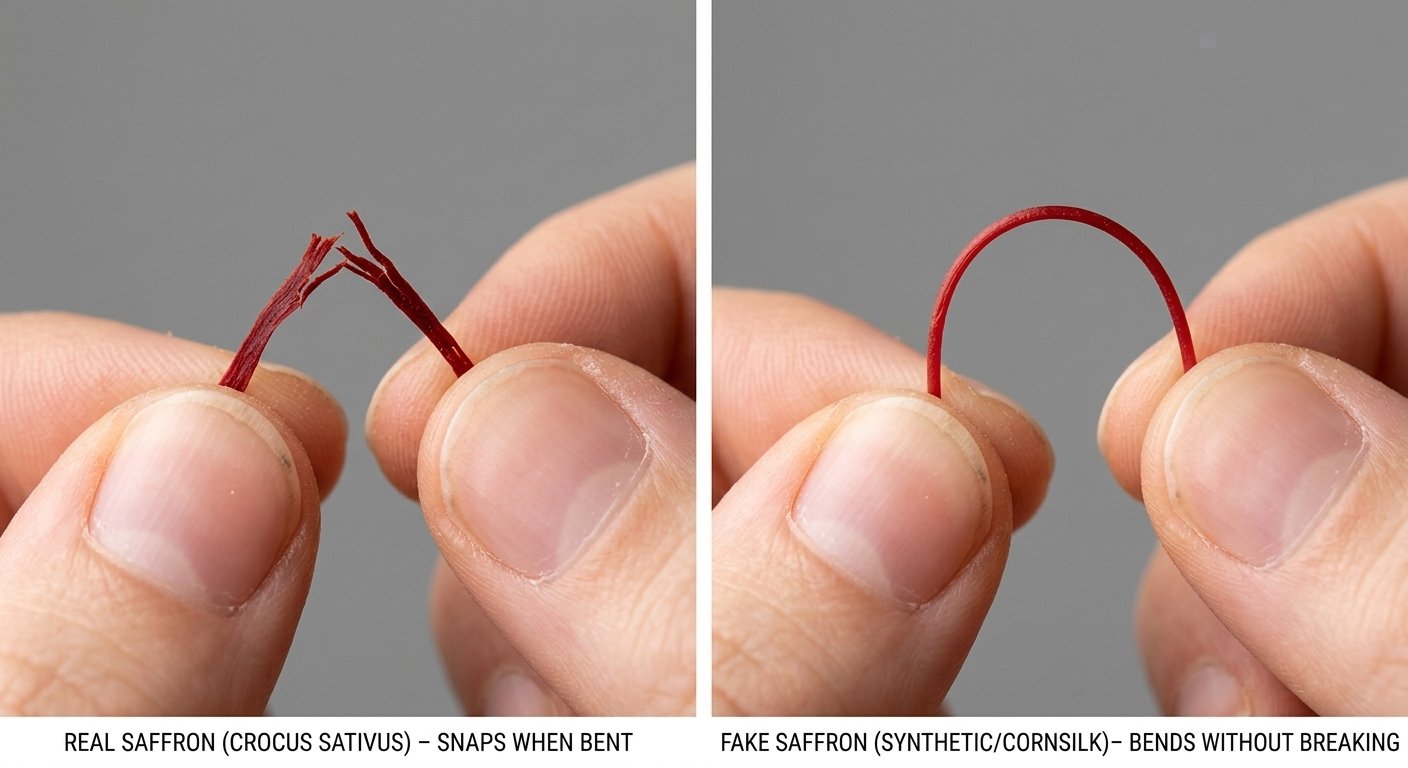
Properly dried, genuine saffron threads should feel dry, brittle, and slightly rough between your fingers, almost like a very fine dried herb. Take a single thread and gently try to bend it. Real saffron will resist bending and often snaps cleanly, or crumbles slightly, rather than folding smoothly like a piece of thread or yarn would.
Fake saffron, especially fiber-based counterfeits like dyed corn silk or synthetic thread, tends to feel noticeably softer and more flexible. It bends easily without breaking, almost like a piece of string, because it lacks the delicate, dehydrated cellular structure of a real dried stigma. Some counterfeiters also coat their threads in glycerin, vegetable oil, or honey to add weight (since saffron is often sold by weight, adding moisture-retaining coatings is a cheap way to inflate the sale weight) and to give threads an artificial shine. If your fingers come away feeling greasy or sticky after handling the threads, that’s a strong indicator of an oil or glycerin coating rather than pure dried spice.
Step 5: The Smell Test
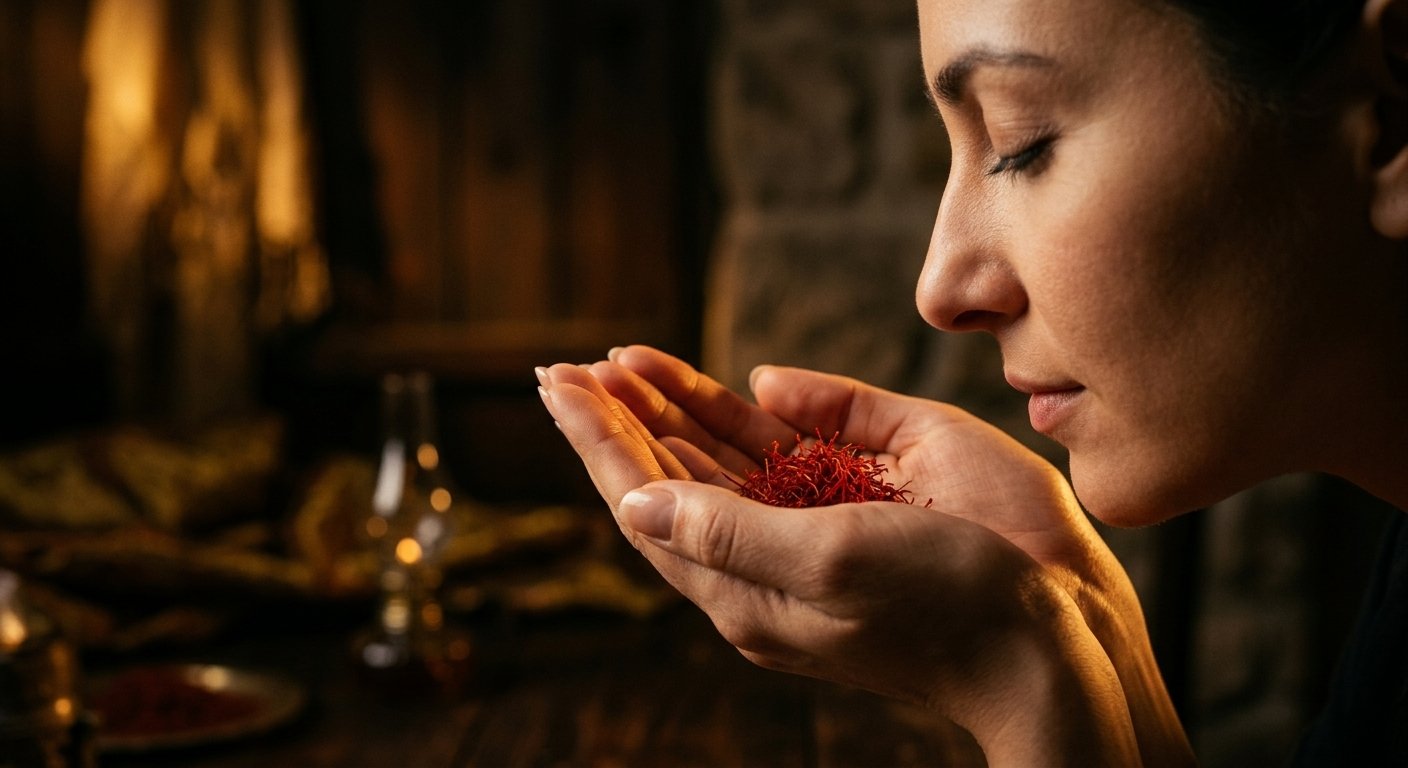
Your nose is a surprisingly reliable saffron detector. Genuine saffron has a distinctive aroma, often described as sweet, hay-like, slightly metallic, and honeyed, with a warmth that’s hard to mistake once you’ve smelled real saffron a few times. This scent comes primarily from safranal, a volatile compound that develops during the careful drying process saffron producers use.
Hold a small pinch of threads close to your nose and inhale gently. If you smell little to nothing, or if the aroma is faintly chemical, dusty, or musty rather than sweet and earthy, you’re likely holding a fake or a very old, degraded batch. Some low-quality fakes are scented artificially, but synthetic fragrances tend to smell “flat” or one-dimensional compared to the complex, layered aroma of real saffron, which shifts slightly as it warms in your palm.
For an even more sensitive version of this test, rub a thread gently between your fingertips for a few seconds to warm it slightly, then smell your fingers rather than the thread itself. Warming saffron releases its volatile aromatic compounds more readily, similar to how rubbing a fresh herb between your palms intensifies its scent. If your fingertips carry a lingering sweet, hay-like note after this, that’s a good sign; if they smell like nothing at all, or oddly like fresh paper or plastic, treat that as a meaningful red flag alongside your other test results.
Step 6: The Taste Test
Taste is one of the most decisive tests because it targets picrocrocin, the compound responsible for saffron’s characteristic bitterness, and it’s genuinely difficult for counterfeiters to replicate convincingly. Place a single thread on your tongue and let it sit for a few seconds without chewing. Genuine saffron should taste distinctly bitter, slightly medicinal, and leave behind a warm, lingering sensation, almost like a subtle heat that builds after a moment.
If the thread tastes sweet, bland, grassy, or oddly fruity, you are very likely tasting a plant fiber that has been dyed but carries none of saffron’s actual flavor compounds. Corn silk, in particular, tends to taste faintly sweet and vegetal rather than bitter. Some more elaborate counterfeits attempt to mimic bitterness using unrelated bitter compounds, but the specific warming, almost peppery aftertaste of real saffron is difficult to fake convincingly, especially when you’re paying close attention.
One important safety note: only ever taste-test a small, single thread, and avoid this test entirely if you suspect the sample might be a synthetic dye or an unknown chemical additive rather than a plant-based fake like corn silk or safflower. In most cases, home saffron counterfeits use food-grade dyes that are not acutely dangerous in the tiny quantity of a single thread, but if a listing or seller seems particularly suspicious, or if you’re testing saffron sourced from an unregulated market with no food safety oversight, it’s safer to rely on the water, smell, and baking soda tests instead and skip tasting altogether.
Step 7: The Baking Soda Chemical Test
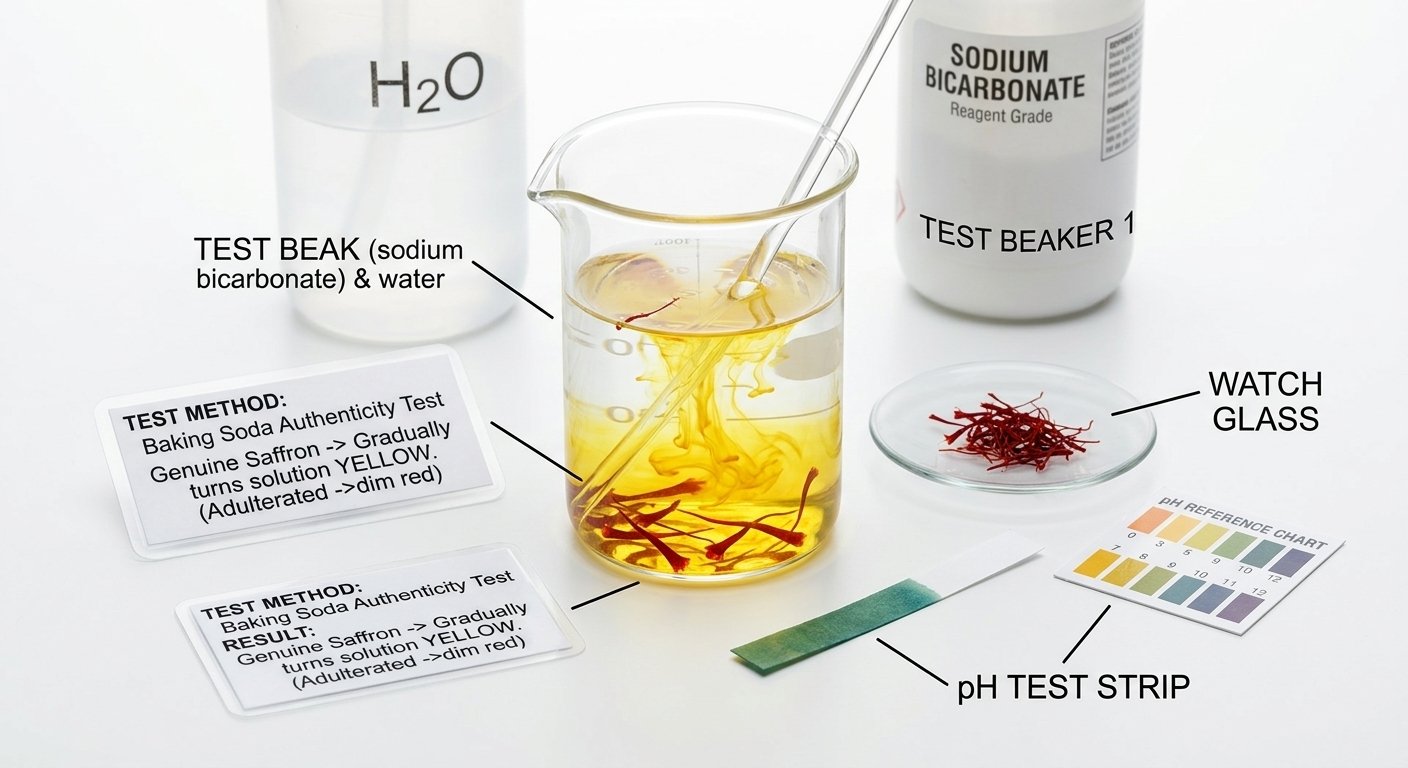
This final test is a favorite among more advanced home cooks because it goes a step beyond the simple water test and specifically checks for artificial dyes. Mix roughly one teaspoon of baking soda into a small glass of water, then add a few threads and let it sit for a minute or two without stirring.
Genuine saffron reacts with the baking soda solution to produce a rich yellow color, since crocin, saffron’s natural pigment, is sensitive to pH changes and shifts more toward yellow in an alkaline solution. If instead you see the water turn red, pink, or orange rather than yellow, that’s a strong sign you’re dealing with an artificial dye such as Sudan red, Congo red, or a similar synthetic colorant, none of which react the same way crocin does to alkaline conditions.
Common Saffron Adulterants and How to Spot Each One
Understanding exactly what fake saffron is usually made from makes every test above easier to interpret. Fraud investigators and food-science researchers have documented a fairly consistent list of substitutes over the years, and each has its own tell.
| Adulterant | What It Is | Biggest Giveaway |
|---|---|---|
| Dyed corn silk | Corn stigma fibers dyed red | Straight, flat strands; instant color bleed in water |
| Safflower (Mexican saffron) | Petals of the safflower plant, often labeled deceptively | No bitterness; sweet, hay-like but shallow aroma |
| Turmeric-coated fibers | Plant fiber dusted with turmeric powder | Yellow-orange dust rubs off on fingers; earthy turmeric smell |
| Dyed paper or plastic strands | Shredded, colored synthetic material | Doesn’t disintegrate or soften in water; no aroma at all |
| Glycerin/oil-coated real saffron | Genuine threads coated to add weight | Greasy feel; threads clump together; higher-than-normal weight for volume |
| Reused/spent saffron | Threads already used once, dried, and resold | Weak, slow color release; faded appearance; little aroma left |
Notice how many of these adulterants specifically target the tests that are easiest to skip, like a quick glance at color. That’s exactly why running the full sequence of visual, water, texture, smell, taste, and chemical tests together is so much more reliable than any single check. If you’re building out a broader spice pantry and want to compare other frequently-adulterated spices, our guides on smoked paprika and whole nutmeg cover two other spices worth buying whole and testing before you grind them.
It’s worth noting that saffron sold in powdered or ground form is far easier to adulterate than whole threads, simply because a fine powder hides its origin completely; there’s no thread shape to inspect, no trumpet tip to look for, and blending in cheaper ground fillers like turmeric, paprika, or annatto becomes trivially easy without any visible sign. For this reason, most experienced buyers strongly prefer whole threads over pre-ground saffron powder whenever authenticity is a concern, reserving powder purchases for well-established, reputable brands with a long track record and transparent sourcing. If you do need ground saffron for a specific recipe, it’s safer to buy whole threads you’ve already tested and grind a small amount yourself using a mortar and pestle just before use, which also preserves more of the aroma compounds that degrade quickly once threads are crushed.
Buying Saffron Online vs. Local Markets: Pros and Cons
Where you buy your saffron matters almost as much as how you test it. Both online retailers and local spice markets have distinct advantages and risks when it comes to authenticity, and the right choice often depends less on which channel is inherently safer and more on how much verification effort you’re willing to put in either way. A trustworthy corner spice shop with decades of reputation may be far safer than an anonymous online storefront with no track record, while a well-reviewed online retailer with published lab results can easily outperform an unlabeled bulk bin at an unfamiliar market. Rather than treating “online” and “local” as simple categories of trustworthy versus risky, think of them as two different verification workflows, each with its own strengths.
Buying Online: Pros
- Access to verified, lab-tested Category I brands
- Customer reviews often flag fake or weak batches quickly
- Easier to compare ISO grading and country of origin
- Return policies protect you if a test fails
Buying Online: Cons
- Cannot smell, touch, or inspect before purchasing
- Marketplace listings can be swapped by third-party sellers
- Stock photos may not match the actual product shipped
Local Markets: Pros
- You can smell and touch threads before committing
- Direct relationships with importers can build trust over time
- Immediate access, no shipping delays
Local Markets: Cons
- Bulk bins are often unlabeled by grade or origin
- Loose bins are easier to adulterate or mislabel
- No formal return or refund process if fake
Whichever route you choose, always run at least the water and taste tests before using a new batch in an important dish, especially the very first time you buy from a new seller or vendor you haven’t purchased from before. If you go the online route, sticking to sellers who publish ISO 3632 lab results, and cross-checking them against our vetted picks in the best saffron brands, dramatically reduces your risk.

Compare verified, lab-tested saffron
Check current listings and customer-verified saffron with transparent origin and grading information.
View ISO-Graded SaffronHow to Store Saffron So It Stays Genuine and Potent
Passing every authenticity test is only half the battle; saffron that starts out genuine can still degrade quickly if it’s stored poorly, losing the very aroma and color compounds you just verified. Light, heat, and humidity are saffron’s three biggest enemies. Safranal and crocin both break down under UV exposure and prolonged heat, which is why saffron sold in clear glass jars sitting in a sunny shop window is often noticeably weaker than the same batch stored properly.
Keep saffron in an airtight, opaque or dark-glass container, away from direct sunlight and heat sources like stovetops or windowsills. A cool, dark pantry shelf works well for short- to medium-term storage. For longer-term storage, some experienced cooks keep saffron in the freezer inside a well-sealed container to slow chemical degradation even further, though it’s important to let the container come to room temperature before opening it to avoid condensation. If you’re managing saffron alongside other bulk spices, our detailed guide on how to store bulk spices covers container choices and shelf-life expectations across an entire pantry, and our piece on how to label spice jars can help you track purchase dates so you always know how fresh your saffron really is.
Well-stored, genuine saffron can retain good potency for one to two years, though its aroma and color strength will slowly fade over time even under ideal conditions. If a batch that once passed all seven tests above starts producing a noticeably weaker color bloom or aroma months later, that’s usually just natural degradation rather than a sign the saffron was fake to begin with, so don’t confuse the two when troubleshooting.
Humidity deserves special mention because it’s the storage mistake most people overlook. Saffron threads are hygroscopic, meaning they readily absorb moisture from the air, and threads that pick up humidity can develop mold or simply clump together and lose their brittle texture, one of the very traits you rely on during the touch test. If you live somewhere humid, consider adding a small food-safe silica packet to your storage container, and always let the container cool fully after freezer storage before opening it, since opening a cold container in a warm kitchen invites condensation directly onto the threads. It’s also worth keeping saffron away from other strongly aromatic spices in your pantry; saffron’s delicate aroma compounds can be affected by nearby strong-smelling ingredients over long storage periods, so many dedicated cooks give it its own small, sealed tin rather than storing it in a crowded spice drawer alongside everything else.
Where to Buy Authentic Saffron
Once you know how to test saffron, the smartest move is simply reducing how often you need to. Sourcing from vetted, transparent sellers who publish grading information up front saves you the hassle of running these tests on every single purchase. Our team has done exactly that kind of vetting in our best saffron brands guide, comparing Category I options from Iran, Spain, and Kashmir on color strength, aroma, and independently verified lab results.
If you’re outfitting a broader spice cabinet at the same time, it’s worth reviewing complementary guides like the best vanilla bean brands for another premium ingredient prone to counterfeiting, or the best black peppercorns if you’re building out your whole-spice collection alongside your saffron purchase. Once your spices arrive, a good spice grinder or mortar and pestle ensures you’re getting the most flavor out of everything else in your pantry, even though saffron itself is almost always used whole rather than ground.
Red Flags to Watch for When Shopping Online
Since you often can’t smell or touch saffron before buying it online, it helps to know which listing details correlate most strongly with fraud, so you can filter out risky sellers before a package ever arrives at your door.
Unrealistically Low Prices
Genuine saffron simply cannot be produced cheaply given the labor involved in hand-harvesting flowers. A listing offering a large quantity of “premium” saffron at a fraction of typical market rates is one of the strongest fraud indicators available, and it should prompt real skepticism regardless of how professional the product photography looks.
Vague or Missing Origin Information
Reputable sellers are usually specific about origin, often naming a region like Khorasan (Iran), La Mancha (Spain), or Pampore (Kashmir) rather than a vague “imported” label. Sellers who avoid naming a specific growing region, or who change their stated origin between listings, are worth treating cautiously.
No Grading or Lab Information
Listings that mention ISO 3632 category or provide any lab testing documentation signal a level of transparency that low-effort counterfeit operations rarely bother with. The absence of grading information isn’t automatically proof of fraud, since many small, legitimate importers simply don’t test formally, but its presence is a strong positive signal worth favoring when comparing similar listings.
Stock Photos That Don’t Match Descriptions
Watch for product photos that look suspiciously like generic stock imagery rather than an actual photograph of the packaged product being sold, particularly on marketplace listings where third-party sellers can sometimes swap in cheaper alternatives behind an established, trusted product photo.
No Verified Purchase Reviews Mentioning the Water Test
Experienced saffron buyers frequently mention running exactly the kinds of tests covered in this guide within their reviews. A total absence of any reviews discussing color, aroma, or the water test, especially on a listing with hundreds of five-star ratings, can be a sign of review manipulation rather than genuine customer feedback.
Frequently Asked Questions
How can you tell real saffron from fake saffron quickly?
The fastest reliable check is the cold water test: drop a few threads into a glass of water and watch the color release. Genuine saffron bleeds color slowly over 10 to 15 minutes, while fake or dyed saffron colors the water almost instantly, usually within the first minute.
Does real saffron turn water red or yellow?
Genuine saffron turns water a warm golden-yellow, not bright red. If your water turns intensely red or orange within seconds, you’re most likely looking at a synthetic dye rather than saffron’s natural crocin pigment.
What does fake saffron smell like?
Fake saffron typically has little to no aroma, or occasionally a faint chemical, dusty, or musty smell. Real saffron has a distinctly sweet, hay-like, honeyed aroma that’s noticeable even before you open the container fully.
Is saffron supposed to taste bitter?
Yes. Genuine saffron has a distinctly bitter, slightly medicinal taste with a warm, lingering aftertaste, thanks to a compound called picrocrocin. If a thread tastes sweet, bland, or grassy instead, it’s likely not real saffron.
Why is saffron so expensive, and does price guarantee authenticity?
Saffron is expensive because each flower produces only three tiny stigmas that must be hand-harvested, and it takes tens of thousands of flowers to yield a single pound of dried threads. However, price alone doesn’t guarantee authenticity; some counterfeiters price fakes just below market rate specifically to appear credible, so testing still matters even for pricier purchases.
Can you tell fake saffron just by looking at it?
Sometimes, but not always. Uniform color, flat straight strands, or an unnaturally shiny/waxy surface are strong visual red flags. However, sophisticated fakes can look convincing at a glance, which is why visual inspection should always be paired with the water, smell, taste, or baking soda tests.
What is “Mexican saffron” and is it real saffron?
“Mexican saffron” is a common marketing name for dried safflower petals, which are not related to true saffron (Crocus sativus) at all. It shares a similar hay-like color when steeped but lacks saffron’s bitterness, aroma complexity, and price point, and is generally considered a mislabeled substitute rather than genuine saffron.
Does soaking saffron threads longer make fake saffron more convincing?
No. While longer soaking naturally deepens color for both real and fake saffron, the key difference is the speed of the initial color release, not the final result. A fake will still show that telltale instant burst of color in the first 30 to 60 seconds, even if you continue soaking it afterward.
How much real saffron should I use per dish?
Because genuine saffron is so potent, most recipes call for a small pinch, roughly 15 to 20 threads, per 4 to 6 servings. If a recipe calls for tablespoons of saffron to achieve color, that’s often a sign the “saffron” in question is heavily diluted, adulterated, or actually a substitute spice.
Can old saffron fail these tests even if it’s genuine?
Yes. Saffron that’s several years old or was stored in heat and light will show a weaker, slower color bloom and a fainter aroma, even though it’s still technically genuine, just degraded. If a batch fails these tests only mildly, consider its age and storage history before assuming it’s fake.
Should I trust saffron sold as loose bulk material at spice markets?
Loose bulk saffron can absolutely be genuine, but it’s also easier to adulterate or mislabel than sealed, branded packaging with grading information. If you buy loose saffron, treat testing as mandatory rather than optional, and buy only a small trial amount first.
Is it normal for saffron to include some yellow threads?
Yes, a small amount of pale yellow “style” material mixed in with the red stigmas is normal, especially in mid-grade saffron, and is not itself a sign of fraud. What matters is whether that yellow material has been artificially dyed to match the red threads, which genuine style material never is.
Can I combine several of these tests, or should I only run one?
Always combine tests when possible. No single test is completely foolproof against a determined counterfeiter, but running the visual check alongside the water test and the taste test together makes it extremely difficult for a fake to pass every stage undetected, since each test targets a different physical or chemical property of the spice.
Does grinding saffron into powder make it harder to verify?
Yes, significantly. Ground saffron powder loses the visual thread shape entirely, which removes one of your easiest and fastest verification tools. Whenever authenticity matters, buy whole threads and grind only a small portion yourself right before use, ideally after you’ve already confirmed the threads pass the tests in this guide.