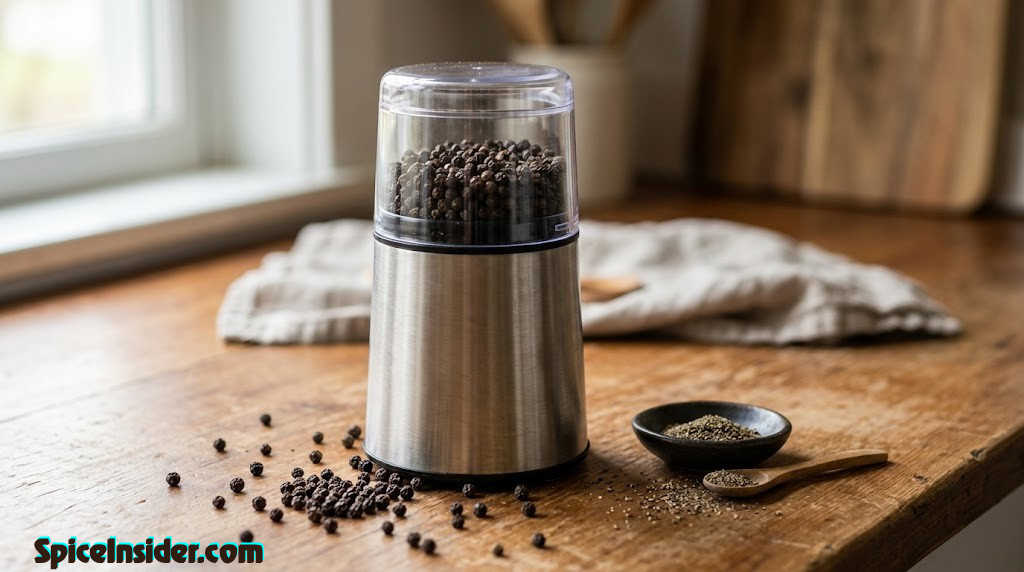
Fast.
Affordable.
Imprecise.
Spins a blade at high speed to chop spices into powder — quick, cheap, and everywhere.
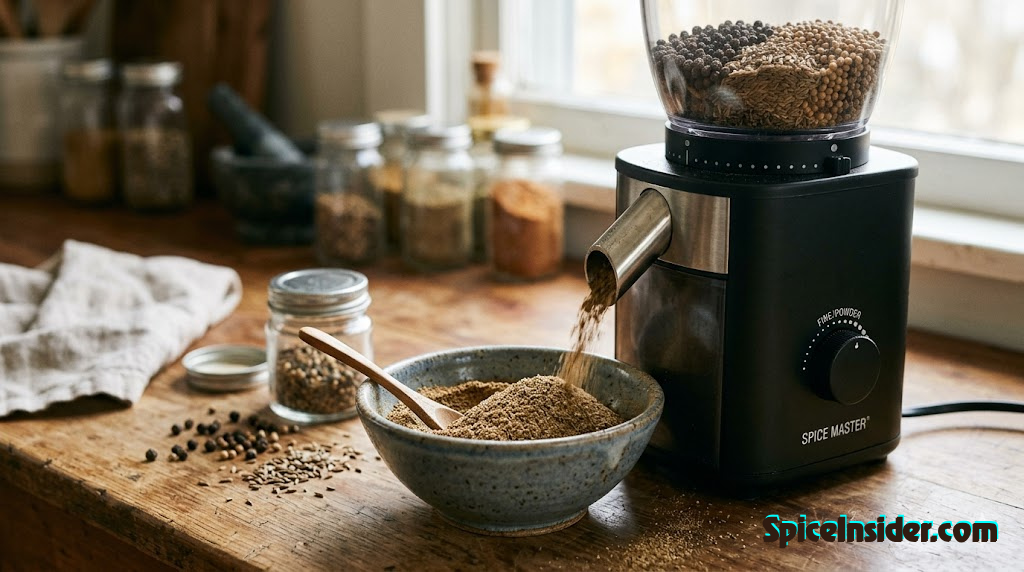
Precise.
Consistent.
Expensive.
Crushes spice between two abrasive surfaces for uniform particle size and better aroma.
Blade vs. Burr Grinder for Spices: The Complete Comparison
By the SpiceInsider Team | Comparison Guide | 16 min read
Why the Blade vs. Burr Question Actually Matters for Spices
Ask ten cooks which grinder to buy and you’ll get ten different opinions, often with surprisingly strong feelings behind them. That’s because the blade vs. burr debate isn’t purely technical — it touches on what you value in cooking: speed and convenience versus precision and quality, upfront cost versus long-term performance, simplicity versus control.
For coffee, this debate has largely been settled: serious coffee drinkers almost universally choose burr grinders for the grind consistency that espresso, pour-over, and French press each demand. But spices are different. The standards, the physics, and the use cases don’t map neatly from coffee onto spice grinding — and a lot of the blade-vs-burr advice online borrows uncritically from the coffee world without accounting for these differences.
This guide examines every meaningful dimension: texture quality, heat generation, aroma preservation, performance by spice type, cleaning burden, cost, and dual-use scenarios. We’ve laid it out so you can follow the comparisons that matter most to your kitchen and skip the ones that don’t. By the end, you’ll know exactly which type fits your cooking style — and which specific models are worth considering. The full list of our top-rated spice grinders covers both categories in detail.
📌 What This Guide Covers
This is a comparison article for people who already understand why fresh-ground spice matters. If you’d like a primer on that first, see our piece on grinding whole spices vs. pre-ground — it covers the science behind volatile oil release and why grind freshness affects flavor more than most cooks realize.
How Each Grinder Actually Works
The fundamental difference between a blade grinder and a burr grinder is the mechanism that reduces whole spice to powder — and that mechanism determines almost every performance characteristic that follows.
⚡ Blade Grinder
A rapidly spinning stainless steel blade (similar to a blender) chops and pulverizes spice through high-speed impact. The spice gets cut, flung against the walls, and cut again — repeatedly — until sufficiently reduced.
- Motor: 100–250W
- Speed: Very fast (10–30 sec)
- Contact: Blade edge + chamber wall
- Particle size: Variable (mix of fine + coarse)
⚙️ Burr Grinder
Two abrasive discs (burrs) rotate against each other. Spice is fed between the burrs and crushed uniformly as it passes through the gap — every particle experiences the same mechanical process.
- Motor: 100–300W (electric) or manual
- Speed: Slower (20–60 sec)
- Contact: Both abrasive surfaces
- Particle size: Highly uniform
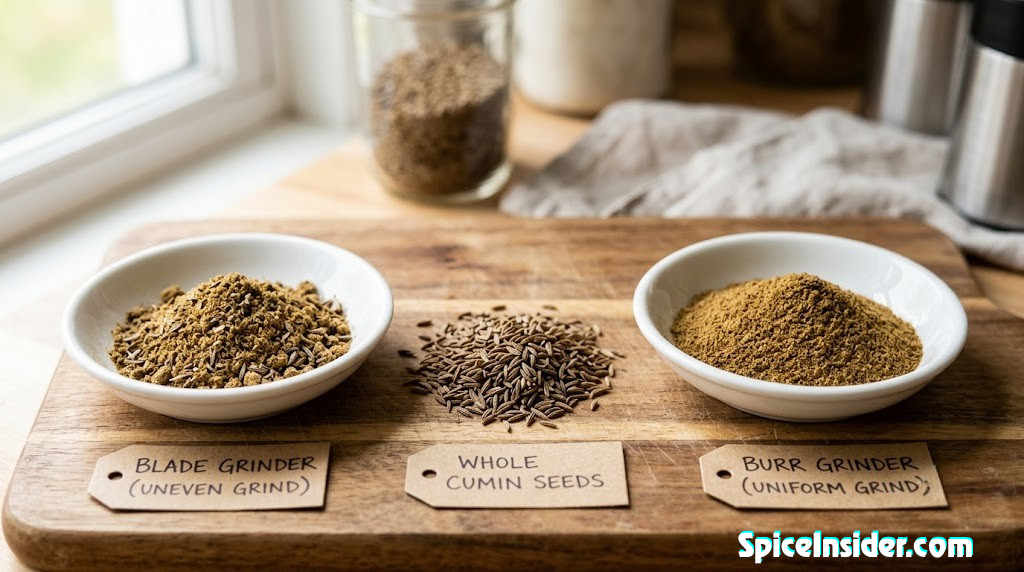
The practical consequence: a blade grinder produces a powder with a wide distribution of particle sizes — fine dust alongside larger broken pieces. A burr grinder produces powder where essentially every particle falls within a narrow size range. For cooking, this matters differently depending on what you’re making and which spice you’re grinding — which we’ll examine closely in the sections ahead.
Texture & Consistency — The Core Difference
Burr wins this categoryTexture consistency is where the burr grinder’s advantage is most tangible and least debatable. When a burr grinder is set to “fine,” it produces a uniform, siftable powder where every particle is approximately the same size. A blade grinder set to run for the same amount of time produces a mixture: some very fine powder, some medium pieces, and usually a few nearly-intact seeds that happened to avoid the blade.
For most everyday cooking — curries, dry rubs, marinades, and spice blends — this inconsistency is a minor inconvenience you can partially offset with technique. Pausing to shake the grinder, pulsing in short bursts, and sieving the output through a fine-mesh strainer all help compensate for the blade’s inherent randomness. For detailed blade grinder technique, our complete spice grinder guide covers every step.
For specific applications — baking (where texture in a spice cake or cardamom shortbread matters), delicate dishes like French cuisses de grenouille with fine pepper, or chai masala where fine powder dissolves seamlessly into milk — the burr grinder’s uniformity becomes genuinely worth the premium. It’s also the better choice for spices with naturally uneven structure, like star anise and cloves, where a blade grinder often leaves fragments.

Top-rated blade grinder with a dedicated spice bowl — our pick for the best value blade unit. See the full review.
Check on Amazon →Heat Generation & Aroma Preservation
Burr wins — but the gap is small for spicesThe burr-grinder camp frequently cites heat as a decisive argument: blade grinders generate more friction heat, which degrades the volatile aromatic compounds in spices before you even finish grinding. This is a real phenomenon — it’s the same reason coffee experts are particular about burr grinders for heat-sensitive single-origin beans.
For spices, however, the practical significance is smaller than it’s often made to sound. Two factors temper the heat argument:
First, most whole spices have been dried at temperatures far higher than any domestic grinder generates — the drying process itself is already a heat event. Second, the aromatic compounds in spices (terpenes, aldehydes, eugenol) are remarkably robust compared to coffee’s comparatively delicate aromatics. The brief heat spike from a 20-second blade grind rarely degrades quality in a way that shows up perceptibly in a finished dish.
The exception: spices with highly volatile oils that you’re grinding specifically to capture at peak potency — freshly ground cardamom for Turkish coffee, fine-ground long pepper for a delicate sauce, or single-spice grinding for direct table use. In these scenarios, the gentler crushing action of a burr grinder does preserve nuance you’d otherwise lose.
Which Spices Suit Each Grinder Type
The honest answer is that both types handle most common spices adequately — the differences emerge at the edges, with hard spices, oily spices, and fine-powder applications.
| Spice | Blade Result | Burr Result | Better Choice |
|---|---|---|---|
| Black Pepper | Good — fast, works well | Excellent — precise coarseness dial | ⚙ Burr for fine dining; ⚡ Blade for everyday |
| Cumin | Very good — soft seed grinds fast | Excellent — uniform powder | ≈ Either |
| Coriander | Good — slightly hollow, grinds easily | Excellent | ≈ Either |
| Cardamom | Good after removing husks | Excellent — fine, fragrant powder | ⚙ Burr (preserves delicate oils better) |
| Cinnamon Stick | Adequate — needs long run time, inconsistent | Very good — uniform fine powder | ⚙ Burr |
| Cloves | Adequate — very oily, coats blade heavily | Good — less residue on surfaces | ⚙ Burr (easier cleaning) |
| Star Anise | Decent — brittle, but leaves fragments | Very good | ⚙ Burr |
| Dried Chiles | Very good — fast, produces great flakes | Good — some models struggle with stems | ⚡ Blade |
| Fennel Seeds | Very good | Excellent | ≈ Either |
| Nutmeg (broken) | Poor — too hard, motor strain | Good — requires powerful model | Neither — use a microplane |
| Mustard Seeds | Good — small, bouncy; keep lid on tight | Very good | ≈ Either |
| Turmeric Root (dried) | Adequate — very hard, use small pieces | Good with high-powered model | ⚡ Blade (most burrs struggle) |
Cost, Durability & Long-Term Value
Blade wins on upfront costThis is the clearest categorical difference between the two types, and it’s substantial. Budget blade grinders — perfectly functional for everyday spice grinding — start around $15–$25. Mid-range dedicated spice blade grinders with better motors and removable bowls run $30–$55. Above that, you’re paying for a purpose-built spice burr grinder, which starts at roughly $60–$80 for entry-level options and can reach $150–$250+ for serious models.
⚡ Blade Cost Profile
- Entry level: $15–$25
- Mid-range: $30–$55
- Premium: $55–$80
- Simple motor — fewer failure points
- Blade sharpness degrades over years
- Low repair cost (usually replace full unit)
⚙️ Burr Cost Profile
- Entry level: $60–$90
- Mid-range: $100–$180
- Premium: $180–$300+
- More mechanical complexity
- Burrs last longer than blades
- Higher repair cost but longer lifespan
Durability is more nuanced. A well-made blade grinder like the Secura or Cuisinart SG-10 will last 5–10 years with proper use (never grinding wet spices, not overloading the motor). A quality burr grinder, with its ceramic or steel burrs, typically outlasts blades — but its gear mechanism and motor are more complex and can fail in ways that aren’t worth repairing on entry-level models.
For cooks who grind spices occasionally (a few times a week), a quality blade grinder offers substantially better value. For cooks who grind daily or need precise control for professional-grade cooking, the burr grinder’s performance justifies the price difference over a multi-year horizon.

Removable stainless bowl, 200W motor, and exceptional build quality for the price. One of our top blade picks — see the full Secura review.
See on Amazon →Cleaning & Maintenance
Blade easier for most usersBoth grinder types require cleaning between different spices to prevent flavor transfer. The mechanism, however, makes the cleaning experience quite different.
Blade grinders with removable bowls — like the Secura and Cuisinart SG-10 — are by far the easiest to clean. Lift the bowl out, wipe or rinse it, and you’re done. Models with fixed (non-removable) bowls require the rice-and-bread dry-cleaning method, which takes about two minutes and works very well. A complete guide to both approaches is in our article on how to clean a spice grinder, and the question of whether you can wash a spice grinder is addressed there in full.
Burr grinders have more surfaces, nooks, and mechanisms where spice residue can lodge. The burrs themselves accumulate powdered spice in their abrasive grooves, which requires a brush and more deliberate effort to clear. Some burr grinders have removable burr assemblies that can be rinsed, but many don’t. If you regularly grind strongly aromatic spices (cloves, star anise, cumin), a burr grinder can develop a persistent background note that contaminates subsequent grinds.
The rice-and-bread method works for burr grinders too, and the odor removal guide covers the full process. But the extra mechanical complexity of burr grinders makes thorough cleaning more effortful. If you’re fastidious about flavor purity between grinds, budget blade grinders with removable bowls arguably offer a cleaner setup than most burr grinders in the same price range.
Coffee Crossover: Using One Grinder for Both
Blade better for dual-useMany home cooks want a single grinder that handles both coffee and spices. This is a legitimate use case, and one where the two grinder types land in different positions.
Blade grinders — especially those with removable bowls — are relatively easy to clean between coffee and spice grinds. A rice-and-wipe cycle takes under two minutes and effectively removes most residual oils. The main concern is flavor transfer, which is manageable with regular cleaning. Our complete guide on grinding coffee in a spice grinder covers the transfer risks and mitigation techniques in detail. The rice and bread smell removal method is the most effective quick-clean approach.
Burr grinders present a more complex picture. Coffee burr grinders — which are far more common and better-value than dedicated spice burr grinders — can technically grind spices, but most coffee enthusiasts strongly discourage it. Spice oils are much heavier and more persistent than coffee oils, and they penetrate into the burr surfaces in ways that are very difficult to clean completely. If you do attempt it, use the rice method and accept some residual cross-contamination.
Full Scorecard: Blade vs. Burr
Who Should Buy Which — The Definitive Answer
⚡ Choose a Blade Grinder if…
- You cook at home 3–5 times a week and want fresh-ground spice without complexity
- Budget is a real constraint
- You also want to grind coffee with the same machine
- You don’t need precise texture control between coarse and fine
- You value easy cleanup above all else
- You grind predominantly “medium” spices (cumin, coriander, fennel, pepper)
- You already own a blade grinder and want to know if it’s “good enough” — it is
⚙️ Choose a Burr Grinder if…
- You cook seriously and texture consistency matters to your outcomes
- You regularly make spice blends for baking or delicate applications
- You want adjustable coarseness settings (coarse crack to ultra-fine)
- You grind high-oil spices (cardamom, long pepper, mace) where aroma matters most
- You’re comfortable with a longer cleanup routine
- You’re willing to spend $80–$150 on a dedicated spice tool
- Your cooking involves high-precision dishes where texture variation shows up
Top Picks in Each Category
If you’ve decided which type you want, here are the specific models we recommend — with context on why. Our full spice grinder buyer’s guide goes into much more detail on each, including in-depth individual reviews.
Best Blade Grinders for Spices
| Model | Bowl Type | Best For | Price Range |
|---|---|---|---|
| Cuisinart SG-10 | Removable stainless bowl | Everyday spice grinding, great overall | $30–$45 |
| Secura Electric Grinder | Removable bowl | Best value, strong motor, easy clean | $25–$38 |
| Hamilton Beach Fresh Grind | Fixed bowl | Budget pick, good motor, small footprint | $15–$22 |
| KRUPS GX5000 | Fixed bowl | Coffee + spice, reliable brand history | $20–$30 |
Best Burr Grinders for Spices
| Model | Burr Material | Best For | Price Range |
|---|---|---|---|
| Zassenhaus Manual Spice Mill | Hardened steel | Single-spice precision, quiet, portable | $60–$90 |
| Kuhn Rikon Spice Grinder | Ceramic | Adjustable coarseness, easy table-side use | $40–$65 |
| Baratza Sette (repurposed for spice) | Steel burrs | High-volume serious cooking, very consistent | $150–$250 |
| Peugeot Royan Spice Mill | Hardened steel | French craftsmanship, excellent black pepper | $70–$110 |

Blade and burr, electric and manual — our full buyer’s guide covers every category with hands-on analysis and ranked picks.
Browse on Amazon →Common Problems — And Which Grinder Type Is More Prone to Each
Understanding a grinder’s failure modes helps you maintain it better and know what to expect. Both types have characteristic problems, but they tend to appear in different circumstances:
⚡ Blade Grinder Issues
- Powder not fine enough — batch size too large or too few pulse cycles
- Chunks left in powder — spice not redistributed between pulses
- Motor burning smell — continuous run too long, especially on hard spices
- Lid stuck — pressure buildup or misalignment
- Blade dulling — normal after years of use, replace unit
⚙️ Burr Grinder Issues
- Burr clogging — oily spices (cloves) can gum burr grooves
- Inconsistent output — burrs need realignment or replacement
- Persistent odor — spice oils penetrate burr surfaces deeply
- Hard spice damage — forcing very hard spices can chip ceramic burrs
- Motor strain — small motors struggle with cinnamon, nutmeg
In both cases, the best maintenance practice is consistent cleaning after each use, never exceeding the manufacturer’s recommended load, and avoiding wet or moist spices entirely. Our complete spice grinder dos and don’ts guide covers maintenance practices for both types in detail. If you’re looking for a machine built to last, see our guide to grinders that don’t break.
Frequently Asked Questions
Verdict: Blade or Burr?
After examining every meaningful dimension — texture, heat, spice compatibility, cost, cleaning, and dual-use — the honest answer is that most home cooks are well-served by a quality blade grinder, and the additional investment in a burr grinder is genuinely worth it only for a specific type of cook: one who grinds daily, cares deeply about texture precision, and uses high-aromatic spices where the oil preservation advantage shows up in the finished dish.
If you’re in the majority — cooking at home several times a week, grinding a core set of spices like cumin, coriander, black pepper, and cardamom, and valuing simplicity and easy cleanup — the Cuisinart SG-10 or Secura grinder give you everything you need for under $40. Master the pulse technique (covered in our how to use a spice grinder guide) and you’ll consistently get results that genuinely compete with what a burr grinder produces.
If you’re leaning toward a burr grinder, go in knowing that the cleaning commitment is real, the price is significant, and the performance advantage is real but context-dependent. Either way, fresh-grinding your own spices from whole seeds puts you so far ahead of pre-ground that the choice between blade and burr is a second-order concern compared to simply grinding fresh. Explore our full best spice grinder picks to find the right fit.
See Our Top Grinder Picks →
A 200W blade grinder with consistent performance, a tight-sealing lid, and one of the best price-to-power ratios available. 30,000+ reviews don’t lie.
Check Price on Amazon →