
SpiceInsider · Coffee × Spice
Can You Grind Coffee in a Spice Grinder?
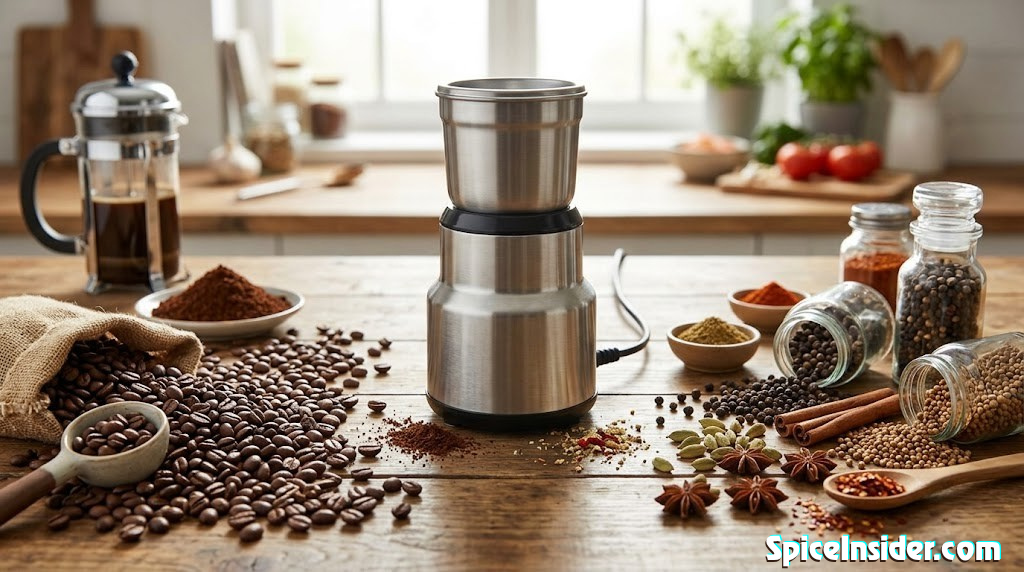
One machine, two aromatic worlds — here’s exactly how to navigate them
The Short Answer
Verdict
Yes — you can absolutely grind coffee beans in a spice grinder. The machines are mechanically nearly identical, the blades handle coffee beans comfortably, and the grind quality is sufficient for most everyday brewing methods. The one real challenge is flavor transfer in both directions, which is solvable with a disciplined cleaning protocol between uses.
This question comes up constantly among home cooks who own a blade spice grinder and either do not want to buy a second machine or simply want to know if the one sitting on their counter can pull double duty. The answer is yes — but the quality of the result and the success of the dual-use arrangement depend entirely on two things: understanding the flavor crossover risk, and building the right cleaning habit around it.
This guide covers every angle: the mechanical comparison between spice and coffee grinders, how flavor transfer actually works, which brew methods tolerate a blade grinder’s uneven output, the exact cleaning sequence to run before grinding coffee, and the specific spice-to-coffee combinations where a shared grinder genuinely makes sense. If you also want to understand how the overall grinder landscape shakes out, our best spice grinder guide evaluates top models with dual-use suitability as a criteria.
Spice Grinders vs. Coffee Grinders: Are They Actually Different Machines?
Walk into any kitchen retailer and you will find two nearly identical products sitting beside each other on the shelf: an electric coffee grinder and an electric spice grinder. Pull them off the shelf and compare them side by side. In most cases, the motor wattage is the same, the blade design is the same, the bowl material is the same, and the lid mechanism is the same. The difference is often nothing more than the label on the box and, occasionally, the color of the housing.
This is not coincidence. The major kitchen appliance brands — Cuisinart, Hamilton Beach, KitchenAid, and their equivalents across price tiers — have long manufactured these as a single platform and marketed them into two categories. The Cuisinart SG-10, for example, which we cover in our Cuisinart SG-10 review, is explicitly marketed for both spices and coffee and comes with two removable bowls for exactly that purpose.
☕ “Coffee Grinder” (blade)
- 250–300W motor typical
- Stainless steel blade, 2–4 wings
- Bowl capacity: 2–3 oz beans
- No grind adjustment dial
- Pulse or continuous operation
- Designed for coarse to medium grind
- Usually cheaper: $15–35
🌿 “Spice Grinder” (blade)
- 200–300W motor typical
- Stainless steel blade, 2–4 wings
- Bowl capacity: 70–85g
- No grind adjustment dial
- Pulse or continuous operation
- Capable of fine to very fine grind
- Usually $20–45; some with dual bowls
The practical upshot: if you own a blade spice grinder, you already own something mechanically equivalent to an entry-level blade coffee grinder. The crossover works in both directions. The question is only about the aromatic legacy each use leaves behind — which we will address thoroughly.
One meaningful difference does exist at the higher end of the market: burr grinders. Burr coffee grinders use two abrasive plates to crush beans to a specific, adjustable particle size — producing a consistency that blade grinders fundamentally cannot match. For specialty coffee, this distinction matters enormously. But burr spice grinders are rarer and more expensive, and the blade-style grinder that most home cooks own is the subject of this guide. If you are curious how those two grinding technologies compare specifically for spices, the full breakdown is in our blade vs burr grinder for spices comparison.
Where the machines do genuinely diverge is in bowl finish and interior coating. Some spice grinders use slightly rougher bowl interiors to help grip hard spices like cinnamon sticks and whole cloves. This rougher surface is exactly what accelerates the retention of aromatic oils — which is why some spice grinders, particularly those with plastic-lined bowls, hold onto spice smells more tenaciously than a stainless-steel coffee grinder bowl would. This is a meaningful cleaning consideration, explored in detail later.
The Flavor Transfer Problem — How Real Is It?
Flavor transfer is the central concern in dual-use grinding, and it is worth understanding properly rather than vaguely worrying about it. Spice aromas are carried by volatile organic compounds — terpenes, aldehydes, phenols, and essential oil fractions — that are released during grinding and deposit as microscopic films on every interior surface the powder contacts. These films are fat-soluble, meaning plain water does not wash them away effectively. They bond to the oils already present in the metal or plastic surface from previous grinds.
When you then grind coffee in that unwashed bowl, two things happen. First, the coffee oils pick up some of those residual spice compounds from the bowl walls, bringing them into your cup. Second, the fresh coffee oil residue layers on top of the spice residue, creating a compounded aromatic deposit that becomes progressively harder to clean with each additional use cycle.
The severity of the flavor transfer depends on three variables: the specific spice that was last ground, the volume of residue left behind, and the strength of the coffee being brewed.
| Last Spice Ground | Flavor Transfer Risk | Detectable Without Cleaning? | Cleaning Needed Before Coffee |
|---|---|---|---|
| Cinnamon | Low | Rarely — coffee-complementary | Rice method only |
| Cardamom | Low | Sometimes — pleasant crossover | Rice method only |
| Black pepper | Medium | Yes — slightly acrid note | Rice + dry wipe |
| Cumin | Medium-High | Yes — distinct savory note | Salt method + rice |
| Clove / Star anise | High | Yes — strongly medicinal | Baking soda + salt + rice |
| Fenugreek | Very High | Yes — maple-bitter off-note | Double baking soda + wet clean |
| Asafoetida (Hing) | Extreme | Yes — sulfurous undertone | Full wet clean; consider separate bowl |
| Turmeric | Medium | Sometimes — earthy, slightly bitter | Salt-lemon + rice + wipe |
| Dried chili | High | Yes — heat compounds persist | Baking soda + salt + rice |
Notice that a few spices — particularly cinnamon and cardamom — are considered low risk not because they leave no residue, but because their flavor profiles are complementary to coffee. There is actually a long culinary tradition of adding cardamom to coffee in many Middle Eastern and Scandinavian traditions. If your most recent spice grinding was cinnamon or cardamom, a quick rice clean before grinding coffee may actually produce a pleasant result rather than a problematic one.
Intentional crossover: Some baristas deliberately grind a small amount of whole cardamom or cinnamon in their coffee grinder before grinding coffee, using the spice oil as a flavor enhancer. If this appeals to you, it is a legitimate technique — but it requires a clean grinder as a baseline, with the spice added intentionally rather than arriving accidentally.
For a deeper dive into eliminating spice odors from your grinder by any method — not just before coffee use — our guide on how to clean a spice grinder with odor removal covers every technique from quick dry methods to full deep cleans.

Best Dual-Use Pick
Cuisinart SG-10 Spice & Coffee Grinder
Comes with two removable bowls — one for coffee, one for spices. The smartest solution for shared grinding without flavor crossover.
View on Amazon ↗Grind Quality: What a Blade Spice Grinder Actually Produces for Coffee
Let us be direct: a blade grinder — whether marketed for spices or coffee — produces an inconsistent grind. The spinning blade chops rather than crushes, and the resulting particle size distribution is wide, meaning your ground coffee will contain a mix of very fine powder and noticeably coarser chunks, all in the same batch. For specialty coffee enthusiasts who obsess over extraction uniformity, this is a genuine limitation.
However, for a large portion of everyday coffee drinkers, this inconsistency is a practical non-issue. Whether it matters to you depends almost entirely on how you brew.
Grind Consistency by Brew Method (Blade Grinder Performance)
Score reflects how forgiving each method is of inconsistent grind particle size. Higher = more tolerant of blade grinding.
The grind size spread matters because coffee extraction is time-and-surface-area sensitive. Very fine particles over-extract, turning bitter. Very coarse chunks under-extract, tasting weak and sour. When you have both in the same batch (as you will with a blade grinder), your cup contains a mixture of both over-extracted and under-extracted coffee simultaneously — which produces a muddier, less defined flavor. This effect is amplified in brewing methods that require precision, and largely washed out in methods that are more forgiving of variance.
The pulse technique: For slightly better consistency from a blade grinder, use short 5-second pulse bursts rather than running continuously, and shake the grinder gently between pulses to redistribute the grounds. This does not eliminate the particle size problem but reduces the worst extremes — fewer floury-fine bits and fewer large chunks in the same batch.
Which Brew Methods Work With a Blade-Ground Spice Grinder?
Not all coffee brewing methods are created equal in their tolerance for grind inconsistency. Understanding which methods work well with a blade grinder’s output — and which are genuinely harmed by it — lets you make an honest assessment of whether your spice grinder can serve as a viable coffee grinder for how you actually drink coffee.
Best Match
Cold Brew — Excellent
Cold brew is the most forgiving brewing method for blade-ground coffee. The long steep time (12–24 hours) and room-temperature or cold water effectively compensates for inconsistent grind size — over-extracted particles dilute into the larger volume, and the slow extraction rate smooths out the particle size disparities. Blade-ground coffee in cold brew produces a genuinely good result.
Strong Match
French Press — Very Good
French press is the second-best match for blade-ground coffee. Its metal mesh filter allows more latitude with particle size than paper filters, and the full-immersion steeping method is forgiving of inconsistency. The one practical issue is that very fine blade-ground particles can pass through the press filter, adding sediment to the cup — something many French press users already tolerate as a characteristic of the method.
Workable
Drip Filter & AeroPress — Good
Standard drip coffee machines are reasonably tolerant of blade-ground inconsistency, particularly if the machine uses a flat-bottom basket rather than a cone filter. The AeroPress is also a strong performer with blade-ground coffee due to its short brew time and adjustable extraction variables (pressure, temperature, steep time) that compensate somewhat for grind inconsistency. Many AeroPress users produce genuinely excellent coffee with blade-ground beans.
Marginal
Moka Pot — Acceptable With Care
The moka pot requires a medium-fine grind and even extraction pressure. Blade-ground coffee with its mixed particle sizes can result in channeling (uneven water flow through the grounds) and over-extraction of fine particles. Results are variable — acceptable on some days, harsh or bitter on others. Use the pulse technique and aim for a more uniform grind if using this method.
Espresso: not recommended. Espresso is highly sensitive to grind consistency and particle size. Blade-ground coffee for espresso tends to produce channeling, uneven extraction, and inconsistent shot timing. If espresso is your primary brewing method, a dedicated burr grinder is not a luxury — it is a requirement for reproducible results.
The Cleaning Protocol: Spice to Coffee and Back Again
The success of a shared-use spice and coffee grinder rests almost entirely on one thing: a disciplined, consistent cleaning protocol between transitions. This is not optional maintenance — it is the central operational requirement of dual-use grinding. Done correctly and consistently, it allows a single grinder to serve both purposes without detectable flavor crossover. Done inconsistently or skipped, it produces exactly the kind of off-flavor cups that give shared grinding a bad reputation.
Two cleaning directions exist: spice-to-coffee (the more critical direction) and coffee-to-spice (simpler, but still important). Here is the full protocol for each.
Direction 1: After Spices, Before Coffee (Critical Path)
The spice-to-coffee direction is the critical cleaning path — the one where failure is most consequential for the sensory experience of your coffee. The sequence above handles the vast majority of situations. For the most pungent spices (asafoetida, fenugreek, very strong dried chilies), consider also doing a partial wet clean of the removable bowl before running the rice step. Our comprehensive guide on how to get smell out of a spice grinder using rice and bread covers the full spectrum of methods with more detail on each.
Direction 2: After Coffee, Before Spices (Simpler)
The coffee-to-spice direction is somewhat more forgiving because coffee oil is aromatic but not pungent in the way that strong spice oils are. A light coffee residue is also less likely to fundamentally ruin a spice blend than vice versa, because coffee’s roasty base notes tend to be dominated by fresh spice oils rather than the other way around.
The protocol is straightforward: run a quick rice grind (thirty seconds), discard, and wipe clean. For delicate spices where even a faint coffee echo would be noticeable — vanilla, dried citrus peel, floral spices like rose petals — add a second rice pass or a brief baking soda cycle for extra insurance.
The bread alternative: If you are out of white rice, dry bread cubes are an excellent substitute for the absorption step in either direction. The porous crumb structure is highly effective at physically adsorbing both coffee and spice oils off bowl surfaces. See our breakdown of all dry cleaning methods including bread for the full comparison.
For comprehensive guidance on cleaning your grinder regardless of what was last ground in it, the full resource is our how to clean a spice grinder guide, which covers every method from the quickest daily refresh to a monthly deep clean.

Cleaning Essential
White Rice — The Fastest Grinder Cleaner
Uncooked white rice is the single most important cleaning tool for a shared coffee-and-spice grinder. Keep some designated specifically for cleaning cycles.
View on Amazon ↗Spice–Coffee Flavor Pairings: When Crossover Becomes an Advantage
Not all flavor transfer is unwanted. A small number of spice-coffee combinations are genuinely complementary, and in some culinary traditions, deliberately combining spice with coffee is a centuries-old practice. Understanding which pairings work — and which do not — lets you approach shared grinding with nuance rather than blanket avoidance.
This matters practically because if your last spice grind was, say, cardamom and you need to grind coffee within a day or two, you may not need to clean as thoroughly as you would after grinding cumin. And if you are curious about intentionally spiced coffee, knowing which spices pair naturally with coffee aromatics gives you a confident starting point.
| Spice | Coffee Compatibility | Flavor Effect | Traditional Use? | Intentional Pairing? |
|---|---|---|---|---|
| Cardamom | Excellent | Floral, citrus-herbal lift | ✓ Middle Eastern, Scandinavian | ✓ Yes |
| Cinnamon | Very Good | Sweet warmth, reduces perceived bitterness | ✓ Mexican café de olla | ✓ Yes |
| Nutmeg | Good | Warm spice note, autumnal | Occasional use | ✓ Small amount |
| Allspice | Good | Warm, slightly peppery-clove | Occasional use | ✓ Small amount |
| Clove | Caution | Medicinal, numbing if heavy | Yes, but trace only | ⚠ Very small amount only |
| Black pepper | Variable | Spicy back-note; polarizing | Some Ethiopian styles | Intentional only |
| Cumin | Poor | Savory, earthy — unwanted in coffee | ✗ No | ✗ Avoid |
| Fenugreek | Very Poor | Bitter maple-syrup off-note | ✗ No | ✗ Never |
| Turmeric | Poor | Earthy, slightly astringent | Golden milk, not coffee | ✗ Not in regular coffee |
| Dried chili | Very Poor | Capsaicin heat, acrid | Mexican mole spiced coffee, specialty only | ✗ Avoid in shared grinder |
The practical takeaway: if your spice grinding centers on the warm-sweet spice group (cardamom, cinnamon, nutmeg, allspice), a shared grinder is actually a natural fit. Your coffee will, at worst, carry the faintest whisper of those flavors — and at best, enhance them. If your cooking relies heavily on pungent savory spices, the case for a second grinder or dedicated bowls becomes considerably stronger.
Understanding this pairing principle also informs how you sequence your grinding sessions. Grinding warm spices on Monday and coffee on Wednesday after a quick rice clean is a low-risk sequence. Grinding asafoetida on Monday and wanting clean coffee on Wednesday is a sequence that demands a full deep clean — and possibly a second cleaning pass — between those sessions.
When to Get a Second Grinder
A single grinder serving both purposes is workable for many households. But there are specific circumstances where the shared arrangement breaks down — either because the cleaning overhead becomes genuinely burdensome, or because one or both uses become compromised. Recognizing these thresholds saves a lot of frustration.
You should seriously consider getting a second grinder — or at minimum, a second removable bowl for your existing grinder — if any of the following apply:
- You grind spices daily, including pungent varieties like cumin, fenugreek, or chili blends
- You drink specialty coffee and care about flavor clarity — blade grinder inconsistency is a consistent limitation, and a second dedicated burr coffee grinder resolves it completely
- You find yourself skipping the cleaning protocol because it is adding friction to your mornings
- You have detected even once-off flavor in your coffee or spice dishes from grinder crossover
- You are a frequent entertainer who needs reliable coffee and freshly ground spices on the same day
The two most cost-effective solutions are: (1) a second inexpensive blade grinder dedicated to whichever use is secondary (usually coffee), or (2) purchasing an additional removable bowl for your existing grinder if the model supports it — the Cuisinart SG-10 and the Secura spice grinder both sell spare bowls. For a full evaluation of which grinders are built to last and handle daily use without degrading, see our spice grinder that doesn’t break guide.
The two-bowl approach: If your grinder has removable bowls, buying a spare and dedicating one bowl exclusively to coffee and one to spices is the most elegant solution. You get the convenience of a single machine with the aromatic isolation of two separate grinders. Label the bottoms with a permanent marker so they never get swapped by accident.

For Serious Coffee
Entry-Level Burr Coffee Grinders
If you care about espresso or pour-over quality, a dedicated burr grinder is the upgrade that actually matters. Even entry-level burr grinders outperform blade grinders significantly for coffee consistency.
View on Amazon ↗Pro Tips for Shared Grinding — Making It Work Long-Term
For households that commit to the single-grinder approach, these are the habits that separate people who find it genuinely workable from those who eventually give up and buy a second machine.
Always Clean Immediately After Spice Grinding
The single most impactful habit is cleaning the grinder immediately after every spice use, while the powder is still dry and loose. Spice oils that sit in a warm bowl for hours begin to oxidize and polymerize — essentially curing onto the surface in a way that makes them progressively harder to remove. The two-minute rice grind you do right after finishing your spice grinding is worth more than a ten-minute cleaning session the next morning. For more detail on why immediate cleaning matters and what changes chemically as oils age, the spice grinder dos and don’ts guide covers this in depth.
Create a Visual Reminder System
The cleaning step that gets skipped is almost always the one that happens when you are in a hurry. Build a simple environmental reminder into your workflow: place a small jar of white rice right next to the grinder. Its presence serves as a physical prompt that cleaning is the next step after grinding spices, not something to handle later. Some cooks place a sticky note on the grinder lid that simply says “rice before coffee.” Simple systems outlast good intentions.
Designate a “Buffer Spice” Before Coffee Grinding Sessions
If you have just ground a pungent spice and you want coffee but are not sure the single rice clean is sufficient, grind a small amount of plain white rice, discard, and then grind a pinch of cardamom or cinnamon before finally grinding your coffee. The warm spice acts as a flavorful aromatic buffer that overwrites any residual pungent notes and, if anything, adds a pleasant nuance rather than a disagreeable one. This is especially useful when you are in doubt about the strength of the previous spice residue.
Track What You Grind
A small whiteboard or sticky note near the grinder that shows what was last ground — and when — removes all guesswork when you return to the machine the next day. “Fenugreek — Monday” tells you immediately that a thorough cleaning cycle is required before coffee. “Cinnamon — Tuesday” tells you a quick rice run is likely sufficient. This sounds trivial but eliminates the uncertainty-driven decisions (was that yesterday or two days ago?) that lead to cutting corners on cleaning.
Understand Your Machine’s Residue Profile
Over time, you will learn how your specific grinder holds onto different spice aromas. Some bowls — particularly those with fine surface scratches from years of hard spice grinding — retain oils more tenaciously than a new bowl would. Others, particularly those with polished stainless steel interiors, are remarkably easy to clean. Paying attention to whether your grinder’s rice-clean output smells neutral or still carries spice gives you reliable feedback on whether the cleaning was sufficient before moving on to coffee. If rice powder consistently comes out smelling strongly of spice, that grinder may need a more aggressive cleaning approach — or the bowl may be due for replacement. See our guide on how to grind spices without a grinder for alternative approaches when your electric grinder needs a rest.
Troubleshooting Shared Grinder Problems
Even with a good protocol in place, things occasionally go sideways. Here are the most common issues that arise in shared coffee-and-spice grinding, and their solutions.
| Problem | Likely Cause | Solution |
|---|---|---|
| Coffee tastes of spice despite cleaning | Insufficient cleaning after a pungent spice; residue in blade crevice | Run baking soda + rice cycle; check underside of blade attachment for buildup |
| Spice dish tastes of coffee | Light coffee oil residue on bowl after morning use | Second rice pass + dry wipe before grinding spices |
| Rice powder comes out dark or strongly aromatic | Heavy spice oil buildup; bowl surface may be scratched | Escalate to wet clean + baking soda; consider bowl replacement |
| Coffee grind tastes bitter or over-extracted | Blade grinder inconsistency — fine particles over-extracting | Use pulse technique; switch to French press or cold brew method |
| Grinder leaves coarse chunks in coffee | Underfilled bowl; insufficient grinding time; blade dull | Fill bowl to halfway; run longer; see chunks troubleshooting guide |
| Lid stuck after cleaning | Moisture swelling the bowl or lid seal | See stuck lid guide for safe removal |
| Burning smell during grinding | Motor overheating — likely from overfilling or running too long | Allow motor to cool; grind in smaller batches; see motor burning smell guide |
| Grinder not fine enough for spice use after frequent coffee grinding | Coffee oil residue on blade may reduce friction; blade wear | Deep clean; see grinder not fine enough for diagnostics |
Shared vs Dedicated Grinder — Full Comparison
If you are still weighing the decision of whether to commit to shared grinding or invest in a second machine, this comparison table brings together all the relevant variables. The right answer depends on your specific cooking and coffee habits, not a universal rule.
| Consideration | Single Shared Grinder | Two Dedicated Grinders | Single Grinder + Spare Bowl |
|---|---|---|---|
| Initial cost | Lowest ($20–45) | Higher ($35–100+) | Medium ($30–75 with bowl) |
| Counter space | Minimal (1 machine) | More (2 machines) | Minimal (1 machine) |
| Flavor crossover risk | Moderate (cleaning dependent) | Zero | Very low (protocol still needed) |
| Cleaning overhead | Moderate — cleaning between every use | None between uses | Very low — swap bowl, clean bowl |
| Coffee grind quality | Blade grade (inconsistent) | Can use burr for coffee | Blade grade (inconsistent) |
| Best for espresso? | ✗ No | ✓ With burr grinder | ✗ No |
| Best for daily spice + coffee? | Workable with discipline | ✓ Ideal | ✓ Very good |
| Recommended for pungent spices? | Marginal — high cleaning burden | ✓ Yes | ✓ Yes |
For most home cooks who grind spices a few times a week and drink everyday filter or French press coffee, the single shared grinder with the cleaning protocol described in this guide is a perfectly adequate and cost-effective solution. For daily spice grinding across pungent varieties, specialty coffee preparation, or espresso — a second dedicated machine or the dual-bowl approach produces a meaningfully better experience.
Whatever your setup, using your grinder more often and with better technique produces better results. Our guide on grinding whole spices vs pre-ground makes the case for why the grinding step itself — regardless of whether it is shared with coffee duty — is worth doing consistently. And if you are thinking about what a fully optimized spice preparation workflow looks like, how to toast spices before grinding covers the step that precedes grinding and arguably matters as much as the grind itself.
Which Types of Coffee Work Best in a Spice Grinder?
Not all coffee is equal when it comes to blade grinding. The roast level, bean density, and moisture content all influence how a blade grinder handles whole beans and what kind of grind it produces. Understanding these variables lets you get the best possible result from a spice grinder, even before accounting for any spice crossover considerations.
Light Roast vs. Dark Roast in a Blade Grinder
Light roast beans are denser, harder, and contain more moisture than darker roasts. This density means a blade grinder has to work harder to break them down, and the result is often a more uneven grind with larger chunks remaining alongside fine powder. If your spice grinder is on the lower end of wattage — say 150 to 180 watts — light roast beans will strain it more noticeably than dark roasts.
Dark roast beans, by contrast, have been roasted longer, which drives out moisture, reduces density, and makes the beans more brittle. A blade grinder cuts through dark roast beans more easily, producing a marginally more consistent grind with fewer large chunks. This is one of the reasons that cheaper grinders — including most blade spice grinders — have historically been associated with darker roast coffee: the physical properties of the bean simply suit blade grinding better.
If you are grinding medium roast, which sits in the middle of the density spectrum, expect results roughly between the two. Medium roast is the most common grocery store purchase and is what most people find “works adequately” in a blade spice grinder without much frustration.
Single-Origin vs. Blends
Single-origin specialty coffees, which are increasingly popular among home coffee drinkers, are often light to medium roast by design — meant to showcase the bean’s distinctive flavor characteristics rather than the roast level itself. These beans typically command a higher price and a higher expectation for flavor clarity. Using them in a blade grinder, which will produce inconsistent extraction, somewhat undermines the investment. If you care enough about single-origin coffee to pay a premium for it, a dedicated burr grinder is worth considering just to do the bean justice.
Standard commercial blends — the kind sold in large bags at the grocery store — are engineered for forgiving extraction across a wide range of equipment and brewing methods. They are the ideal coffee for a shared spice grinder, because the blend’s built-in robustness compensates for blade grinding’s limitations.
Pre-Ground vs. Whole Bean
One point worth addressing: if you are considering grinding coffee in a spice grinder because you need freshly ground coffee, the underlying motivation is sound. Freshly ground coffee produces noticeably better flavor than pre-ground coffee, because the volatile aromatic compounds that create coffee’s complexity begin oxidizing immediately upon grinding. A blade spice grinder that produces an imperfect grind from whole beans still produces coffee with more vibrancy and aroma than pre-ground coffee that has been sitting in a bag for weeks.
The grind consistency limitation of a blade grinder matters most when compared to a burr grinder. Compared to pre-ground coffee, freshly blade-ground coffee is almost always a net improvement — which is the relevant comparison for most households making the decision of whether to use their spice grinder for coffee beans.
Oily Beans — A Special Consideration
Very dark roast beans — French roast, Italian roast, espresso roast — are often visibly oily on their surface. This oil exudes from the beans during the roasting process and accumulates on the blade grinder’s bowl interior during grinding. These coffee oils are aromatic and persistent, and they layer on top of any existing spice oil residue in the bowl. If you are using a shared grinder and have just ground a batch of oily dark roast beans, the bowl will be more challenging to clean before spice use than it would be after grinding a light or medium roast. Run an extra rice cleaning cycle and make sure to wipe the bowl walls thoroughly, paying attention to the darkened oil staining that oily beans tend to leave behind.
Grinding tip for medium and dark roasts: For slightly better consistency from a blade spice grinder, add the beans in two batches if the bowl is very full. Grind the first batch briefly, remove half the grounds, then grind the remaining beans together with the returned grounds. This redistributes the material and reduces the worst particle size extremes — a small technique improvement that makes a noticeable difference in the cup.
A Brief History: Why Spice and Coffee Grinding Have Always Been Intertwined
The question of whether you can grind coffee in a spice grinder has a satisfying historical dimension: for most of human history, there was no distinction between the two. The hand-cranked or stone-ground mill used for spices was the same implement used for coffee. The question of dedicated versus shared grinding is a distinctly modern one, born from the convenience of electric appliances and the consumer marketing categories that grew up around them.
In traditional Ethiopian coffee ceremonies, whole spices — particularly cardamom — are roasted alongside coffee beans and ground together in a single mortar and pestle. The spice is not a contamination to be cleaned away; it is a deliberate ingredient. Similarly, in Turkish coffee tradition, cardamom is often added to the grinder alongside coffee beans as a routine flavoring practice, not a special occasion addition.
The Scandinavian tradition of kardemummkaffe (cardamom coffee) follows the same logic — whole cardamom pods or seeds ground with the coffee are foundational to the beverage, not a garnish. The implied lesson is clear: the pairing of certain spices with coffee is not accidental flavor crossover but a deliberate enhancement with deep culinary roots.
This historical perspective is useful precisely because it reframes the shared grinder question. Rather than asking “how do I prevent spice contamination of my coffee,” you might also ask “which spice residues in my grinder actually enhance my coffee?” For a household that regularly grinds cardamom and brews coffee in the same machine, the cleaning protocol can be lighter — and the flavor outcome may even be better — than for a household treating the two as completely incompatible. Understanding the intentional culinary tradition behind spice-coffee combination also opens possibilities for deliberate experimentation with your own grinding workflow.
The modern electric blade grinder is, in this context, simply a faster version of the mortar and pestle that many cultures have always used for both purposes. The only genuinely new challenge it introduces is the enclosed nature of the motor housing, which creates the cleaning complexity that simply did not exist with hand implements you could disassemble and wash completely.
Maintaining a Shared Grinder for Long-Term Performance
A blade grinder used for both coffee and spices faces a compounded cleaning challenge: coffee oils layering on top of spice oils, creating progressively denser aromatic deposits with every use cycle where cleaning is even slightly incomplete. Over months and years of dual use, this buildup can affect both the grinder’s performance and the cleanliness of everything that comes out of it. Staying ahead of this buildup is the key to a shared grinder that continues performing well over years rather than degrading into something that leaves faint background notes in everything you grind.
The Monthly Deep Clean Protocol for Dual-Use Grinders
Standard weekly dry cleaning — rice, bread, dry wipe — handles daily maintenance admirably. But once a month, a dual-use grinder benefits from a more thorough reset that addresses the accumulated oil film that dry methods cannot fully reach. This is especially true if the previous month included any grinding of highly aromatic spices alongside coffee use.
Start by doing a complete dry clean cycle: dry brush, then rice grind, then dry wipe. Next, remove the bowl from the motor base and inspect it closely under good light. Any yellow, brown, or orange tinting on the bowl walls that remains after the dry clean represents oxidized oil residue that has begun bonding to the surface. For a stainless steel bowl, a paste made from equal parts baking soda and water, applied with a soft cloth in circular motions and left to sit for five minutes before rinsing thoroughly, effectively addresses this buildup. Allow the bowl to dry completely — at least one hour of open-air drying — before reassembly.
For the blade assembly, check whether the blade mount shows any dark, gunky buildup in the crevice where the blade meets the bowl base. A stiff toothbrush and a small amount of the baking soda paste, applied carefully to just this area and scrubbed gently, then rinsed and dried, addresses this frequently neglected accumulation point. This crevice is exactly where mixed coffee-and-spice oil deposits tend to concentrate and linger through routine surface cleaning.
After the deep clean and thorough drying, run one final rice grind before returning to regular use. This neutralizes any residual cleaning agent trace and re-seasons the bowl slightly with a neutral starch surface before the next grinding session. For a complete guide to all available cleaning approaches and how they rank for different types of buildup, see our full article on how to clean a spice grinder.
Blade Care and Longevity
The blade in your grinder is not designed for sharpening and does not need to be sharpened in the way a kitchen knife does. Its cutting action relies on impact and centrifugal force more than edge sharpness. However, the blade can dull over extended use, and the first signs of dulling are usually grind inconsistency — more large chunks remaining, longer grinding times needed for the same fineness — rather than any single dramatic failure.
Dual use actually helps here to some extent: alternating between coffee (soft and brittle) and spice (variable hardness) means the blade experiences a wider range of materials, which can distribute wear more evenly than grinding the same material exclusively. The genuinely hard whole spices — unbroken cinnamon sticks, dried allspice berries, raw peppercorns — cause more blade wear than coffee beans. If you notice grind quality declining, our guide on spice grinder not grinding fine enough covers the diagnostic steps for identifying whether the issue is blade wear, buildup, motor performance, or technique.
When to Replace Rather Than Maintain
Blade grinders are relatively inexpensive appliances, and at a certain point — typically after three to five years of heavy daily use — replacement is more practical than continued maintenance of a degraded machine. Signs that a grinder has reached end-of-life include: consistent inability to achieve a fine grind despite cleaning, a motor that runs hot after short grinding sessions, visible deep scoring or pitting inside the bowl that creates impossible-to-clean oil traps, or a lid that no longer seals properly. For guidance on selecting a replacement that suits dual-use needs well, our best spice grinder roundup evaluates models specifically on cleanability, dual-use suitability, and build durability.
Real-World Use Cases: Who Should and Shouldn’t Share a Grinder
The advice in this guide is necessarily general, but your kitchen is specific. Let us work through the most common household types and give an honest assessment of whether the shared-grinder approach makes sense for each.
The Occasional Spice User Who Drinks Daily Coffee
This is probably the most common household profile: someone who grinds a few whole spices here and there — maybe cumin for a curry, cinnamon for baking — but whose daily priority is a decent morning cup of coffee. For this household, a shared blade grinder works well. The spice grinding is infrequent enough that cleaning before each coffee use is minimal overhead, and the spice variety is often mild enough that a single rice pass is sufficient. This household has little reason to buy a second grinder.
The Frequent Spice Grinder Who Also Drinks Coffee
This household grinds spices most days — Indian cooking, Southeast Asian cuisines, spice blend production — and uses coffee regularly. Here, the cleaning overhead of a shared grinder becomes meaningful: a cleaning cycle before every morning coffee, plus attention to what was last ground and whether it requires escalated cleaning, adds up to a real daily friction cost. The dual-bowl solution is the best recommendation for this household: one machine, two bowls, zero crossover. If the existing grinder does not support spare bowls, a second inexpensive blade grinder dedicated to one use resolves the problem cleanly.
The Specialty Coffee Enthusiast Who Also Cooks with Spices
This person cares about grind consistency for their pour-over or espresso and already owns or should consider a dedicated burr coffee grinder. Their spice grinding can go in the blade spice grinder without any coffee crossover concern — the two machines serve different purposes entirely, and the cleaning protocol is a one-directional consideration (keeping the spice grinder clean for spices, with no coffee ever going in it). This is the most straightforward profile, and the pairing of a burr coffee grinder with a blade spice grinder is genuinely excellent for everyday kitchen use.
The Minimalist Kitchen — One Machine for Everything
Some households prioritize simplicity and counter space above all else and want one machine that does everything adequately. This is a legitimate preference, and a blade spice grinder on French press or cold brew coffee duty is a perfectly workable solution with the cleaning habits described in this guide. The trade-off is accepted consciously: slightly less coffee precision and a cleaning step between uses, in exchange for one fewer appliance. For this household, understanding the flavor transfer table earlier in this guide is especially important — knowing which spice-to-coffee transitions are high risk vs. low risk lets you calibrate how much cleaning effort is needed and when you can take the shortcut.
Whatever your kitchen profile, the most important thing is making an informed, intentional decision about your setup rather than a default one. Using your spice grinder well — whether for spices, coffee, or both — is ultimately about understanding the tool’s capabilities and working within them with deliberate habits rather than wishful thinking.
Frequently Asked Questions
Can you grind coffee in a spice grinder?
Yes, absolutely. Most blade-style electric spice grinders are mechanically identical to blade coffee grinders and will handle coffee beans without any issue. The blades, motor, and bowl are all designed for hard, dry materials — and coffee beans are actually softer than many common whole spices. The only real consideration is flavor transfer from prior spice grinding, which is addressed with a cleaning protocol before switching uses.
Will spice grinder coffee taste different from a dedicated coffee grinder?
Compared to another blade coffee grinder, no meaningful difference — they are the same machine. Compared to a burr coffee grinder, the difference is noticeable: blade grinders produce inconsistent particle sizes, which results in a wider range of extraction and a less defined flavor profile. For French press and cold brew, this inconsistency matters little. For espresso, it matters greatly.
Does coffee remove spice smell from a grinder?
Yes — grinding coffee in a spice grinder is actually a legitimate odor-neutralization technique. Coffee’s powerful volatile aromatic compounds can overpower and displace most spice residues. However, you should clean the grinder before grinding coffee you intend to drink, since running coffee through as a cleaning step will leave coffee residue that then needs its own clean before the next spice use.
How do I clean a spice grinder before grinding coffee?
The standard pre-coffee cleaning sequence: (1) dry brush all loose powder from the bowl, (2) grind two tablespoons of uncooked white rice for 30 to 45 seconds and discard the powder, (3) wipe all interior surfaces thoroughly with a dry paper towel. For strongly aromatic spices like fenugreek, clove, or dried chili, add a baking soda grind cycle between steps 2 and 3, letting it dwell for five minutes before discarding. See our full spice grinder cleaning guide for detailed instructions on each method.
Can I use a coffee grinder for spices?
Yes. Dedicated blade coffee grinders and blade spice grinders are typically the same machine with different branding. The same cleaning protocol applies in reverse — clean thoroughly with rice or bread between coffee and spice use to prevent flavor crossover. One note: some coffee grinders have smaller bowl capacities than spice grinders, which may limit the amount you can grind in a single batch.
What is the best grind setting for coffee in a spice grinder?
Blade spice grinders have no adjustable setting — coarseness is controlled by timing. For coarser grinds (French press): pulse in 5-second bursts, 4 to 5 times, checking between bursts. For medium grinds (drip): run continuously for 15 to 20 seconds. For finer grinds (AeroPress, moka pot): run continuously for 25 to 35 seconds. Always check the grind texture frequently to avoid over-grinding into fine powder.
Is a blade grinder good enough for coffee?
For everyday drip coffee, French press, cold brew, and AeroPress — yes, a blade grinder produces acceptable to good results. For espresso or high-precision pour-over methods that rely on grind consistency for extraction control, a burr grinder produces significantly better and more reproducible results. Whether a blade grinder is “good enough” depends entirely on how you drink your coffee.
What spices can I grind right before or after coffee?
The safest neighbors for coffee in a shared grinder are the warm-sweet spices: cardamom, cinnamon, nutmeg, and allspice. These have complementary flavor profiles and their residue wipes away more easily. Avoid grinding cumin, fenugreek, asafoetida, or dried chili immediately before or after coffee without a thorough cleaning cycle — their pungent oil residues are incompatible with coffee’s flavor profile.
Does grinding coffee damage a spice grinder?
No. Coffee beans are relatively soft compared to most hard whole spices like cinnamon sticks, cloves, or black peppercorns. If anything, using your grinder for coffee is gentler on the blade than most typical spice grinding tasks. The concern with shared use is entirely about flavor transfer and aroma contamination, not mechanical wear.
How much coffee should I grind in a spice grinder at once?
Fill the bowl no more than halfway — roughly 2 to 3 tablespoons (approximately 14 to 21 grams) of whole beans for most standard home spice grinders. Overfilling prevents even grinding, causes the motor to work harder, and produces particularly inconsistent results with large chunks remaining at the top of the bowl while the bottom is already over-ground.
Can you grind flavored coffee in a spice grinder?
Technically yes, but it is not recommended for a shared grinder. Flavored coffees — particularly those with vanilla, hazelnut, or caramel coatings — leave a sticky aromatic residue that is significantly harder to clean out than plain roasted coffee oil. The artificial flavoring compounds can persist through multiple cleaning cycles and contaminate subsequent spice grinds. Stick to unflavored coffee for any grinder that also handles spices.
Should I buy a separate grinder for coffee and spices?
If you grind both coffee and strongly aromatic spices regularly, a second dedicated grinder is worth the modest investment — even an inexpensive blade grinder costs less than the ongoing frustration of persistent flavor crossover. If your spice grinding is occasional and confined to mild spices like cinnamon and cardamom, a single grinder with the cleaning protocol in this guide is perfectly workable. The dual-bowl approach (one machine, two bowls) is an excellent middle ground for grinders that support it.
The Bottom Line
Yes, you can grind coffee in a spice grinder — and for many households, a single machine doing both jobs is a perfectly sensible arrangement. The key is understanding that the success of this dual use rests on two pillars: a consistent cleaning protocol between transitions, and an honest assessment of which spices and coffee methods you are actually working with.
If your spice world centers on warm, sweet spices and your coffee is French press or cold brew, the shared grinder approach is practically frictionless. If you regularly work with pungent savory spices and care about specialty coffee quality, the second grinder or dual-bowl solution pays for itself in consistency and peace of mind almost immediately.
Whichever path you choose, the most important takeaway is this: clean immediately, clean consistently, and understand what your last grind was before the next one begins. The rest takes care of itself.
Find the Best Dual-Use Grinder →
Complete Setup
Spice Grinder Cleaning Essentials
Keep your shared grinder clean between coffee and spice sessions with the right supplies: stiff-bristle brushes, cleaning rice, and baking soda in one convenient bundle search.
View on Amazon ↗