Why Your Spice Grinder Is Not Getting Fine Enough
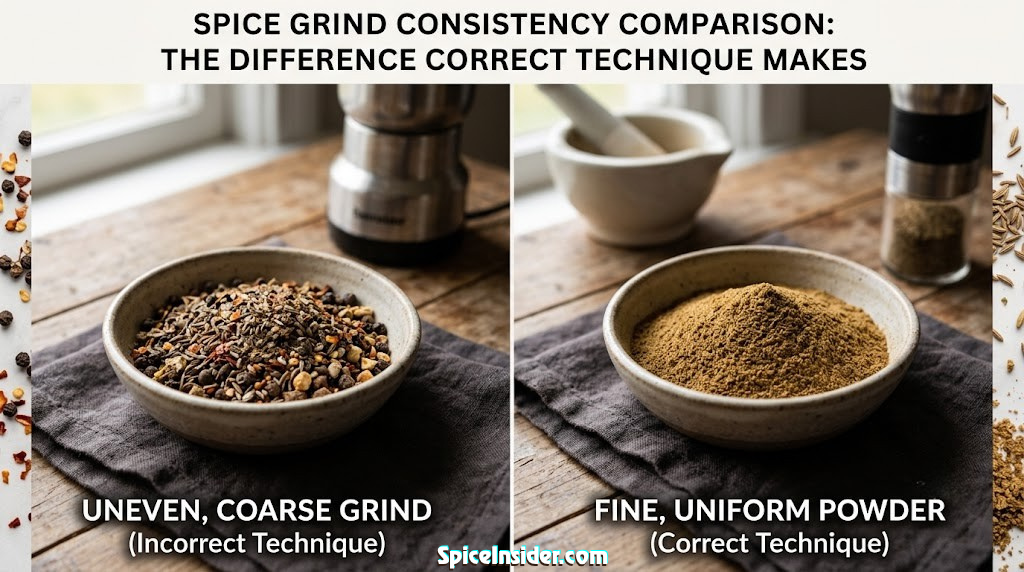
You press the button, run the grinder for what feels like forever, open the lid — and what you’ve got is a pile of gritty, inconsistent pieces that look nothing like the fine spice powder you were aiming for. It’s one of the most common frustrations in the home kitchen, and almost always fixable once you understand the actual cause.
The important thing to understand upfront is that “my grinder isn’t fine enough” is rarely a single problem. It’s usually a constellation of factors: a small technique error compounding with a slightly dull blade, or an underpowered machine being asked to grind the one spice that genuinely resists fine grinding. Isolating the cause is the first step to fixing it permanently.
This guide walks through every cause, ranked from most to least common, with a specific fix for each. It also covers the honest limits of different grinder types, so you know whether a technique change will solve your problem or whether a machine upgrade is the real answer. For a broader overview of best practices, our guide to spice grinder dos and don’ts covers the full picture of correct usage.
How Often Each Cause Is Responsible
Quick Self-Diagnosis Checklist
Before diving into individual causes, use this diagnostic table to identify your situation. Find the symptom that matches your experience and follow it to the most likely cause and the section that addresses the fix.
| What You’re Seeing | Most Likely Cause | Jump To |
|---|---|---|
| Coarse chunks regardless of how long you grind | Overloading + moisture | Section 3 & Section 4 |
| Fine at the bottom, coarse at the top | Overloading; no bowl shaking | Section 3 |
| Spice clumping or turning to paste | Moisture in the spice | Section 4 |
| Grinder used to work fine but now it doesn’t | Dull blade | Section 6 |
| Machine slows or struggles mid-grind | Overloading + motor strain | Section 7 |
| One specific spice never grinds fine | Resistant spice type | Section 8 |
| Grind is good but never truly powder-fine | Blade grinder inherent limit | Section 9 |
| Results inconsistent between sessions | Technique variation | Section 5 |
Understanding the Grind Spectrum
It helps to know what “fine enough” actually means in context. The spectrum below shows the four key texture zones and the cooking applications each one serves. Most grinder problems involve being stuck at coarse or medium when the recipe demands fine or powder.
Cracked
Sandy

Powerful stainless blade, removable grinding cup, and consistent fine-grind results. Our top pick for everyday home use.
Check Price on AmazonProblem 1: You’re Overloading the Bowl
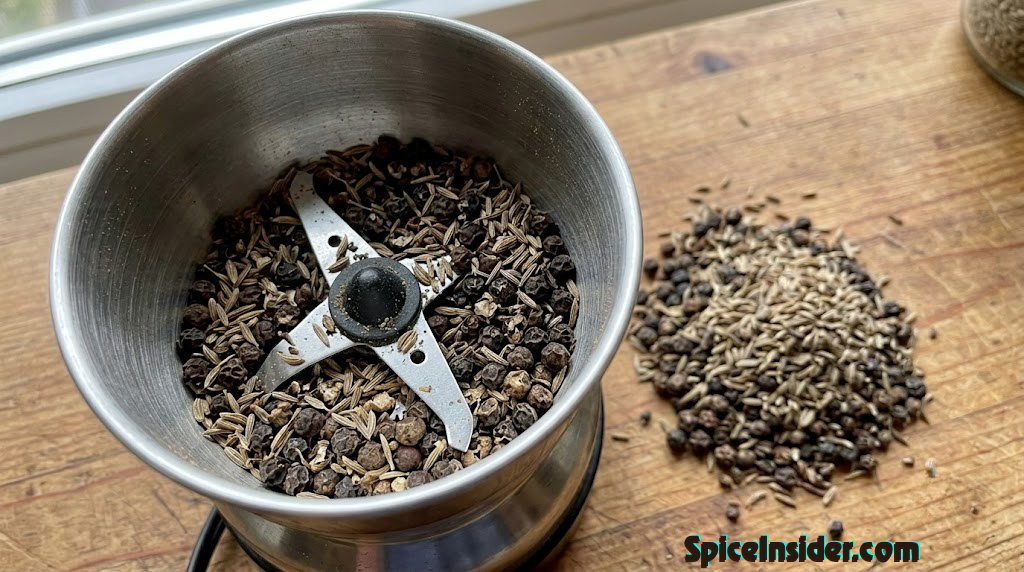
Overloading is the single most common reason a spice grinder fails to produce a fine result, and it’s also the easiest to fix. It happens because overfilling seems logical — more spice in, more ground spice out, faster. But the physics of how a blade grinder works makes that intuition exactly wrong.
The Vortex Problem
A blade grinder works by creating a rotating vortex inside the bowl. Spices near the blade get cut, then the circulation moves them to the outside and pulls fresh pieces toward the cutting zone. This circulation is what allows the blade to process all the spice in the bowl — not just the portion immediately above the blade.
When the bowl is packed past two-thirds full, there isn’t enough free space for that circulation to happen. Pieces at the top of the pile sit above the vortex action entirely. They don’t get carried toward the blade. You end up with a fine powder at the bottom and essentially whole spice at the top, no matter how long you run the machine.
✖ The Cause
Bowl packed past 2/3 capacity. Top layer of spice never enters the blade’s vortex circulation zone. Motor works harder, result stays coarse.
✔ The Fix
- Fill to 60–65% of bowl capacity maximum
- For a standard 70g bowl: 1–2 tablespoons whole spice
- Grind in two small batches instead of one large one
- Shake bowl between every 3–4 pulses to redistribute
Problem 2: Moisture in the Spice
Dry spices fracture cleanly. Moist spices compress, smear, and paste — they resist the blade instead of breaking along their natural internal fracture lines. This is why a batch of cardamom seeds that are perfectly dry will grind to a fine powder in 12 pulses, while seeds from a jar that’s been sitting near the stove (exposed to steam and temperature fluctuations) will stay stubbornly coarse no matter how long you run the machine.
Sources of Spice Moisture
The most common moisture sources aren’t dramatic — nobody is putting wet spices directly into the grinder. The culprits are subtle: storage near the stovetop or kettle, jars with loose or cracked lids, spice racks placed above the dishwasher’s steam vent, or simply spices that have been open in a humid kitchen for too long without being in an airtight container.
Some spices are naturally higher in moisture than others. Dried chilis often retain more moisture than hard seeds. Cinnamon bark, especially thicker cassia cuts, can hold humidity in its fibrous layers. Fenugreek seeds, despite being dense, are porous enough to absorb ambient moisture readily.
The Toasting Solution
A 60–90 second dry toast in a skillet over medium heat solves virtually all moisture-related grinding problems. The gentle heat drives off surface moisture, begins to crack the outer hull of seeds, and activates the volatile aromatic oils inside — making the spice grind faster, finer, and more fragrant simultaneously. Always let toasted spices cool completely (5–7 minutes) before grinding to avoid condensation inside the bowl.
For the full technique — how to toast different spice types, signs that toasting is complete, and which spices to skip — our complete guide on how to toast spices before grinding covers everything.
✖ The Cause
Retained moisture causes spice to compress rather than fracture. Result: paste-like texture, clumping, and stubborn coarseness regardless of pulse count.
✔ The Fix
- Dry-toast spices 60–90 sec in a skillet before grinding
- Cool completely before loading into the grinder
- Store whole spices in airtight jars away from heat and steam
- Check the moisture test: press a few seeds — if they feel soft, toast first

High-torque motor handles dense, hard spices that underpowered budget grinders struggle with. Strong value at its price point.
Check Price on AmazonProblem 3: Wrong Grinding Technique
Technique is often the invisible variable. Two people with the identical grinder, identical spices, and identical load sizes can get wildly different results depending entirely on how they operate the machine. The most common technique errors are also the ones nobody thinks to question because they feel perfectly natural — holding the button down continuously, never shaking the bowl, and stopping too soon.
The Hold-vs-Pulse Distinction
Holding the trigger down for 30–60 seconds straight seems like the most efficient path to a fine grind. It’s actually one of the least effective. Continuous running creates heat inside the enclosed bowl. That heat from friction subtly affects the texture of some spices (particularly those with higher oil content) and it also causes the motor to work under sustained load, which can trigger thermal protection circuitry in some models — making the motor slow or stop temporarily.
Short pulses of 3–5 seconds do several things simultaneously: they allow the vortex to fully form and dissipate between bursts (carrying new material toward the blade), they prevent heat accumulation, and they give you control — you can check progress every few pulses and stop exactly when you reach the texture you want.
The Shake Step Nobody Does
Every three or four pulses, remove the lid and shake the bowl vigorously — two or three sharp shakes. This redistributes spices, moves coarser pieces that have settled along the bowl walls back toward the center, and breaks up any clumps that have started to form. It takes two seconds and makes a significant difference in final fineness for the same total pulse count.
How Many Pulses Does It Actually Take?
Most people significantly underestimate. A genuinely fine grind of dense spices like coriander or fenugreek from a blade grinder takes 14–20 pulses of 4–5 seconds each, with shaking between sets. Many home cooks stop at 6–8 pulses, see something that looks “mostly ground,” and call it done — then wonder why their spice blend lacks the aromatic punch of a freshly ground commercial product.
| Target Texture | Pulse Count | Pulse Duration | Shake Intervals |
|---|---|---|---|
| Coarse / Cracked | 3–5 pulses | 3 sec each | Once after all pulses |
| Medium / Sandy | 7–10 pulses | 4 sec each | Every 3–4 pulses |
| Fine | 12–16 pulses | 4–5 sec each | Every 3 pulses |
| Near-Powder | 16–22 pulses | 5 sec each + motor rest | Every 2–3 pulses; motor rest every 15 sec |
✖ The Cause
Holding the button continuously, never shaking the bowl, stopping too early, or not pulsing long enough in total. These are habit errors, not machine errors.
✔ The Fix
- Always pulse (3–5 sec on, 1–2 sec off) — never hold
- Shake the bowl vigorously every 3–4 pulses
- Add 4–6 more pulses than you think you need
- Check progress visually after each shake, not just at the end
Problem 4: Your Blade Is Dull or Worn
This is the problem nobody wants to think about because it implies the machine itself is degraded — which it is, gradually, with every use. The blade in a standard electric spice or coffee grinder is a hardened stainless steel stamping. It starts sharp enough to cut efficiently, but every grinding session puts wear on the cutting edge through repeated impact with hard spice material. Salt is particularly abrasive; dense spices like whole nutmeg and dried galangal accelerate blade wear noticeably faster than softer seeds.
How to Tell If Your Blade Is Dull
The most reliable diagnostic is comparison: grind a tablespoon of black pepper with correct technique and compare the result to what you got with the same machine when it was new. Alternatively, if you have another functioning grinder, compare the two side by side with the same spice and same technique. A dull blade will produce noticeably coarser results with the same number of pulses.
Visual signs are also sometimes visible: run a finger carefully along the blade edge (machine unplugged and safe). A blade that’s still keen will feel noticeably different from one that’s been rounded by months of heavy use. You may also see small visible nicks from encounters with particularly hard materials.
What You Can Do About a Dull Blade
For most budget and mid-range blade grinders (under $60), the most practical response to blade dullness is replacement rather than sharpening. The blades in these machines are small, asymmetrically ground, and difficult to sharpen correctly at home without specialized equipment. Some manufacturers sell replacement grinding bowls with new blades attached — this is worth checking for popular models like the Cuisinart SG-10, for which replacement parts are widely available.
If you want to try extending a blade’s useful life before replacement, grinding a tablespoon of coarse salt can temporarily sharpen mild dullness (the abrasive action hones the edge slightly). Clean immediately and thoroughly afterward — salt corrodes metal rapidly. This works as an occasional measure, not a permanent solution.
For a look at machines built with longer-lasting blade assemblies and more durable construction overall, see our guide to a spice grinder that doesn’t break.
✖ The Cause
Blade edge has rounded through repeated impact with hard spice material. No longer fractures spice cleanly — compresses instead. Effect compounds over time and with abrasive ingredients like salt.
✔ The Fix
- Check for replacement bowl/blade assembly for your model
- For budget grinders: replace the unit — often cheaper than repair
- Avoid grinding salt and very hard materials to slow future dulling
- Occasional salt grind (1 tbsp, then clean thoroughly) for mild honing

Detachable grinding cup is dishwasher-safe. Clean blade geometry maintains sharpness well for its price class.
Check Price on AmazonProblem 5: Underpowered Motor for the Spice You’re Grinding
Not all spice grinders are built equal, and some are genuinely underpowered for certain tasks. A 150-watt entry-level grinder can handle soft seeds like fennel, cumin, and caraway without trouble. But ask it to fine-grind dried cassia bark, whole nutmeg, or dried galangal root — materials with much higher fracture resistance — and it will struggle noticeably: slowing mid-grind, producing more heat, and leaving more coarse fragments behind.
Power vs. Technique: How to Tell Them Apart
If your grinder works well on most spices but consistently underperforms on one or two specific hard materials, it’s most likely a power issue — the motor simply doesn’t have the torque to drive the blade through that material efficiently. If the grinder struggles with everything, including soft spices like fennel, the problem is more likely technique, load size, or blade dullness.
| Motor Wattage | Handles Well | May Struggle With | Verdict |
|---|---|---|---|
| Under 150W | Soft seeds, dried herbs, light spices | Cinnamon bark, dried roots, nutmeg, dense seeds | Budget / Light Use |
| 150–200W | Most everyday spices, coriander, pepper | Thick cassia bark, dried galangal, whole nutmeg | Good General Use |
| 200–280W | Nearly all dried spices including dense roots | Very thick bark pieces (pre-break recommended) | Strong Performance |
| 280W+ | All dried spices, light nuts, dried chilis | Very few limitations | Professional / Heavy Use |
✖ The Cause
Motor lacks the torque to drive the blade efficiently through high-resistance spice material. Most common with sub-150W grinders and exceptionally dense ingredients.
✔ The Fix
- Pre-break dense spices (cinnamon, galangal, nutmeg) into smaller pieces
- Reduce batch size for hard materials — smaller loads = less resistance
- Upgrade to 200W+ motor if hard spices are part of regular use
- Use a mortar and pestle for the initial coarse break, finish in the grinder
If your machine has recently started struggling with spices it used to handle easily, the culprit is more likely blade dullness (Section 6) or debris buildup on the blade housing adding friction. A thorough clean and test will confirm which it is. Our guide on spice grinder motor burning smell explains what happens when the motor is consistently over-stressed — and how to prevent it before permanent damage occurs.
Problem 6: The Spice Itself Resists Fine Grinding
Some spices have physical properties that make genuinely fine grinding challenging regardless of machine quality or technique. Knowing which spices fall into this category lets you adapt your approach — rather than blaming the grinder or endlessly adding more pulses without improving the result.
The Most Resistant Spices
Cinnamon bark — especially thick cassia cuts — is fibrous and dense. The fibers align in a way that makes them resist the blade’s impact rather than fracturing cleanly. Breaking sticks into very small pieces (1–2 cm maximum) before grinding, and toasting to reduce moisture in the fibrous structure, makes a significant difference.
Dried turmeric root, when used in whole or large-chunk form, has a dense, almost woody consistency that is genuinely tough for all but the most powerful blade grinders. Pre-buying turmeric in finger (whole root) form and grinding it is rewarding for flavor but demanding on equipment. A preliminary coarse break and a very small batch size are essential.
Star anise presents a different challenge: the seed pods are fragile and grind easily, but the hard seeds inside are significantly tougher. Grinding star anise whole is fine; expecting a perfectly uniform powder from every part of the star anise is unrealistic in a blade grinder because the different-density components finish at different rates.
Cardamom behaves differently from the pod than the seeds inside. Grinding whole pods produces a milder, more varied result. Removing seeds from the pod and grinding those alone produces a finer, more concentrated powder — two to three times the aromatic intensity for the same grinding effort.
Understanding which spices need special handling connects directly to the larger picture of ingredient preparation. Our deep comparison of grinding whole spices vs. pre-ground explains exactly when the effort of whole-spice grinding is worthwhile and when pre-ground is a practical alternative — particularly for the most demanding spice types.
Blade vs. Burr: Honest Limits of Each Grinder Type
One of the most important things to understand when troubleshooting a fineness problem is whether you’re hitting a technique limitation (which you can fix) or a machine-type limitation (which requires a different tool). Blade grinders and burr grinders have fundamentally different mechanisms, and their fineness limits are genuinely different — not a matter of quality within the same category.
The Blade Grinder’s Fineness Ceiling
A blade grinder works by random impact: the blade moves at high speed through the spice, striking pieces from various angles until they’re broken down. This means the resulting particle sizes are not uniform — you will always have a mix of fine powder and slightly coarser fragments. Even with perfect technique, a blade grinder’s finest possible result is what a food scientist would call “bimodal” — two populations of particle sizes rather than one tight distribution.
For most home cooking this is absolutely fine. Bimodal ground spice is still dramatically more aromatic and flavorful than pre-ground alternatives. But for applications requiring true uniformity — commercial spice blending, fine pastry baking, certain spice pastes — a blade grinder hits a ceiling that technique cannot overcome.
What a Burr Grinder Does Differently
A burr grinder crushes spices between two abrasive surfaces set at a precise distance. Every particle that passes through must be small enough to fit through that gap. This produces a much more uniform particle size distribution — closer to what laboratory equipment and commercial mills achieve. The trade-offs are real, though: burr grinders are significantly more expensive, require more involved cleaning (residue gets packed into the burrs), and handle oily or wet spices poorly.
Our detailed breakdown of blade vs. burr grinders for spices covers every dimension of this comparison — when each type is worth the investment, which cooking styles benefit most from burr grinding, and how to get the most out of whichever type you own.
| Factor | Blade Grinder | Burr Grinder |
|---|---|---|
| Grind particle uniformity | Variable (bimodal) | Highly uniform |
| Finest achievable result | Near-fine with technique | True fine powder |
| Grind size control method | Pulse count + technique | Dial setting |
| Consistency across batches | Moderate (technique-dependent) | High (dial-repeatable) |
| Heat generation | Higher | Lower |
| Handles oily spices | Adequately | Poorly (gums burrs) |
| Price range | $15–$60 | $70–$300+ |
| Cleaning complexity | Low (wipe/rinse bowl) | High (burr disassembly) |
| Best for | Everyday home cooking | Spice blending, baking, precision |

200W motor, stainless bowl, and an ergonomic top-press design that makes pulse technique natural and effortless.
Check Price on AmazonWhen to Upgrade Your Spice Grinder
Knowing when to keep fixing versus when to replace is a practical question with a clear answer once you’ve worked through the diagnostic process. If you’ve addressed all the controllable variables — load size, moisture, technique, blade condition — and still can’t get the fineness you need, the machine itself is the remaining variable.
Signs It’s Time to Replace or Upgrade
The clearest signal is a machine that used to grind well and no longer does, even after a thorough cleaning and with fresh technique. If the blade is not replaceable and the grinder is more than two years old with regular use, it has likely reached the end of its effective life. Entry-level grinders under $25 are not designed for heavy multi-year use — the motors and blades are sized for occasional light duty, not the demands of someone who grinds spices multiple times a week.
A second scenario: you’ve confirmed through honest testing that your current grinder simply doesn’t have the motor power for the spices you regularly cook with. If cassia cinnamon, dried galangal, and whole dried turmeric root are regular ingredients in your kitchen, a grinder rated above 200W is a meaningful upgrade, not a luxury.
What to Look For in a New Grinder
For blade grinders targeting maximum fineness: look for a removable stainless bowl (for easy cleaning and no flavor carryover into the motor housing), a motor rated at 200W or above, and a bowl size matched to your typical batch — larger bowls for larger households, not necessarily larger individual batches. Read our full picks in the best spice grinder guide, which covers every price tier with honest performance assessments.
If you regularly encounter stuck lids or difficulty removing the bowl after grinding — which is a sign of fine powder getting into the seal over many sessions — choosing a model with a well-reviewed lid seal design is worth prioritizing. Our guide to dealing with a stuck spice grinder lid covers the problem in detail.
| Symptom | First Try | If That Doesn’t Work |
|---|---|---|
| Coarse results despite correct technique | Reduce load; toast spices | Inspect/replace blade |
| Machine slower than it used to be | Deep clean; check for debris on blade | Replace blade or unit |
| Burning smell during grinding | Reduce load; clean bowl thoroughly | Stop using; evaluate motor damage |
| Inconsistent results between batches | Standardize technique; same load size | Check blade wear; upgrade motor |
| Never gets fine enough (any technique) | Switch to burr grinder | Consider high-speed blender for powders |
If you can’t grind spices at all for any reason — machine broken, no grinder available — our guide on how to grind spices without a grinder covers every manual technique from mortar and pestle to cast iron and rolling pin, so your cooking never has to wait on equipment.
Pro Techniques for Getting the Finest Possible Grind
Once you’ve addressed the fundamental causes — correct load size, dry spices, proper pulse technique — there are several additional strategies used by serious spice workers that push grind fineness beyond what standard home use typically achieves. These are worth knowing if you’re working on spice blends, homemade curry pastes, baking projects, or any application where powder fineness is critical to the outcome.
Before loading any hard or large spice into the grinder, break it down physically first. A wooden mortar and pestle, the flat of a heavy knife, or the bottom of a cast iron pan all work. Two seconds of pressure breaks a cinnamon stick into 8–10 small fragments. Those fragments grind to a finer powder in far fewer pulses than a whole stick would — because the blade is starting from a smaller initial piece size.
For very oily spices — cardamom seeds, certain dried chilis, cloves — a brief 15–20 minutes in the freezer before grinding makes them significantly more brittle. Cold oil is less fluid and reduces the tendency of high-oil spices to smear rather than fracture. Don’t freeze the whole spice — just the seeds or pieces you’re about to grind. This technique is used commercially for processing high-fat spices and works well at home too.
After your initial grind, pass the powder through a fine mesh sieve. The fine powder goes into your container; the coarser pieces that remain in the sieve go back into the grinder for a second short pulse sequence. This two-pass approach consistently produces finer results than any single-pass grind, and it gives you visible confirmation of progress — the volume that passes through the sieve increases with each pass.
For extended fine-grind sessions (many pulses needed), build in deliberate motor rests. After every third set of pulses, pause for 20–30 seconds with the lid off. This cools the bowl and prevents the subtle heat-induced clumping that starts to occur when the bowl temperature rises. It also lets you do a visual check and physically redistribute any clumps that have formed along the bowl walls.
Grinding one spice type at a time — never mixing different spices in the same grind — consistently produces finer results than grinding blended mixes. Different spices have different densities, moisture contents, and hardness levels. A mixed grind means different ingredients reach their ideal fineness at different pulse counts; some will be over-ground while others are still coarse when the mix is “done.” Grind each spice separately, then combine the finished powders to create your blend.
This approach also simplifies cleaning between uses and prevents cross-contamination between strong flavor families. Our article on how to use a spice grinder covers the full workflow for dedicated single-spice grinding sessions, from prep through to storage.
It’s easy to overlook, but a bowl coated with residue from a previous grind creates a different grinding environment than a clean bowl. Residue adds a thin layer of resistance, reduces the effective blade-to-spice clearance, and can cause fresh spice to stick to the walls rather than circulating freely. Wiping the bowl clean before each use — not just after — is a small habit that contributes measurably to grind quality over time.
For a complete guide to bowl cleaning that also covers odor removal — another factor in producing clean-tasting ground spice — see our in-depth article on how to clean a spice grinder and our guide on spice grinder odor removal.
Grinder Performance Comparison: What You’re Actually Getting
To put all the diagnostic and technique information in context, it helps to see how different grinder types perform across the key fineness-related variables. This table reflects real-world performance, not manufacturer specifications.
| Grinder Type | Finest Achievable Grind | Consistency | Best Spice Types | Weakness |
|---|---|---|---|---|
| Budget blade (<150W) | Medium-fine with technique | Variable | Soft seeds, dried herbs | Dense roots, thick bark |
| Mid-range blade (150–220W) | Fine with technique | Good | Most everyday spices | Requires technique discipline |
| High-end blade (220W+) | Near-powder with technique | Good–Very good | All dried spices | Still bimodal particle distribution |
| Entry burr grinder | Fine-uniform | Very good | Hard seeds, peppercorns | Oily spices; harder to clean |
| Premium burr grinder | True fine powder | Excellent | All dried spices, precision blends | Price; oily spices still problematic |
| High-speed blender | True powder (dry jar) | Good | Large batches, hard materials | Heat buildup; harder to control |
For specific model recommendations within these categories, our Cuisinart SG-10 review and Secura spice grinder review provide detailed, honest performance assessments. Both are mid-range blade grinders that consistently outperform their price points on fineness when used correctly.
Browse our full guide to the best spice grinders — with power ratings, cleaning notes, and fineness performance tested across dozens of spice types.
Shop Top-Rated Spice GrindersFrequently Asked Questions
Why is my spice grinder not grinding fine enough?
The most common causes are overfilling the bowl, not pulsing long enough, grinding spices that retain moisture, or using a blade grinder that has become dull over time. Fixing the technique — smaller loads, longer pulse sequences, toasting spices first — resolves the issue in the majority of cases without any equipment change.
Can a blade spice grinder ever produce truly fine powder?
Yes, with correct technique. A blade grinder can produce a near-powder grind through extended pulse sequences with shaking between sets. However, it will never match the absolute uniformity of a burr grinder. For applications requiring true flour-like fineness across every particle, a burr grinder or high-speed blender with a dry jar is the more appropriate tool.
Does toasting spices before grinding make them grind finer?
Yes, significantly. Toasting removes surface moisture that causes spices to compress and smear rather than fracture cleanly. Dry spices break along natural fracture lines, producing a finer, more uniform grind in fewer pulses. A 60–90 second dry toast in a skillet makes a measurable difference in final grind fineness, and also dramatically improves the aroma of the finished powder. See our full guide on how to toast spices before grinding.
How do I know if my spice grinder blade is dull?
Signs of a dull blade include: the same spice taking significantly more pulses than it used to, a noticeably coarser texture even after extended grinding, and small pieces that bounce around the bowl rather than being caught and cut. Inspect the blade edge carefully (machine unplugged) — visible nicks or a rounded rather than keen edge confirm dullness.
Why does my grinder grind unevenly — fine at the bottom and coarse at the top?
This is a blade grinder characteristic caused by the blade only cutting in a narrow zone near the base. The solution is shaking the bowl between every few pulses to move coarser pieces toward the blade. Reducing the load size so spices can circulate freely also significantly reduces this unevenness. It is the most common technique gap in home grinding.
Is a burr grinder really better than a blade grinder for fine spice powder?
For consistent, uniform fineness, yes. A burr grinder produces a highly uniform particle size; a blade grinder produces variable particle sizes. For most home cooking applications a well-used blade grinder with correct technique is sufficient, but for spice blending or applications requiring uniformity, burr grinders deliver a clearly better result. Read our full comparison in blade vs. burr grinders for spices.
Can grinding in smaller batches really improve fineness?
Significantly. A smaller load allows the blade vortex to circulate spices continuously through the cutting zone. Half the normal load often produces twice the fineness for the same pulse count. This is one of the highest-leverage changes you can make without touching any other variable.
Why does my grinder leave chunks no matter how long I run it?
Persistent chunks despite long grinding point to one of three things: the bowl is overfilled and pieces can’t circulate, the spices are too moist to fracture cleanly, or the blade is significantly dull. Reduce load, toast first, and inspect the blade. If chunks persist with a small load and dry spice, blade replacement is likely needed. Also see our dedicated guide on why spice grinders leave chunks.
Does running the grinder continuously (not pulsing) help get a finer grind?
No — continuous running works against you. It heats the bowl (causing some spices to clump), overheats the motor, and prevents the pauses that allow vortex reformation and bowl redistribution. Short pulse bursts with pauses and bowl shaking produce a finer, more consistent result than holding the button for the same total duration.
Which spices are hardest to grind fine?
The most challenging for blade grinders are cassia cinnamon bark, dried whole turmeric root, whole nutmeg, dried galangal, and thick-walled dried chilis. All benefit from being broken into smaller pieces before loading and from toasting to reduce moisture before grinding.
Will a more powerful motor always produce a finer grind?
Not necessarily. Motor power helps with tough or dense spices, but fineness is more a function of blade sharpness, load size, and grinding technique than raw wattage. A 200-watt grinder with correct technique often outperforms a 400-watt grinder used without attention to load size and pulse method.
How can I fix my grinder if it stopped being as powerful as it used to be?
Loss of grinding power over time is usually caused by a dull blade reducing cutting efficiency, or by oil and debris buildup on the blade surface adding drag. A thorough deep clean followed by a test grind will tell you which it is. If cleaning doesn’t restore performance, blade dullness is the culprit. For most inexpensive blade grinders, replacing the unit is more practical than sharpening. Our guide on how to clean a spice grinder covers the deep-clean process completely.
Getting a Fine Grind Is Almost Always Within Reach
The vast majority of “my grinder isn’t fine enough” problems are solvable without buying anything new. Reducing the load, toasting spices to remove moisture, switching to a pulse-and-shake technique, and grinding longer than you think you need to — applied consistently — transforms results for most home cooks. These are free changes with immediate impact.
Where those fixes don’t fully close the gap, a blade upgrade or a step up to a burr grinder offers a genuine improvement. But start with technique. The machine is rarely the limiting factor when the fundamentals haven’t been optimized.
If you’re ready to find a grinder that performs reliably at the fineness level you need, our full guide has you covered.
Shop Best Spice Grinders on Amazon