Best Spice Grinder: Top Rated Electric and Battery Models Compared
We rounded up the spice grinder reviews that matter, dug into specs, and lined up the most-searched electric spice grinder options side by side so you can buy a spice grinder online with confidence instead of guesswork.
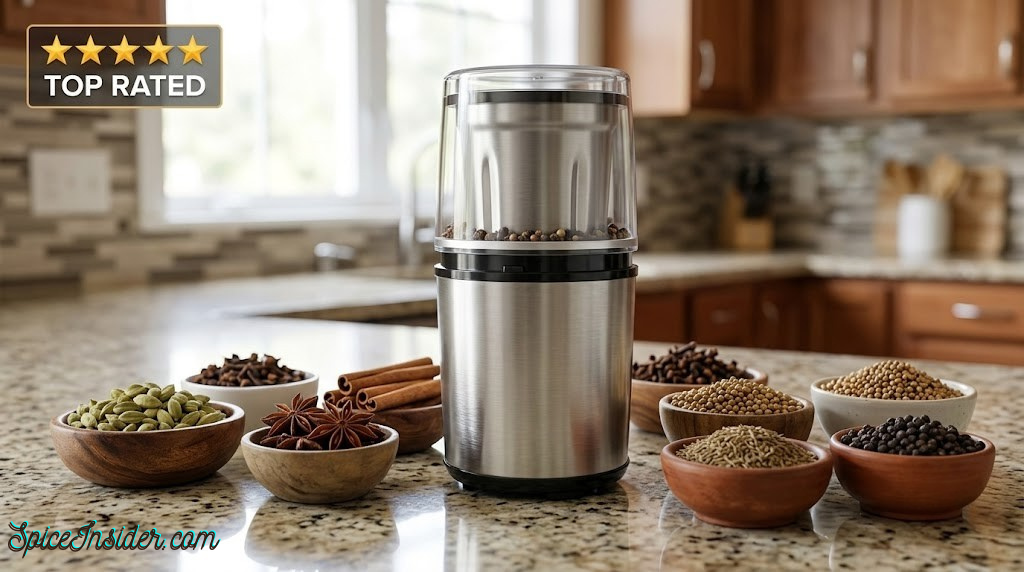
Anyone who has cooked with a jar of pre-ground cumin that’s been sitting in the cabinet since who knows when already understands the problem. It smells like cardboard. It tastes like almost nothing. And no recipe, no matter how carefully written, can save a dish seasoned with spice dust that lost its punch months ago. The fix isn’t complicated, but it does require the right tool, and that’s exactly what this guide is built around: helping you find the best spice grinder for the way you actually cook, not just the one with the most five-star badges slapped across its listing photo.
We pulled together the spice grinder reviews, owner feedback, and manufacturer specs for thirteen of the most-searched models, from compact electric grinders built specifically for spice duty to dual-purpose coffee-and-spice grinders, a battery-powered pod-based mill designed for one-handed tableside use, and even a premium manual burr mill for the cooks who take their pepper seriously. Whether you’re shopping for an electric spice grinder to build bold curry powders from scratch or you just want something better than the manual mill that’s been frustrating you for years, the picks below are organized so you can find your category fast and compare the details that actually affect day-to-day cooking.
One thing worth saying plainly before we get into the reviews: there is no single objectively “best” spice grinder that works for every kitchen. A restaurant line cook batching pounds of spice rub every shift has completely different needs than someone living alone who wants to grind a teaspoon of fresh black pepper over a Sunday omelet. A home baker who occasionally needs a fine cinnamon-clove blend for a spice cake doesn’t need the same tool as a home cook who builds an entirely fresh garam masala from a dozen whole spices every week. That’s why this guide spends as much time helping you figure out which category of grinder fits your actual habits as it does ranking individual products against each other.
It also helps to set realistic expectations going in. Even the best electric spice grinder on this list is still, mechanically speaking, a small motor spinning a blade inside a bowl. It is not a commercial mill, it will not produce laboratory-consistent particle sizes, and it will occasionally leave a few stray fragments larger than the rest no matter how careful you are. Knowing that upfront keeps you from feeling like you bought the “wrong” grinder the first time a batch of toasted coriander seeds comes out slightly uneven. A little technique, covered later in our troubleshooting and do’s-and-don’ts sections, solves the vast majority of those moments.
If you’ve already got a grinder and you’re here because something’s gone wrong with it, jump down to our troubleshooting section on grind consistency or our guide to cleaning a spice grinder properly. Everyone else, read on, because the difference between a good grinder and a great one usually shows up in the very first batch of cumin seeds you toss in.
Why a Dedicated Spice Grinder Actually Matters
It’s tempting to think a mortar and pestle, or worse, the flat side of a knife, gets the job done well enough. For small amounts, sure. But once you’re regularly building spice blends, toasting and grinding whole cumin or coriander seeds, or trying to get a fine, even powder for a rub or curry base, hand tools start to show their limits fast. Uneven grinds mean uneven seasoning, which means some bites of a dish taste sharp and others taste flat. A grinder built for the job solves that with speed and consistency that’s hard to replicate by hand.
There’s also the freshness factor. Whole spices hold their essential oils, and therefore their flavor and aroma, far longer than pre-ground versions. The moment a spice is ground, its surface area increases dramatically, which speeds up the rate those oils oxidize and evaporate. Grinding whole spices in small batches right before cooking is the single easiest way to upgrade flavor in almost any dish without changing a single ingredient in the recipe itself. For a deeper look at why this matters so much, our guide on grinding whole spices vs. pre-ground breaks down the flavor chemistry in more detail.
The right grinder also opens the door to building your own spice blends. Garam masala, ras el hanout, homemade curry powder, a custom steak rub, all of these come together better when you control the ratio of freshly ground components yourself rather than relying on a pre-mixed jar that may be mostly filler. That’s the real argument for owning a dedicated tool rather than improvising. It’s not about gadget obsession. It’s about giving every dish the best possible shot at tasting like it should.
There’s a cost angle here too that’s worth mentioning honestly. Buying whole spices in bulk and grinding them yourself is almost always cheaper per ounce than buying small jars of pre-ground spice from the grocery store rack, sometimes dramatically so. Whole peppercorns, whole cumin seed, whole coriander seed, and dried whole chilies are widely available at lower cost per unit of flavor than their pre-ground counterparts, partly because pre-ground spice degrades on the shelf and retailers price in that loss, and partly because grinding is a value-added processing step that someone in the supply chain is charging you for. Over a year of regular cooking, the savings from buying whole and grinding fresh can genuinely offset the cost of even a mid-range grinder.
There’s also a sensory pleasure to the process that’s easy to undersell in a buying guide focused on specs and prices, but it’s real. The smell that fills a kitchen the instant you crack open a fresh batch of cardamom pods or toast and grind cumin seed is simply not something a jar of pre-ground spice from six months ago can deliver. If you cook because you enjoy it, not just because you need to eat, that sensory payoff is part of the case for owning a good grinder, separate from any purely practical argument about flavor potency or cost savings.
How We Evaluated Each Spice Grinder
Not every “spice grinder” on the market was actually designed with spices as the primary use case, and that distinction matters more than marketing copy usually lets on. Some of the models below are purpose-built spice and nut grinders. Others are coffee grinders that happen to handle spices well as a secondary function. We treated both categories fairly, but we made sure to call out where a grinder’s primary design intent lies so you’re not surprised later.
Here’s what we weighed for every model on this list:
- Grinding power and motor wattage. A stronger motor handles harder whole spices like cinnamon bark, star anise, and whole nutmeg without straining or stalling mid-cycle.
- Bowl or chamber capacity. Matters more than people expect. A grinder that only holds a tablespoon of seeds is fine for a quick pinch of pepper but frustrating if you’re batching a spice rub for a brisket.
- Bowl material and removability. Stainless steel bowls that detach from the motor base are dramatically easier to clean than fixed plastic chambers, and they resist staining and odor retention better over time.
- Grind consistency. We looked at how evenly each model handles both brittle spices (coriander, cumin) and oilier or fibrous ones (cloves, dried chilies, herbs) since the two behave very differently in a blade grinder.
- Build quality and safety features. Things like lid-lock interlocks that prevent operation unless the lid is properly seated, which matters a lot for a tool that’s spinning a sharp blade at high speed.
- Noise level and footprint. Small appliance, but it still has to live somewhere on your counter or in a cabinet, and nobody wants a grinder that sounds like a leaf blower at 7am.
- Price relative to what you actually get. A higher price is only justified when it buys real performance, not just a nicer-looking shell.
For a closer look at where blade-style grinders like most of these fall short compared to burr mechanisms, see our breakdown on blade vs. burr grinders for spices later in this guide.
We also paid close attention to how each grinder is actually marketed and intended to be used, because that intent shapes design decisions in ways that matter once a product is in your kitchen. A grinder engineered from the ground up for spices, like the Cuisinart SG-10, tends to make different tradeoffs than a coffee grinder that lists spice grinding as a secondary capability, like the Hamilton Beach Fresh Grind. Neither approach is inherently better, but they serve different priorities, and conflating the two categories is one of the more common mistakes we see in spice grinder shopping advice elsewhere online.
Finally, we weighed owner sentiment over time rather than just initial unboxing impressions, since a grinder that feels great for the first few uses but develops problems within a few months tells a very different story than one that holds up reliably over a year or more of regular cooking. Where we found a meaningful pattern in long-term complaints, like the salt-corrosion concerns some owners report with steel-mechanism mills, we called it out directly rather than burying it in fine print.
Top Rated Spice Grinders Reviewed
Below are the spice grinders we found come up again and again in searches, owner reviews, and kitchen forums, organized roughly from best all-around picks to more specialized tools. Each entry includes what it’s genuinely good at, where it falls short, and who should (and shouldn’t) buy it.
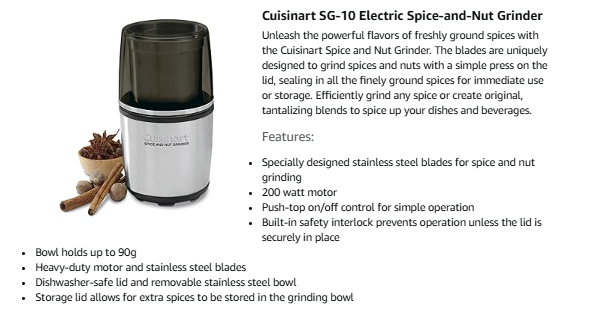

Cuisinart SG-10 Electric Spice-and-Nut Grinder
Best for: everyday spice grinding in small to medium batchesThe Cuisinart SG-10 runs on a 200 watt motor and uses stainless steel blades specifically designed for spice and nut grinding, which puts it squarely in the purpose-built category rather than a coffee grinder doing double duty. The bowl holds up to 90 grams, and a push-top lid both starts the grinding cycle and seals the bowl for storage afterward, a small design touch that ends up mattering a lot once you’re trying to portion out a fresh batch of garam masala without spilling it across the counter.
A built-in safety interlock prevents the unit from running unless the lid is securely locked in place, and both the lid and the removable stainless steel bowl are dishwasher safe, which is genuinely one of the more underrated features on this list. Pop the bowl off, toss it in the dishwasher, and you’re not stuck hand-scrubbing turmeric stains out of a fixed plastic chamber. The grinder measures roughly 4 inches by 4 inches and stands close to 8 inches tall, so it has a small enough footprint to live on a counter without crowding other appliances.
Owner feedback skews positive for spice grinding specifically, with reviewers noting it does a solid job grinding spices, though some mention it pulverizes nuts more aggressively into a paste-like consistency rather than a coarse chop. If nut grinding is a secondary use case for you, that’s worth knowing going in.
Who it’s genuinely best for: someone who wants a dedicated, no-flavor-crossover tool for grinding fresh spice blends a few times a week, values easy cleanup over raw capacity, and doesn’t mind running two or three short cycles for a larger batch rather than one big one. Who should look elsewhere: anyone planning to grind pounds of spice at a time for resale or large-batch meal prep, since the 90-gram bowl will mean a lot of repeated cycles, or anyone who specifically wants a coarse, rustic chop on nuts rather than a fine pulverized result.
Pros
- Purpose-built for spices, not a repurposed coffee grinder
- Dishwasher-safe removable bowl and lid
- Safety interlock prevents accidental operation
- Compact footprint, simple one-touch operation
Cons
- 90g bowl capacity is limiting for big batch spice blending
- Can over-pulverize nuts into paste rather than a coarse chop
Check Price on Amazon →
Want a deeper dive on this exact model? Read our full Cuisinart SG-10 review for long-term durability notes and grind tests across different spice types.

SHARDOR Electric Spice Grinder with Removable Bowl
Best for: budget-conscious shoppers who still want a removable steel bowlThe SHARDOR grinder follows a familiar formula that works well in this category: a one-touch push-button lid, a removable stainless steel grinding bowl, and stainless steel blades that handle both coffee beans and spices. It’s frequently mentioned in spice grinder reviews alongside the SG-10 as a more budget-friendly alternative that still hits the core feature checklist most home cooks actually care about.
Where it tends to differentiate itself is price point and simplicity. There’s no learning curve here, no settings dial to fiddle with, just a lid you press down to grind and release to stop. That kind of straightforward operation makes it a solid pick for someone who wants to upgrade from pre-ground spices without overthinking the tool itself.
If you’re trying to decide between a model like this and a manual mill, our comparison on blade vs. burr grinders for spices explains why blade grinders like this one trade a bit of grind-size precision for speed and simplicity.
The SHARDOR tends to appeal most to first-time spice grinder buyers who aren’t yet sure how often they’ll actually use the tool and don’t want to commit a lot of money to find out. It’s also a sensible pick as a second grinder, kept separate from a primary coffee grinder specifically to avoid flavor crossover, without doubling your appliance budget in the process. If you already know you’ll be grinding daily for years to come, investing a bit more upfront in a model with a more established track record, like the Cuisinart, may pay off in longevity.
Pros
- Affordable entry point into electric spice grinding
- Removable stainless steel bowl simplifies cleanup
- Simple one-touch operation with no settings to learn
Cons
- No adjustable grind settings
- Build materials feel less premium than higher-priced models
Check Price on Amazon →

Hamilton Beach Fresh Grind Electric Grinder (80335R)
Best for: cooks who want one grinder for coffee and spicesHamilton Beach markets this primarily as a coffee grinder, but the durable stainless steel blades also handle herbs and spices, and the removable grinding chamber makes both filling and cleanup considerably easier than fixed-chamber alternatives. It can grind up to 9 tablespoons of beans at once, enough for about 12 cups of coffee, which translates to a genuinely generous capacity if you’re also using it for larger spice batches.
Hamilton Beach specifically approves this grinder for dry spices like peppercorns, coriander, and fennel, along with dry seeds such as flax, chia, and sesame, but is clear that wet or fresh ingredients should never go in it. The unit also includes hideaway cord storage built into the base, a small but appreciated detail for keeping a countertop tidy.
The catch, and it’s a real one if you’re particular about flavor crossover: using the same grinder for both coffee and pungent spices means some aroma transfer is almost inevitable unless you clean thoroughly between uses. If that’s a dealbreaker, a dedicated spice-only model like the Cuisinart SG-10 above is the safer bet. Our guide on whether you can grind coffee in a spice grinder covers this exact tradeoff from the other direction.
In practice, owners who report being happiest with this grinder tend to fall into one of two camps: people who grind coffee daily and only occasionally need spices, where the convenience of one appliance outweighs occasional minor crossover, or people who’ve simply accepted a quick rinse-and-dry routine as part of switching between the two uses. If neither of those describes your habits, and you’d rather not think about flavor crossover at all, a dedicated single-purpose grinder removes the question entirely.
Pros
- Genuinely dual-purpose for coffee beans and dry spices
- Large capacity relative to dedicated spice grinders
- Removable, dishwasher-safe stainless steel bowl
- Quieter operation than many competing models
Cons
- Flavor crossover risk between coffee and strong spices
- No adjustable grind settings, single press-and-hold operation
Check Price on Amazon →

AmazonBasics Stainless Steel Electric Grinder
Best for: a no-frills backup grinder at a low price pointThis is about as straightforward as electric grinders get: a stainless steel housing, a removable bowl, and one-touch operation. It won’t win any awards for power or capacity, but it’s a reliable entry point for someone who isn’t ready to invest heavily in a dedicated tool and just wants to start grinding fresh spices instead of buying pre-ground jars.
Because it shares a basic blade-grinder architecture with most of the other entries on this list, the same fundamentals apply: pulse rather than running it continuously, don’t overfill the bowl, and clean between strongly flavored spices to avoid cross-contamination. Check our spice grinder do’s and don’ts for the full list of habits that extend the life of any blade-style grinder like this one.
It’s a sensible pick specifically for anyone testing the waters with electric spice grinding for the first time, or for a household that wants a low-cost backup grinder kept separate from a primary coffee grinder to avoid flavor crossover without spending much extra to do so.
Pros
- Very accessible price point
- Removable stainless steel bowl
- Simple, no-learning-curve operation
Cons
- Smaller capacity, better suited to single-serving batches
- Less robust build than premium dedicated models
Check Price on Amazon →

Compact 3-Ounce Electric Grinder
Best for: tight kitchens or apartment counters with limited storageIf counter or cabinet space is genuinely tight, this style of compact 3-ounce grinder solves a real problem: bulky appliances that never get used because they’re a hassle to dig out of a crowded cabinet. The stainless steel housing keeps it durable for what it is, and the smaller capacity is actually appropriate here since the whole design is built around minimal footprint rather than batch grinding.
This isn’t the grinder for someone prepping large quantities of a spice rub for smoking a whole brisket, but for grinding a fresh teaspoon of peppercorns or toasted cumin right before a weeknight dinner, the smaller scale is a feature rather than a limitation.
This style of grinder also tends to suit people who simply don’t want a visible appliance cluttering their countertop aesthetic. Its smaller size makes it easy to tuck into a drawer or a single cabinet shelf between uses, pulled out only when actually needed rather than living permanently on display the way a larger appliance often does by necessity.
Pros
- Small footprint fits in tight kitchens
- Stainless steel housing for durability
- Good for quick, single-use grinding sessions
Cons
- 3-ounce capacity is too small for batch spice blending
- Not ideal if you regularly grind for larger recipes
Check Price on Amazon →

FinaMill Classic Battery Spice Mill
Best for: one-handed grinding directly over a dish at the table or stoveThe FinaMill takes a genuinely different approach from the blade grinders above. It runs on four AA batteries and uses a system of interchangeable, refillable pods, with an Everyday Pod and a Pepper Pod most commonly included in starter sets. Each pod is fully adjustable from a coarse grind down to a delicate texture, and because the pods themselves store the spice, switching between, say, black pepper and a dried herb blend takes seconds with zero cross-contamination.
The interchangeable pod system is the real differentiator here. The Everyday Pod handles common pantry spices and oilier seasonings, the Pepper Pod is tuned specifically for peppercorns, a Dried Herbs+ Pod handles larger spices and dried herbs, and a Grater Pod exists for harder whole spices like nutmeg, cinnamon, and even chocolate. That modularity makes it less of a single-purpose grinder and more of a small grinding system you build out over time.
It’s worth being clear about what this is not: a high-capacity batch grinder. This is a tableside and stovetop seasoning tool, designed for grinding directly over food with one hand while you’re mid-recipe, not for prepping a big jar of pre-mixed rub to store for weeks. For that kind of batch prep, one of the bowl-style electric grinders above is the better fit.
The pod system also creates a kind of natural upgrade path that’s worth knowing about before you buy. A starter kit typically includes the mill itself plus one or two pods, but the line is built around the assumption you’ll add more over time as you find yourself wanting separate pods for different categories of spice. Think of the base mill as the investment and individual pods as the lower-cost expansion, similar to how a single coffee grinder can serve multiple bean types without dedicated hardware per bean, except here each pod genuinely keeps flavors from mixing in a way a single shared bowl can’t.
Pros
- One-handed operation, ideal for grinding directly over food
- Interchangeable pods prevent flavor cross-contamination
- Adjustable grind size from coarse to fine
- Runs on standard AA batteries, no charging required
Cons
- Not designed for large batch grinding
- Additional pods are a separate purchase
Check Price on Amazon →

Waring Commercial-Style Grinder
Best for: cooks who grind large volumes regularly or run a small food businessWaring built its reputation on commercial kitchen equipment, and that heritage shows here. This is a sturdier, more heavy-duty option than most of the consumer-grade grinders on this list, built to handle frequent, repeated grinding cycles without the motor strain that lighter-duty home models can experience under heavy use.
If you’re someone who grinds spices daily, whether for a meal prep routine, a small spice blend business, or just a household that cooks intensely seasoned food constantly, the extra durability here is the entire value proposition. For occasional home cooks who grind a few times a week, it may be more grinder than you actually need, and one of the lighter consumer models above will serve you just as well for less money.
Commercial-heritage equipment like this also tends to be easier to source replacement parts for over the long run, since the manufacturer is accustomed to supporting professional kitchens that can’t afford extended downtime waiting on repairs. That’s a meaningful, if less glamorous, advantage for buyers planning to put serious hours on their grinder over several years.
Pros
- Built for frequent, heavy-duty use
- More robust motor and components than typical consumer models
Cons
- Overkill for occasional home cooking needs
- Higher price reflects commercial-grade positioning

ZWILLING Enfinigy Electric Salt & Pepper Mill
Best for: countertop or table seasoning with a premium finishThis is a different category of tool than the bowl-style spice grinders above, and it’s worth understanding that distinction before buying. The ZWILLING Enfinigy is a push-button electric mill built specifically for salt and pepper (or other small, free-flowing spices) rather than batch grinding a whole jar of cumin seeds. It uses a ceramic grinding mechanism rather than steel blades, which matters because ceramic resists the corrosive effects of salt far better over time.
A spin dial adjusts grind size from fine to coarse, and an automatic light illuminates the area you’re grinding into, a genuinely useful feature when you’re seasoning a dish and want to see exactly how much is landing where. It recharges via USB cable rather than running on disposable batteries, and a 360-degree viewing window lets you keep an eye on fill levels without opening it.
Owner experiences are mixed on long-term durability, with some reviewers reporting years of reliable use and others noting the grinding mechanism on the salt mill specifically can wear down faster than expected, which tracks with the broader caution that salt is simply harder on grinding mechanisms than pepper over time. If you want a single elegant unit for the table rather than a workhorse for the kitchen counter, this fits that role well.
One detail worth flagging for anyone considering the matching salt-and-pepper set: the two mills, while visually identical, are not interchangeable internally, since the salt unit’s mechanism is built to better resist the corrosive properties of salt specifically. If you’re only buying one and want it for an occasional second job grinding something like coarse sea salt flakes, lean toward the salt-specific unit rather than assuming the pepper mill will handle it equally well over time.
Pros
- Ceramic mechanism resists salt corrosion better than steel
- Adjustable grind dial from fine to coarse
- Built-in light for visibility while seasoning
- Rechargeable via USB, no disposable batteries
Cons
- Not designed for batch grinding whole spices
- Mixed long-term durability reports, particularly the salt unit
- Higher price point than basic blade grinders
Check Price on Amazon →

Microplane Spice Mill
Best for: cooks who want a manual mill on hand alongside an electric grinderMicroplane is best known for its graters and zesters, and that same precision-cutting design philosophy carries over into this manual spice mill. It’s a good complement to, rather than a replacement for, an electric grinder, useful for situations where you want fine control over a small amount of spice without firing up an appliance, or as a backup when you want a fresh crack of pepper or fennel without the noise of a motor.
Manual mills like this one give you a level of grind-size feel that’s hard to replicate with a blade grinder, since you can stop the instant you hit the texture you want rather than guessing how a pulse will turn out. The tradeoff is effort and time for anything beyond a small amount, which is why most kitchens benefit from having both a manual mill for finesse and an electric grinder for volume.
The build quality and design language here will feel immediately familiar to anyone who already owns a Microplane grater or zester, which is a meaningful point of reassurance for a brand that’s built its reputation on precision cutting tools rather than full-scale kitchen appliances. If you already trust the brand for other tools in your kitchen, that confidence reasonably extends to this mill as well.
Pros
- Precise manual control over grind texture
- Quiet, no electricity or batteries required
- Compact and easy to store
Cons
- Slower and more effort-intensive for larger quantities
- Best as a complement to an electric grinder, not a full replacement

MANNKITCHEN Pepper Cannon
Best for: serious pepper grinding output and adjustable burr precisionThis is the outlier on the list in the best possible way. The Pepper Cannon is a manual burr mill, not electric, but it’s included here because it genuinely changes the math on what a pepper mill can output. Standard mills typically grind pepper within a narrow 12 to 28 mesh size range, while the Pepper Cannon adjusts from roughly 8 all the way past 60, meaning it can produce a grind coarse enough for stocks and roasts, or finer than most pre-ground pepper on store shelves.
A double-bearing supported drive shaft powers hardened high-carbon stainless steel burrs, and dual spring-plungers with detents hold your chosen grind setting in place reliably between uses. The body is milled from a solid piece of aerospace-grade aluminum and anodized black for durability and easy cleaning. It holds roughly half a cup of peppercorns, which is generous for a manual mill without becoming unwieldy.
The catch is right there in the price and the single-spice focus: this is a pepper mill, full stop, not a multi-purpose spice grinder, and manufacturer guidance explicitly warns against using it for salt, since it will eventually corrode the stainless steel internals. If pepper is the spice you season with most and you’ve been frustrated by how slow and inconsistent ordinary mills are, this is worth the splurge. If you need something that handles a dozen different spices, look toward the electric bowl grinders above instead.
It’s also worth addressing the price honestly, since it’s a recurring talking point in reviews of this mill. This is a premium product priced well above typical pepper mills, and the manufacturer is upfront that the cost reflects the aerospace-grade aluminum construction and precision-machined burr mechanism rather than mass-market manufacturing. For someone who grinds a modest amount of pepper occasionally, that premium may not be justified. For someone who seasons heavily, cooks for a household that goes through a lot of fresh pepper, or has simply grown tired of cranking an ordinary mill dozens of times for a meaningful amount of output, owners consistently report the difference in speed and grind quality is immediately noticeable from the first use.
Pros
- Dramatically higher output per crank than standard mills
- Adjustable from coarse to extra-fine with a stable detent setting
- Durable aerospace-grade aluminum body
- Quick-release top for fast refilling without recalibration
Cons
- Significantly more expensive than typical pepper mills
- Single-purpose; not suitable for salt or general spice grinding
- Manual operation requires more hand effort than electric mills

OXO Brew Conical Burr Grinder
Best for: coffee lovers who occasionally need a finer, more consistent spice grindOXO built this primarily as a conical burr coffee grinder, and that’s still its main job. But the same burr mechanism that produces consistent coffee grounds can also be repurposed for grinding certain whole spices when you want a more uniform texture than a blade grinder typically delivers. It’s not a primary recommendation for spice-only shoppers, but if you’re already in the market for a quality burr coffee grinder and want one tool that can occasionally pull double duty, it’s worth knowing this category exists.
The obvious caveat is flavor transfer between coffee and spices, which is even more pronounced in a burr grinder than a blade grinder because of how thoroughly the burr chamber contacts every particle that passes through it. If you go this route, plan on a dedicated cleaning routine between uses, similar to what we cover in our spice grinder odor removal guide.
This is realistically a recommendation for a fairly narrow audience: people who are already shopping for a quality conical burr coffee grinder as their primary purchase decision and simply want to know whether it can also handle occasional spice duty as a bonus, rather than people shopping specifically and only for a spice grinder. If the latter describes you, several of the purpose-built spice grinders earlier on this list will serve you better and at a lower price point.
Pros
- Conical burr design produces highly consistent particle size
- Quality build aimed primarily at coffee enthusiasts
Cons
- Not purpose-built for spices, coffee remains the primary use
- Higher risk of flavor crossover between coffee and spices

Wakit Electric Grinder
Best for: shoppers comparison-shopping the lower end of the price rangeThe Wakit grinder rounds out the budget end of this list with a similarly straightforward feature set: activated grinding at the press of a lid, a compact housing, and stainless steel blades suited to both spices and coffee in small batches. It shows up frequently in side-by-side searches against the SHARDOR and AmazonBasics models above, and the decision between the three often comes down to price fluctuations and current stock rather than meaningful feature differences.
As with any budget blade grinder, expect to clean between strongly flavored spices and avoid continuous long runs that can strain a smaller motor. Pulsing in short bursts, letting the motor rest, then pulsing again typically produces a finer, more even result than holding the lid down continuously.
If you’re comparing the Wakit head-to-head against the SHARDOR or AmazonBasics options above and feeling stuck, current pricing at the time you’re shopping is honestly the most reasonable tiebreaker. All three occupy a similar tier of build quality and feature set, and waiting for whichever happens to be on sale is a perfectly sound strategy rather than overthinking marginal differences between them.
Pros
- Low price point
- Simple activated-grind operation
Cons
- Limited differentiation from other budget models
- Smaller motor benefits from pulse grinding rather than continuous runs

BLACK+DECKER Push-Button Grinder
Best for: shoppers who prefer a recognizable, established appliance brandBLACK+DECKER’s entry brings the brand recognition and accessible service network of a major small-appliance maker to the spice grinder category. The push-button stainless steel design follows the same proven formula as most of the budget and mid-tier models on this list, but the brand backing can offer peace of mind around warranty support and parts availability that smaller or newer brands sometimes can’t match.
Performance-wise, it sits comfortably alongside the SHARDOR, AmazonBasics, and Wakit models in terms of capacity and power. The decision between them often comes down to brand preference, current pricing, and which color or finish fits your kitchen.
For shoppers who’ve had a frustrating experience with a lesser-known appliance brand in the past and specifically want the reassurance of buying from a name they already recognize and trust from other small kitchen appliances, that brand equity is a legitimate factor in the purchase decision, even if it doesn’t show up as a measurable spec on a comparison table.
Pros
- Established brand with broad service support
- Simple push-button operation
- Stainless steel construction
Cons
- Performance is comparable to other budget models, not a major upgrade
Quick Comparison Table
If you’ve skimmed the reviews above and just want the key specs side by side, here’s a condensed comparison of the standout picks from this list.
| Grinder | Type | Capacity | Bowl/Mechanism | Best For |
|---|---|---|---|---|
| Cuisinart SG-10 | Electric blade | 90g | Removable stainless, dishwasher safe | Everyday spice grinding |
| SHARDOR Grinder | Electric blade | Small-medium | Removable stainless | Best value |
| Hamilton Beach 80335R | Electric blade | 9 tbsp / 12 cups coffee | Removable stainless, dishwasher safe | Coffee + spice dual use |
| FinaMill Classic | Battery, pod-based | Per-pod, refillable | Ceramic, swappable pods | Tableside one-handed seasoning |
| ZWILLING Enfinigy | Electric, rechargeable | Small (salt/pepper only) | Ceramic, adjustable | Salt & pepper at the table |
| MANNKITCHEN Pepper Cannon | Manual burr | ~1/2 cup | High-carbon steel burrs | Serious pepper output & precision |
| Microplane Spice Mill | Manual | Small | Precision grater mechanism | Fine manual control, backup tool |
Check Price on Amazon →
Blade vs. Burr Grinders for Spices
Most of the grinders covered above use a spinning blade, similar to what you’d find in a basic blender, to chop and pulverize whatever’s loaded into the bowl. It’s fast, inexpensive to manufacture, and works fine for the vast majority of home cooking needs. The tradeoff is consistency: a blade grinder chops chaotically, which means you’ll often end up with a mix of fine powder and slightly larger fragments rather than one uniform texture throughout.
Burr mechanisms, like the one inside the MANNKITCHEN Pepper Cannon, work differently. Two textured surfaces crush the spice between them at a fixed (but often adjustable) gap, which produces a far more consistent particle size from one grind to the next. The catch is that burr mechanisms are typically built around a single spice, most commonly pepper, rather than handling a dozen different spices interchangeably the way a blade grinder’s open bowl can.
For most kitchens, the practical answer is to own both: a blade-style electric grinder for general spice duty across cumin, coriander, chilies, and blends, and a dedicated burr pepper mill for the one spice you use constantly enough to justify the upgrade in consistency. Read our full breakdown on blade vs. burr grinders for spices for more on how each performs across different spice types.
It’s worth understanding why this mechanical difference exists in the first place. A blade grinder is essentially a small, enclosed version of a blender, relying on raw rotational speed to chop whatever’s loaded into the bowl through repeated, chaotic impact. There’s no fixed gap controlling particle size, which is exactly why results vary depending on how long you run it, how full the bowl is, and how the spice happens to bounce around during the cycle. A burr mechanism instead forces every particle to pass through a fixed (or adjustable) gap between two textured surfaces before it can exit, which is what makes the resulting grind so much more predictable from one session to the next.
That mechanical precision comes at a manufacturing cost, which is the real reason quality burr mills tend to be priced higher than blade grinders of similar size. Producing two surfaces that mesh together at a precise, consistent gap, and that hold that calibration reliably over months or years of use, requires tighter tolerances than building a spinning blade and an open bowl. It’s also why burr mechanisms are far more commonly built around a single spice category, usually pepper, rather than a general-purpose bowl meant to handle a dozen different spice types interchangeably; designing burrs that perform consistently across wildly different spice hardness and oil content adds even more complexity.
| Factor | Blade Grinder | Burr Grinder |
|---|---|---|
| Grind consistency | Variable, mixed particle sizes | Highly consistent |
| Spice versatility | Handles many spice types | Usually single-spice focused |
| Speed | Very fast | Slower, manual effort required |
| Typical price | Lower | Higher for quality units |
| Maintenance | Simple, often dishwasher-safe parts | Hand-care recommended, keep dry |
Electric vs. Manual Grinding: Which Should You Choose?
Electric grinders win decisively on speed and effort. A blade grinder can take whole coriander or cumin seeds down to a near-powder in 15 to 30 seconds, while a manual mill might take a minute or more of cranking to process the same volume, especially with harder spices. If you’re prepping a spice rub for a roast or building a multi-spice blend from scratch, the time savings add up fast.
Manual mills earn their place for precision and portability. There’s no motor noise, no need to be near an outlet, and many people find it easier to gauge exactly how much they’re grinding by feel and sound rather than guessing how long an electric pulse will run. For tableside use, like cracking pepper directly over a finished plate, a manual mill or a battery-powered option like the FinaMill tends to feel more natural than reaching for a corded electric appliance.
There’s also a cost consideration worth mentioning honestly: quality manual burr mills, like the Pepper Cannon, can cost more than an entire electric blade grinder, because the manufacturing tolerances needed for consistent burr grinding are more demanding than what a spinning blade requires. Electric blade grinders, by contrast, are mechanically simpler and tend to be more affordable as a category.
- Choose electric if you regularly batch-grind multiple spices, want speed, or are building blends that need a fine, even texture fast.
- Choose manual if you primarily grind one spice (especially pepper), want tableside convenience, or prefer the tactile control of cranking by hand.
- Choose battery-powered pod systems like the FinaMill if you want the convenience of one-handed grinding without being tied to an outlet or a single spice.
There’s also a noise consideration that doesn’t come up often enough in these comparisons. Electric blade grinders, by their nature, are loud for a few seconds, a sharp whirring buzz that’s noticeable but brief. Manual mills are nearly silent except for a soft mechanical clicking or grinding sound, which matters if you’re cooking early in the morning or late at night without wanting to wake anyone else in the house. It’s a small factor, but for households with infants, light sleepers, or apartment-thin walls, it can genuinely tip the decision toward keeping at least one manual option on hand even if an electric grinder is your primary tool.
Longevity comparisons between the two categories are a little harder to generalize, since it depends heavily on build quality within each category rather than electric vs. manual as a blanket rule. A well-built manual burr mill with quality bearings can outlast a cheap electric grinder by years, while a premium electric grinder with a robust motor can likewise outlast a poorly made manual mill with weak internal gearing. The honest takeaway is that build quality within whichever category you choose matters more than the electric-vs-manual decision itself, which is part of why this guide spends so much time on individual product details rather than treating the categories as monolithic.
Capacity, Wattage & Grind Speed: What Actually Matters
It’s easy to fixate on wattage numbers when comparing electric grinders, but motor power only tells part of the story. A 200-watt motor, like the one in the Cuisinart SG-10, is plenty for spice duty because spices, even hard ones like cinnamon bark or whole nutmeg, require far less torque to break down than something like ice or frozen food. Wattage matters more for how quickly and confidently a grinder powers through a full load without bogging down mid-cycle than for raw grinding power in isolation.
Bowl or chamber capacity is the spec that trips people up more often. A grinder that holds 60 to 90 grams is genuinely plenty for grinding a fresh batch of one or two spices for a single meal. But if you like to prep larger quantities of a spice blend to store in a jar for the next few weeks of cooking, that same capacity will mean multiple grinding cycles, which adds time and the hassle of emptying and reloading the bowl repeatedly.
Grind speed is less about the timer and more about technique. Running a grinder in short pulses, two to five seconds at a time with brief pauses, almost always produces a more even result than holding the lid down for one long continuous run. The pause lets larger fragments settle back toward the blades instead of getting flung to the sides of the bowl where they escape further grinding.
There’s a practical exercise worth trying if you want to understand your own grinder’s sweet spot rather than relying purely on a manufacturer’s marketing claims. Take a tablespoon of whole coriander seed, run it for a single five-second pulse, and inspect the result. Then run another tablespoon for three separate five-second pulses with brief pauses between each, shaking the bowl gently between pulses. Compare the two batches side by side. Almost every blade grinder, regardless of brand or price point, will produce a noticeably more even result from the pulsed approach than the single continuous run, and once you’ve seen that difference yourself, the technique becomes second nature rather than something you have to consciously remember every time.
Capacity also interacts with grind fineness in a way that’s easy to overlook. Overloading a bowl doesn’t just risk uneven grinding, it can also mean the blades spend more time chopping through a dense mass of spice rather than freely circulating particles past the cutting edge, which slows down how quickly you reach a fine texture even with a powerful motor. If you consistently find yourself needing a finer grind than you’re getting, try cutting your batch size in half before assuming the grinder itself is underpowered.
Should You Use Your Coffee Grinder for Spices, or Buy a Dedicated Spice Grinder?
This is one of the most common questions we see, and the honest answer is: it depends on how often you grind pungent spices and how much you care about flavor purity in your morning coffee. A handful of models on this list, the Hamilton Beach Fresh Grind in particular, are explicitly designed and marketed to handle both, with manufacturer guidance confirming they’re approved for dry spices like peppercorns, coriander, and fennel in addition to coffee beans.
The risk with any shared grinder is aroma and oil transfer. Spices like cloves, cumin, and fenugreek carry strong, oily compounds that can linger in a bowl or blade assembly even after a quick rinse, and that residue can absolutely show up as an off-flavor in your next batch of coffee. If you go the dual-purpose route, plan on a more thorough cleaning routine between uses than you might with a coffee-only grinder; running a small batch of plain rice through the chamber, as covered in our guide to using rice and bread for odor removal, helps absorb lingering oils and smells.
If you grind coffee daily and only occasionally need ground spices, sharing one grinder with diligent cleaning is a reasonable compromise. If you season heavily and often, especially with assertive spices, a dedicated unit like the Cuisinart SG-10 removes the flavor-crossover question entirely and is worth the modest extra cost of owning two small appliances instead of one. For the deeper version of this question from the opposite angle, see can you grind coffee in a spice grinder.
Check Price on Amazon →
Whole Spices vs. Pre-Ground: Why Grinding Fresh Makes a Real Difference
Whole spices are essentially little sealed packages of aromatic oil. As long as the seed, bark, or pod stays intact, those oils are largely protected from oxygen and light, which is why a jar of whole cumin seeds can stay potent for a year or more while pre-ground cumin starts losing noticeable flavor within just a few months. The moment you grind a spice, you dramatically increase its exposed surface area, which speeds up oxidation and lets those same volatile aromatic compounds evaporate far faster.
This is the entire argument for owning a grinder in the first place rather than relying on the spice aisle’s pre-ground jars. Grinding a small batch right before you cook captures flavor at its peak, rather than whatever’s left after a jar has been sitting in a cabinet for months. The difference is genuinely noticeable in dishes that lean heavily on a single spice’s character, like a curry built around fresh-ground coriander and cumin, or a steak rub finished with fresh-cracked pepper.
That said, pre-ground spices aren’t worthless, they’re simply a convenience tradeoff. For spices you use in tiny pinches infrequently, the flavor loss from pre-ground may not be worth the cabinet space and cost of also stocking a whole-spice version. The sweet spot for most home cooks is keeping whole versions of high-impact, frequently used spices (pepper, cumin, coriander, fennel) and accepting pre-ground convenience for lower-stakes seasonings used occasionally. Our full comparison on grinding whole spices vs. pre-ground goes deeper into which specific spices benefit most from fresh grinding.
Grind Texture by Spice Type: A Quick Reference
Not every spice behaves the same way in a grinder, and knowing what to expect from each one helps you set realistic expectations and adjust your technique accordingly rather than assuming something’s wrong with your grinder when a particular spice doesn’t turn into fine powder as easily as another.
Brittle Seeds (Coriander, Cumin, Fennel, Mustard)
These grind the most predictably and finely of any common spice category, typically reaching a fine, even powder within 15 to 20 seconds in most electric blade grinders. Toasting first, as covered above, slightly changes their texture by making them a touch more brittle, which can actually make for an even finer result.
Peppercorns (Black, White, Pink, Green)
Pepper grinds well in both blade and burr mechanisms but behaves differently in each. Blade grinders tend to produce a mix of fine powder and slightly larger fragments unless run for a longer cycle, while burr mills, like the MANNKITCHEN Pepper Cannon, allow you to dial in a much more consistent texture across the entire batch, from coarse cracked pepper to a near-powder.
Whole Dried Chilies
Dried chilies, depending on variety, can be fibrous and sometimes a bit oily, which means they’re more prone to clumping along the sides of a grinder bowl than brittle seeds are. Breaking larger chilies into smaller pieces by hand before grinding, and removing stems, helps the blades make more even contact throughout the batch.
Cloves, Allspice, and Other Oily Whole Spices
These tend to leave more residual oil and aroma behind in a grinder bowl than drier spices, which is part of why they’re frequently named as the worst offenders for lingering smell and flavor crossover. If you’re sharing a grinder between spices or with coffee, these are the ones to be most careful about cleaning thoroughly after grinding.
Cinnamon Bark, Nutmeg, and Other Hard Whole Spices
These are the most demanding on a grinder’s motor, since they’re genuinely harder and denser than seeds or dried pods. A grinder with a weaker motor may struggle or take noticeably longer to fully process whole cinnamon bark or a whole nutmeg, which is one reason some specialized pod systems, like FinaMill’s Grater Pod, exist specifically to handle this category differently from softer spices rather than relying on the same mechanism for everything.
Dried Herbs (Oregano, Thyme, Rosemary)
Dried herbs grind into a coarser, flakier texture rather than a true powder in most blade grinders, which is generally the desired outcome anyway since most recipes call for crumbled or lightly crushed dried herbs rather than a fine dust. Running these for too long can sometimes produce an overly fine, almost dusty result that loses some of the visual and textural appeal a slightly coarser herb grind provides in a finished dish.
Salt
As covered elsewhere in this guide, salt is mechanically easy to grind but chemically harsh on most metal grinding mechanisms over repeated use. If salt grinding is a regular need, a ceramic-mechanism mill built specifically for that purpose, rather than a general steel-blade spice grinder, will hold up significantly better over time.
Toasting Spices Before Grinding: Worth the Extra Step?
Toasting whole spices in a dry pan for a minute or two before grinding is one of those techniques that sounds fussy but takes almost no extra time and meaningfully changes the flavor outcome. Heat releases and intensifies the essential oils in spices like cumin, coriander, and fennel seeds, building a deeper, slightly nutty complexity that raw grinding alone doesn’t produce. It’s a staple technique in Indian, Middle Eastern, and many other global cuisines for exactly this reason.
The process is simple: warm a dry skillet over medium heat, add whole spices in a single layer, and shake or stir constantly until they become fragrant and just slightly darker, usually 60 to 90 seconds. Pull them off the heat the moment they smell toasted, since spices can go from perfectly toasted to burnt surprisingly fast. Let them cool for a minute or two before grinding, since hot spices can create steam inside a sealed grinder bowl and lead to clumping rather than a clean powder.
Not every spice benefits from toasting, and some, like turmeric or delicate dried herbs, are better ground raw to preserve their character rather than risk scorching. For a step-by-step walkthrough including which spices respond best to this technique, see our guide on how to toast spices before grinding.
Cleaning & Odor Removal Between Spices
Cross-contamination between strongly flavored spices is one of the most common frustrations people run into with any shared grinder, electric or manual. Cinnamon residue lingering into a batch of black pepper, or garlic flavor showing up faintly in a cup of coffee, are classic examples of why a quick cleaning routine between uses pays off.
For grinders with a removable bowl, the easiest approach is simply detaching it and running it through the dishwasher if it’s labeled dishwasher safe, which is the case for several models on this list including the Cuisinart SG-10 and Hamilton Beach Fresh Grind. For grinders without a removable bowl, or for a faster between-uses clean, the rice and bread trick works well: run a small handful of plain, uncooked white rice or a torn piece of stale bread through the grinder on a quick pulse. Both absorb lingering oils and odors, and you simply discard the resulting crumbs or rice powder afterward.
For deeper periodic cleaning, a soft brush (an unused toothbrush works well) helps dislodge stuck residue from blade crevices and bowl seams that a quick wipe or rinse can miss. Always make sure the unit is unplugged and the blades aren’t moving before reaching in with a brush or cloth.
Frequency is worth a quick word too. You don’t necessarily need a full deep clean after every single use, especially if you’re grinding the same one or two spices repeatedly throughout a week. A quick wipe-out is generally sufficient between uses of the same spice, with a more thorough wash reserved for switching between very different or particularly pungent spices, or on a weekly basis as routine maintenance regardless of what you’ve been grinding. Letting residue accumulate over many uses without ever doing a deeper clean is what eventually leads to the stubborn staining, sticking, and odor issues that are much harder to fully resolve once they’ve set in.
For the complete step-by-step process, including specific instructions for both removable-bowl and fixed-chamber grinders, see our full guides on how to clean a spice grinder and whether you can wash a spice grinder. If odor specifically is the issue rather than general cleaning, our dedicated piece on spice grinder odor removal covers a few additional tricks beyond rice and bread.
Troubleshooting Common Spice Grinder Problems
Even a well-reviewed grinder runs into the occasional hiccup. Here are the issues we see come up most often, along with quick fixes.
Grind Isn’t Fine Enough
This is almost always a technique issue rather than a defective unit. Overfilling the bowl prevents spices from circulating properly past the blades, so larger pieces never make full contact. Try grinding in smaller batches, and use short pulses with pauses in between rather than one continuous run, shaking the bowl gently between pulses to redistribute the contents. Full details in our guide on what to do when your spice grinder isn’t grinding fine enough.
Moisture content is another frequently overlooked factor. Spices that have absorbed even a small amount of ambient humidity, common in kitchens near a stove or in humid climates, grind less finely than properly dry spices because moisture causes particles to clump rather than separate cleanly. If you suspect this is the issue, try a small test batch of spices you know are bone dry, fresh from a sealed jar, and compare the result to your typical grinding session.
Motor Smells Like It’s Burning
A faint warm-electronics smell during the first few uses of a new grinder is often normal as components break in, but a strong, persistent burning odor is a sign to stop immediately. This usually means the motor is being overworked, often from overfilling the bowl, running continuously for too long without rest, or trying to grind something too hard or fibrous for the unit’s design. Let the unit cool completely before trying again, and if the smell persists on subsequent uses, it may indicate a motor problem worth contacting the manufacturer about. See our full breakdown at spice grinder motor burning smell.
If your grinder is still within its warranty period, which for many of the models on this list runs well over a year, document the issue and reach out to the manufacturer rather than continuing to use a unit that’s showing signs of motor distress. Continuing to run an overheating motor risks permanent damage that may not be covered once you’ve kept using it after noticing the warning sign.
Lid Is Stuck
Spice residue, particularly from oilier spices, can build up around the lid seal over repeated use and cause sticking. A gentle wiggle while pulling straight up, rather than twisting forcefully, usually frees it. If it’s consistently sticking, a light clean of the lid seal area, where residue tends to accumulate, typically resolves it going forward. Our guide on what to do when your spice grinder lid gets stuck covers a few additional fixes for stubborn cases.
On models with a safety interlock mechanism, like the Cuisinart SG-10, a lid that seems stuck is sometimes actually just slightly misaligned rather than genuinely jammed, since the interlock is designed to resist opening unless it’s seated and released in the correct sequence. Reviewing the specific model’s manual for the proper lock-and-release motion before assuming there’s a mechanical problem can save some frustration.
Grinder Leaves Chunks Instead of a Smooth Powder
Beyond overfilling, this often comes down to spice moisture content or natural fibrousness. Oily spices like cloves or fibrous dried herbs simply don’t break down as cleanly as brittle seeds like coriander or cumin, regardless of how good the grinder is. Toasting first (see our toasting section above) can help brittle-but-stubborn spices grind more evenly. For a deeper look at why certain spices behave this way, see why does my spice grinder leave chunks.
If you’re consistently getting chunks specifically with one spice type while others grind fine, that’s a good sign your grinder is working correctly and the spice itself is simply harder to process, rather than a sign of a broken or underpowered unit. Adjusting your expectations and technique per spice type, using the grind-by-spice reference earlier in this guide, usually resolves the frustration faster than troubleshooting the grinder itself.
Spice Grinder Do’s and Don’ts
A few habits go a long way toward extending the life of any spice grinder, electric or manual, and avoiding the most common frustrations owners run into. Most of these aren’t specific to any one brand or model on this list; they apply broadly across blade grinders, burr mills, and pod-based systems alike, because they address the underlying physics and chemistry of grinding rather than any particular product’s quirks.
Do
- Grind in short pulses rather than one long continuous run
- Let the motor rest between pulses on extended grinding sessions
- Clean between strongly flavored or aromatic spices
- Let toasted spices cool slightly before grinding
- Remove the bowl for cleaning whenever the design allows it
- Store your grinder somewhere dry, away from direct stove heat and steam
- Check manufacturer guidance before grinding anything outside typical dry spices
Don’t
- Overfill the bowl past the manufacturer’s recommended line
- Grind wet or fresh ingredients in a grinder rated for dry spices only
- Submerge the motor base in water
- Run a steel-blade grinder with salt regularly without expecting eventual wear
- Force a stuck lid by twisting hard rather than gently wiggling it free
- Let spice residue sit unwashed for extended periods between uses
- Assume every spice will reach the same fineness in the same amount of time
For the full expanded list with more context on each point, see our complete guide to spice grinder do’s and don’ts.
How to Choose the Right Spice Grinder for Your Kitchen
With this many options, it helps to narrow things down by how you actually cook rather than chasing the single “best” grinder in the abstract. A few questions worth asking yourself before you buy:
- How often do you grind, and how much at once? Daily, large-batch grinding favors a higher-capacity electric model. Occasional, small-quantity grinding is fine with a compact unit or even a manual mill.
- Do you also grind coffee? If so, decide upfront whether you want one dual-purpose grinder (accepting some flavor-crossover risk) or two dedicated units.
- Is pepper your primary use case? If you season heavily with pepper specifically and want maximum output and control, a burr mill like the Pepper Cannon is worth the investment over a general blade grinder.
- How much counter or storage space do you have? Compact grinders trade capacity for footprint, which is a reasonable tradeoff in smaller kitchens.
- How important is easy cleanup? Prioritize a removable, dishwasher-safe bowl if cleaning hassle is your biggest hesitation about owning a grinder at all.
- Do you want one tool or a small system? Pod-based options like the FinaMill function more like an expandable system than a single-purpose appliance, which appeals to some buyers and feels unnecessary to others.
- What’s your actual budget ceiling? Be honest with yourself about whether you’re shopping for a casual upgrade from pre-ground spices or making a long-term investment in a tool you’ll use daily for years. The right answer at each end of that spectrum looks different, and there’s no shame in either one.
Once you’ve got a sense of your priorities, matching them against the comparison table above should point you toward one or two strong candidates rather than leaving you stuck choosing between thirteen near-identical options. And if you’re just getting started with the basics of operating whatever grinder you land on, our guide to how to use a spice grinder covers the fundamentals from first use onward.
It’s also worth giving yourself permission to start small and upgrade later if needed. A budget-friendly first grinder, used consistently for a few months, will teach you far more about your actual grinding habits, preferred grind textures, and frustration points than any amount of pre-purchase research can. If you outgrow it, that initial investment was still worthwhile, both as a genuine upgrade over pre-ground spices in the meantime and as a way to clarify exactly what you’d want from a second, more deliberate purchase down the line.
One final consideration that’s easy to overlook in a guide focused on individual products: think about how a new grinder fits into your existing kitchen workflow, not just your counter space. If your spice rack is disorganized or your whole spices are scattered across multiple cabinets, even the best grinder in the world will feel like more friction than it’s worth simply because finding the spice you want to grind becomes its own small chore. Pairing a grinder purchase with even a modest reorganization of how you store whole spices, keeping the ones you reach for most often closest to where you’ll actually be grinding them, often does more for your day-to-day cooking experience than chasing marginal spec differences between two similarly capable grinders.
Best Spice Grinder by Cooking Style
Specs and comparison tables only go so far. Sometimes it’s more useful to think about your grinder choice in terms of how you actually cook day to day. Here’s how the picks above tend to map onto a few common cooking styles and habits.
For Indian and South Asian Cooking
If your kitchen regularly involves building garam masala, curry powders, or chutney pastes from whole cumin, coriander, fennel, cardamom, and dried chilies, you want a grinder with real capacity and a bowl that can handle a mix of hard and oily ingredients without clogging. The Cuisinart SG-10’s 90-gram bowl handles a multi-spice blend comfortably in one cycle, and its dishwasher-safe parts matter a lot here since these spice combinations tend to leave behind more oil and color residue than a single dry spice would. Toasting whole seeds first, covered in our dedicated toasting section below, is especially worthwhile for this style of cooking since so many classic South Asian spice blends start with a quick dry-roast.
For Barbecue, Grilling, and Dry Rubs
Rub-focused cooking tends to mean bigger batches made in advance and stored for repeated use over several cooking sessions, which shifts the priority toward capacity and speed over fine precision. A higher-capacity electric grinder, or even the heavier-duty Waring model if you’re rubbing meat weekly, lets you build a full batch of a paprika-cumin-brown sugar rub in one or two cycles rather than emptying and reloading a small bowl five times. If pepper is the backbone of your rub, pairing your bulk grinder with a dedicated burr mill like the MANNKITCHEN Pepper Cannon for the pepper component specifically gives you the best of both: speed for the bulk ingredients, precision and high output for the pepper.
For Everyday Weeknight Cooking
If your spice use is mostly grinding a small amount of one or two spices fresh per meal rather than building elaborate blends, a compact grinder is genuinely the better fit, not a compromise. The smaller bowl sizes on the SHARDOR, AmazonBasics, or compact 3-ounce models are sized appropriately for exactly this use case, and you’ll appreciate the smaller footprint on a counter that’s already crowded with everyday appliances. There’s no real benefit to buying more capacity than you’ll regularly use.
For Coffee Lovers Who Also Cook With Spices
As covered in our dual-purpose section above, the Hamilton Beach Fresh Grind is the most explicitly built-for-both option here, with manufacturer guidance confirming it’s approved for both whole bean coffee and a defined list of dry spices and seeds. If you go this route, build the cleaning habit early, before flavor crossover becomes a problem rather than after you’ve already ruined a pot of coffee with lingering clove flavor.
For Tableside Seasoning and Entertaining
If part of what you want is the experience of grinding fresh pepper or a custom spice blend directly over a finished dish at the table, in front of guests, the FinaMill’s one-handed pod system or a classic manual pepper mill simply feels more natural in that context than walking back to the kitchen to use a corded electric grinder. The ZWILLING Enfinigy splits the difference nicely here too, since its rechargeable, cordless design and built-in light make it comfortable to keep right on the dining table rather than tucked away in a cabinet.
For Spice Blend Hobbyists and Small-Batch Sellers
If you’re grinding spices often enough that you’re considering selling blends, gifting them, or simply maintaining a serious home pantry of custom mixes, durability and capacity both become more important than they are for casual users. The Waring’s heavier-duty construction is built with exactly this kind of repeated, frequent use in mind, and pairing it with a removable, dishwasher-safe bowl design elsewhere on this list minimizes the cleaning burden that comes with grinding multiple different spice combinations in a single session.
Long-Term Care & Storage Habits That Extend a Grinder’s Life
Most of the wear and tear that shortens a spice grinder’s working life comes down to a handful of preventable habits rather than inherent product flaws. A little attention to how you store and maintain your grinder between uses pays off in years of added service life.
Store It Dry, Always
Moisture is one of the more underrated threats to a small kitchen appliance’s motor and electrical components. Even a removable, dishwasher-safe bowl should be completely dry before it’s reattached to the motor base, and the base itself should never be wiped with anything more than a barely damp cloth. If you live somewhere humid, consider storing the grinder in a cabinet rather than directly on an open, steam-prone counter near a stove.
Don’t Let Spice Residue Sit
Leftover spice oils and particles left in a bowl for days at a time can harden, stain, and in some cases corrode certain metal components faster than fresh residue wiped away promptly. Building a habit of at least a quick wipe-out immediately after grinding, even if you’re not doing a full wash every single time, meaningfully extends how long a bowl and blade assembly stay in good working condition.
Respect the Motor’s Duty Cycle
Every small appliance motor has a practical limit on how long it can run continuously before heat buildup becomes a problem, even if the manufacturer doesn’t always spell out an exact number in consumer-facing materials. Pulsing in short bursts rather than holding the lid down for an extended single run isn’t just better for grind consistency, covered earlier in this guide, it’s also genuinely easier on the motor over the long run.
Keep Manual Mills Away From Moisture
This one is specific to mills like the MANNKITCHEN Pepper Cannon that explicitly use dry-running bearings rather than sealed, lubricated ones. Manufacturer guidance for this style of mill typically advises against dishwashing or submerging it, since trapped moisture in dry bearings can lead to corrosion or seizing over time. A quick wipe with a barely damp cloth on the exterior only, followed by thorough drying, is the safer long-term approach for this category of tool.
Replace Worn Seals and Gaskets When Available
Some higher-end grinders sell replacement gaskets, seals, or even blade assemblies as standalone parts. If a grinder you otherwise like develops a minor issue, like a lid that no longer seals tightly, it’s worth checking the manufacturer’s site for available replacement parts before assuming the whole unit needs replacing. This is one more reason brand recognition and an established service network, mentioned earlier regarding the BLACK+DECKER model, can carry real practical value beyond just initial purchase confidence.
For grinder-specific cleaning instructions beyond general maintenance, revisit our full guides on how to clean a spice grinder and whether you can wash a spice grinder, both of which go model-type by model-type into safe washing practices.
Frequently Asked Questions
What is the best spice grinder for everyday home cooking?
For most home kitchens, a compact electric grinder with a removable stainless steel bowl, like the Cuisinart SG-10 or SHARDOR electric grinder, offers the best balance of grinding power, capacity, and easy cleanup. These models handle everyday spices such as peppercorns, cumin seeds, and dried chilies without the hand fatigue of a manual mill.
Is an electric spice grinder better than a manual one?
Electric spice grinders are generally faster and require less physical effort, making them better suited for grinding larger batches of spices or harder whole spices like cinnamon bark and nutmeg. Manual mills, however, often allow finer control over grind size and are preferred by cooks who only need small amounts ground right at the table.
Can I use a coffee grinder as a spice grinder?
You can use a blade coffee grinder for spices, and several grinders on this list, including the Hamilton Beach Fresh Grind, are explicitly built to handle both. The main consideration is flavor transfer, so many cooks keep a separate grinder for spices or thoroughly clean the bowl and blades between coffee beans and pungent spices like cloves or fenugreek.
How fine can an electric spice grinder grind whole spices?
Most electric blade grinders can take whole spices down to a fine, almost powder-like consistency within 15 to 30 seconds, especially with brittle spices like coriander or cumin seeds. Oilier spices and fibrous dried herbs may grind less finely and can clump along the sides of the bowl.
What size spice grinder do I need for a home kitchen?
A bowl capacity between 0.6 and 3 ounces is typically enough for most households grinding spices in small batches for immediate use. Larger capacity models are worth considering only if you regularly prepare big batches of spice blends or rubs to store for later.
Do battery operated spice mills work as well as electric grinders?
Battery operated mills like the FinaMill Classic are designed more for tableside seasoning and pepper grinding than heavy-duty batch grinding. They excel at convenience and one-handed operation but typically can’t process the same volume in a single use as a corded electric grinder with a wider bowl.
How do I clean an electric spice grinder so it doesn’t smell?
Start by wiping out loose spice residue with a dry brush or paper towel, then run a small batch of plain white rice or stale bread through the grinder to absorb oils and odors. Removable stainless steel bowls that are dishwasher safe make this process considerably easier than fixed, non-removable grinding chambers. See our full odor removal guide for more detail.
What’s the difference between a blade grinder and a burr grinder for spices?
Blade grinders, which are far more common for spices, use a spinning blade to chop and pulverize whatever is in the bowl, which is fast and inexpensive but can produce an uneven grind. Burr grinders, like the MANNKITCHEN Pepper Cannon, crush spices between two surfaces for a more consistent and adjustable grind, though they’re usually limited to a single spice like pepper.
Should I get a dedicated spice grinder or just use my coffee grinder?
If you grind coffee daily and only occasionally need ground spices, a dual-purpose blade grinder can work for both as long as you clean it thoroughly between uses. Cooks who grind pungent or oily spices often, such as turmeric, cloves, or toasted cumin, tend to prefer a dedicated unit to avoid any lingering flavor crossover into their morning coffee.
Why does my spice grinder leave chunks instead of a fine powder?
Chunky results usually come from overfilling the bowl, grinding spices that still have too much moisture, or running the grinder in one long burst rather than short pulses. Letting the motor rest between pulses and shaking the bowl partway through the grind cycle typically produces a finer, more even result.
Are electric spice grinders dishwasher safe?
Many electric spice grinders feature a removable stainless steel bowl and lid that are dishwasher safe, while the motor base itself should never be submerged and is typically just wiped down. Always check the specific model’s care instructions, since some grinding chambers are fixed to the unit and require hand washing only.
How long do electric spice grinders typically last?
With light to moderate home use and proper cleaning, a well-built electric spice grinder can last several years, though the motor is usually the first component to wear down under heavy daily use. Choosing a grinder with a stainless steel bowl and avoiding excessive overloading helps extend its working life.
Can I grind salt in an electric spice grinder?
Most stainless steel blade grinders can technically process coarse salt, but salt is corrosive to certain internal metal parts over repeated use, which is why dedicated salt mills often use ceramic mechanisms instead of steel. If you plan to grind salt regularly, look for a model with a ceramic grinding mechanism or keep a separate mill just for salt.
Final Verdict: Which Spice Grinder Should You Buy?
If you want a single, no-regrets answer: the Cuisinart SG-10 remains our top overall pick for most home cooks, thanks to its purpose-built design, dishwasher-safe removable bowl, and reliable everyday performance. If budget is the deciding factor, the SHARDOR or AmazonBasics grinders get you into electric spice grinding without a big spend. If you also grind coffee and want one appliance to handle both, the Hamilton Beach Fresh Grind is the most genuinely dual-purpose option on this list. And if pepper is your most-used spice and you want a noticeable upgrade in output and grind precision, the MANNKITCHEN Pepper Cannon is worth the splurge.
Whichever model you land on, the bigger shift in your cooking won’t come from the grinder itself, it’ll come from the habit of grinding fresh, in small batches, right before you cook. That’s the change that actually shows up on the plate.
Check Price on Amazon →
For more buying guides and troubleshooting help, explore our full spice grinder equipment hub, or browse individual reviews like the Cuisinart SG-10 review and Secura spice grinder review for even more detail before you buy.