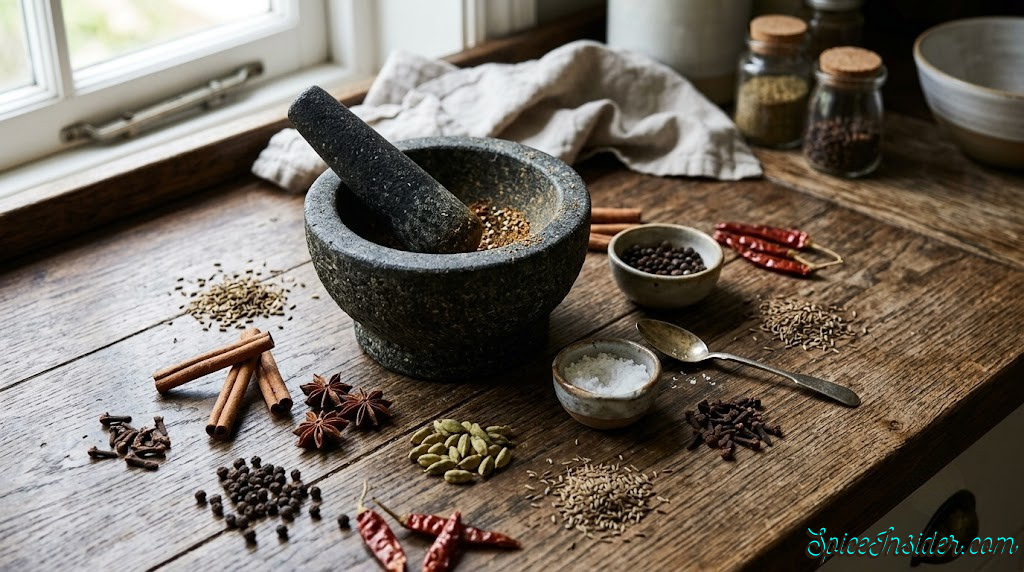
How to Grind Spices Without a Grinder
8 kitchen-tested methods that deliver fresh, fragrant ground spices — no electric grinder required. Backed by technique, not guesswork.
Why Grinding Spices Without a Grinder Is Worth Learning
There’s a moment every home cook knows: you’re halfway through building a curry, a dry rub, or a Moroccan chermoula, and you reach for your electric spice grinder — only to find the jar empty, the motor dead, or the whole machine simply absent from the kitchen. What do you do?
The answer is simpler than most people expect. Long before electric appliances entered kitchens, spices were ground with breathtaking skill using nothing more than stone, wood, and a bit of muscle. Those same techniques — refined over centuries — are still available to you right now, with tools you almost certainly have within arm’s reach.
This guide covers eight distinct methods for grinding spices without a grinder, from the time-honored mortar and pestle to the surprisingly effective rolling pin and zipper bag. Each method is broken down step-by-step with an illustrated SVG diagram, practical tips, and an honest assessment of what it does well and where it falls short. You’ll also find a detailed comparison table, spice-by-spice guidance, and storage advice to keep your hard-won ground spice fresh as long as possible.
Before we dive in, it’s worth noting that not all situations are equal. If you’re grinding spices regularly and in volume, nothing beats a dedicated electric unit — you can explore the best spice grinder options for that purpose. But for occasional use, improvisation, travel, or simply to reconnect with the craft of cooking, hand-grinding is an entirely valid — and often superior — approach.
🌱 The Case for Fresh-Ground Spices
Whole spices retain their volatile aromatic oils far longer than pre-ground versions. When you crack or grind them fresh, you release those oils at peak potency — the flavor difference is immediate and dramatic. Understanding grinding whole spices vs. pre-ground is a game-changer for your cooking.
Tools You Already Own (That Can Grind Spices)
You don’t need to buy anything. Here’s a quick visual map of the eight methods covered in this guide:
Each has a unique strengths profile — some shine at fine powder, others at coarse crack. The method you choose will depend on your spice, your target texture, and the equipment you have available. Let’s go through each one.
Method 1 – Mortar & Pestle
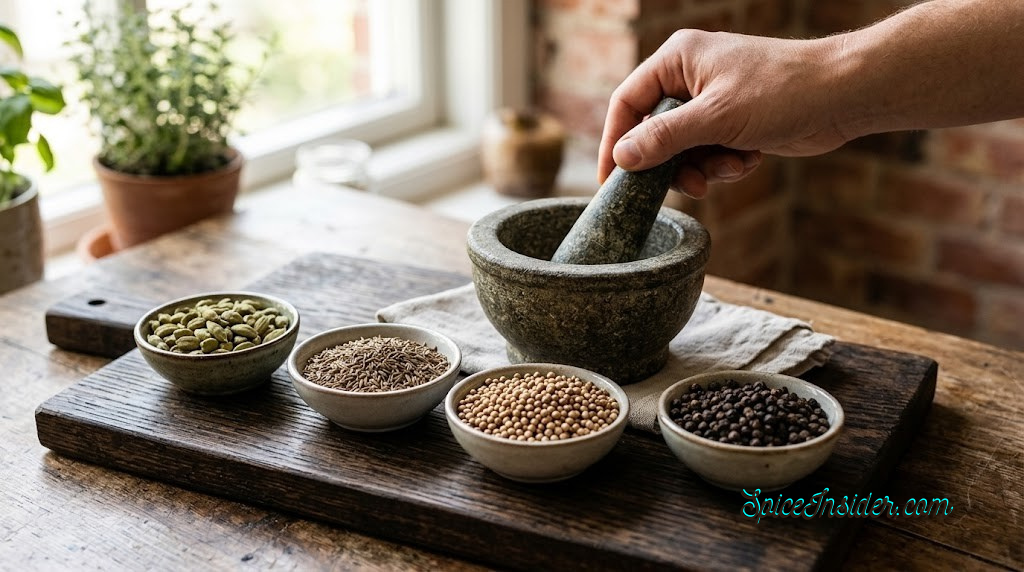
⭐ Best All-Around MethodThe mortar and pestle is arguably the oldest kitchen tool on Earth, and there’s an excellent reason it has survived thousands of years without fundamental change: it simply works better than most modern alternatives for grinding spices. If you own one — even a small decorative version — this is your first stop.
The key principle is controlled pressure and rotation. You’re not hammering; you’re pressing and rolling the pestle against the spice while the mortar’s rough inner surface does the abrasive work. The motion is circular and deliberate, not frantic.
Toast the whole spices (optional but recommended)
Place the whole spices in a dry pan over medium heat for 60–90 seconds, stirring constantly, until fragrant. Let them cool completely before grinding. Toasting dramatically deepens flavor by triggering the Maillard reaction in the outer husk. Learn more about how to toast spices before grinding for the full technique.
Add a small amount to the mortar
Work in small batches — no more than 2 tablespoons at a time. Overcrowding the mortar causes spices to jump out and results in uneven grinding. For round seeds like coriander or cumin, start with the pestle pressed flat to “crack” the seeds before switching to a circular grinding motion.
Use pressing circular strokes, not hammering
Press the pestle down firmly and rotate it in circles, dragging the spice against the rough mortar wall. Apply steady downward pressure throughout. After 15–20 seconds, scrape the sides back into the center and continue. Most spices reach a fine powder in 45–90 seconds of active effort.
✅ Pros
- Excellent texture control (coarse to fine)
- Releases maximum volatile oils
- No electricity needed
- Easy to clean
- Works on wet pastes (ginger, garlic, turmeric)
❌ Cons
- Slow for large quantities
- Requires some physical effort
- Coarse stone can absorb strong odors

Unpolished natural granite for maximum grip and efficient grinding. A kitchen essential for whole spice lovers.
View on Amazon →Method 2 – Rolling Pin & Cutting Board
Best for: Pepper, Coriander, Cumin, FennelThis is the method most professional kitchens fall back on during a busy service when the grinder is occupied. A heavy wooden or stainless-steel rolling pin plus a sturdy cutting board can crack and coarsely grind most whole spices in under two minutes. It’s fast, requires zero setup, and is easy to clean.
Spread spices in a single layer on the board
Place your whole spices in the center of a large cutting board. Don’t pile them — spread them out so the rolling pin can make full contact with each seed. Consider lining the board with a sheet of parchment paper to prevent seeds from scattering.
Apply firm forward pressure with the rolling pin
Using the heel of your hand on the rolling pin, lean into it and push forward across the spices with firm, steady pressure. The goal is to crush rather than roll. After one pass, gather the spices back to center and repeat, increasing pressure with each pass. For finer texture, keep going; for a coarse crack, 2–3 passes is often enough.
✅ Pros
- Almost every kitchen has a rolling pin
- Fast for medium-coarse textures
- Great for black pepper cracking
- Zero cleanup if using parchment
❌ Cons
- Difficult to achieve fine powder
- Seeds can scatter
- Not suitable for fibrous or very hard spices
Method 3 – Chef’s Knife (The Smash-and-Chop)
Best for: Garlic, Lemongrass, Dried Chiles, Black PepperEvery cook already knows how to smash garlic with the flat of a knife — the same technique works beautifully on many whole spices. It’s fast, intuitive, and produces a pleasingly rustic coarse grind that works perfectly in braises, marinades, and sauces where a fine powder isn’t necessary.
Smash with the flat of the blade, then rock-chop
Place whole peppercorns, coriander seeds, or dried chiles on the board. Lay the flat side of a heavy chef’s knife across them and press down sharply with the heel of your palm. This initial smash cracks the seed. Then, use the knife in a rocking chop (tip stays in contact with board, heel rocks down) to reduce to your desired consistency.

Large-capacity unpolished granite for heavy-duty spice grinding, herb pastes, and guacamole.
Check Price on Amazon →Method 4 – Countertop Blender
Best for: Larger Batches, Dried Chiles, Spice BlendsA standard blender isn’t optimized for spice grinding — the blades sit low and spices need to bounce around — but it can work admirably for dried herbs, larger batches of spice blends, and especially dried chiles or bay leaves where you’re aiming for a coarse or medium-fine grind.
The key insight: blenders work better with small batches and pulse bursts. Running the blender continuously on a tablespoon of cumin will just spin them uselessly. But pulsing with 3–4 rapid bursts causes the seeds to jump up, get caught, and get cut. You want chaos, not sustained motion.
Add spices + use short pulse bursts, not continuous blending
Add at least ¼ cup of whole spices for the blender to work effectively — too little and the blades can’t catch them. Place the lid on firmly and hold it down. Use 5–6 short pulse bursts (1–2 seconds each), then stop and shake the blender jar to redistribute spices. Repeat until you reach the desired texture.
Method 5 – Blade Coffee Grinder
Best for: Fine Powder, Large BatchesIf you have a blade coffee grinder gathering dust in a cabinet, you already own one of the most effective spice grinding tools available. Blade coffee grinders are nearly identical to purpose-built spice grinders in mechanism and can produce fine, consistent powder from most whole spices within 15–30 seconds.
The only real caveat is flavor transfer. Ground coffee oils cling to the metal chamber and blades, and will taint your spices — and vice versa. The solution is a simple rice-and-bread cleaning method that removes residual aromas between uses. Grinding a tablespoon of uncooked white rice for 20 seconds, discarding the rice powder, and wiping the chamber is often enough to eliminate coffee odor before switching to spices.
If you use the grinder frequently for both coffee and spices, you might consider keeping a dedicated unit for each. You can also look at our breakdown of blade vs. burr grinders for spices to understand why some configurations produce better powder than others.
Pulse-grind in 5-second intervals for even powder
Fill the grinder chamber no more than halfway. Pulse in 5-second intervals rather than running continuously — this prevents heat buildup and allows the spices to redistribute for more even grinding. Shake the grinder between pulses. Most spices reach a fine powder in 3–4 pulse cycles (15–20 seconds total).
✅ Pros
- Fastest route to fine powder
- Works on nearly any dried spice
- Handles large batches (up to ½ cup)
- Consistent texture
❌ Cons
- Flavor cross-contamination risk
- Requires odor-removal cleaning between uses
- Hard to clean thoroughly
- Not ideal for wet or oily spices
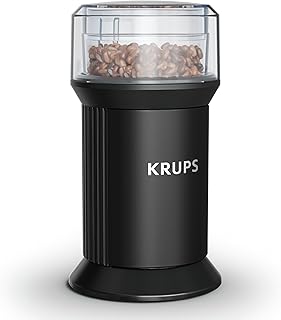
Dual chambers — one for coffee, one for spices — eliminate cross-contamination entirely.
See on Amazon →Method 6 – Zip-Lock Bag & Heavy Mallet (or Cast Iron Pan)
Best for: Peppercorns, Cardamom, Allspice, Dried GingerThis is possibly the most satisfying method on this list, and it requires nothing more than a sturdy freezer bag and something heavy. Meat mallets, small cast iron skillets, the bottom of a heavy saucepan, or even a thick-bottomed bottle — all work. The sealed bag contains everything, makes cleanup trivial, and gives you excellent tactile feedback on the grinding progress.
Seal spices in a sturdy bag and pound methodically
Place the spices in a zip-lock freezer bag (not a regular storage bag — the thicker walls prevent splitting). Seal it, pressing out most of the air. Lay the bag flat on a cutting board. Using a mallet or the bottom of a heavy pan, pound in short, firm strikes, moving systematically across the bag. Avoid slamming the edge of a pan, which can tear the bag. After a minute, most peppercorns and small seeds reach a coarse-medium texture.
Method 7 – Microplane Grater or Box Grater
Best for: Nutmeg, Dried Ginger, Cinnamon Sticks, Tonka BeanFor hard spices with a dense, waxy interior — nutmeg above all — a fine microplane grater is genuinely the best tool available, superior even to electric grinders. It produces an ultra-fine, almost fluffy powder that dissolves almost instantly into cream sauces, bechamel, and warm drinks. The key is using a fine grater (the kind designed for citrus zest), not a coarse box grater.
Hold spice at an angle and use short, controlled strokes
Hold the microplane firmly with one hand and the whole nutmeg (or cinnamon stick, or dried ginger root) with the other. Draw the spice across the grater at a slight angle using short downward strokes. Rotate the spice regularly so you grind evenly from all sides, rather than creating a flat spot. One whole nutmeg yields roughly 2–3 teaspoons of powder.
Method 8 – Food Processor
Best for: Spice Blends, Dried Herbs, Large VolumeA food processor is the workhorse of the kitchen but a mediocre spice grinder — unless you’re working with volume. For a single teaspoon of cumin, the blades never make proper contact with the seeds. But for making a large batch of baharat, ras el hanout, or a dry rub where you’re combining eight or ten different spices, a food processor can handle the job efficiently enough.
Use the mini bowl (if available) and pulse, not run
Most food processors come with a small bowl insert (1–2 cups) that brings the blades closer to the food. Always use this smaller bowl for spices — it’s the difference between effective and ineffective grinding. Use 8–10 rapid pulses, scraping down the sides between each. For a finer result, transfer to a mortar and finish by hand after the food processor reduces the spices to rough pieces.
Spice-by-Spice Grinding Guide
Not all spices respond the same way to these techniques. Here’s a practical breakdown of the most common whole spices and the best hand-grinding method for each:
| Spice | Best Method | Texture Achievable | Notes |
|---|---|---|---|
| Black Pepper | Mortar & Pestle or Rolling Pin | Coarse to Fine | Crack first, then grind for fine; rolling pin great for cracked pepper |
| Cumin Seeds | Mortar & Pestle | Coarse to Fine | Toast first for best flavor; quick to grind, oils release easily |
| Coriander Seeds | Mortar & Pestle or Bag & Mallet | Coarse to Medium-Fine | Slightly hollow — cracks fast; coarse texture excellent for marinades |
| Nutmeg | Microplane | Ultra-Fine | Always grate fresh; store whole nutmeg in a cool, dark place |
| Cardamom | Mortar & Pestle | Coarse to Fine | Crush pods first to release seeds; discard husks (or leave in for chai) |
| Cinnamon Sticks | Microplane or Coffee Grinder | Fine | Very hard; microplane ideal for small amounts; use coffee grinder for batches |
| Dried Chiles | Coffee Grinder or Knife | Flakes to Powder | Toast lightly, remove seeds for milder result; coffee grinder is fastest |
| Fennel Seeds | Mortar & Pestle or Rolling Pin | Coarse to Medium | Fragrant and relatively soft; fast to grind; excellent in sausage rubs |
| Star Anise | Coffee Grinder or Bag & Mallet | Medium to Fine | Brittle — smash in bag first, then finish in coffee grinder or mortar |
| Cloves | Mortar & Pestle | Fine | Very oily; mortar captures oils best; clean tools after — odor lingers |

The gold standard for freshly grated nutmeg, cinnamon, dried ginger, and citrus zest. Razor-sharp etched blades last for years.
Check on Amazon →Always Consider Toasting Before You Grind
Regardless of which grinding method you choose, one step consistently elevates the final result: toasting. Dry-toasting whole spices in a skillet before grinding triggers a cascade of chemical reactions — caramelization, Maillard browning, and the conversion of volatile compounds into more aromatic forms — that dramatically deepen flavor and aroma.
The rule of thumb: toast over medium heat, stirring constantly, just until the spice smells intensely fragrant and the color deepens slightly (30–90 seconds for most seeds). Remove immediately to a cool plate — residual heat in a hot pan will continue cooking, and over-toasted spices turn bitter. Full technique guidance is available in our comprehensive toasting guide.
🌡️ Which Spices Benefit Most from Toasting?
Cumin, coriander, fennel, mustard seeds, star anise, cardamom, cloves, and black pepper all show dramatic improvement with toasting. Paprika, turmeric, and pre-ground spices should not be toasted — they burn quickly and turn bitter. Nutmeg benefits only slightly and is typically grated directly.
Method Comparison Table
Not sure which method to reach for? Here’s a complete side-by-side comparison across the most important factors:
| Method | Fineness | Speed | Equipment Needed | Cleanup | Best Volume |
|---|---|---|---|---|---|
| Mortar & Pestle | ★★★★★ | Moderate | Mortar & Pestle | Easy | 1 tsp – 2 tbsp |
| Rolling Pin | ★★★☆☆ | Fast | Rolling pin, board | Very Easy | 1–3 tbsp |
| Chef’s Knife | ★★☆☆☆ | Very Fast | Heavy knife, board | Easy | ½–2 tbsp |
| Blender | ★★★☆☆ | Fast | Countertop blender | Moderate | ¼–1 cup |
| Coffee Grinder | ★★★★☆ | Very Fast | Blade coffee grinder | Moderate | 1 tbsp – ½ cup |
| Bag & Mallet | ★★★☆☆ | Moderate | Freezer bag, mallet/pan | Very Easy | 1–4 tbsp |
| Microplane | ★★★★★ | Slow | Fine grater | Easy | Small amounts |
| Food Processor | ★★☆☆☆ | Fast | Food processor | Moderate–Hard | ¼–2 cups |
Storing Fresh-Ground Spices Properly
All the effort you’ve put into grinding fresh spices only pays off if you store them correctly. Ground spices are dramatically more volatile than their whole counterparts — the increased surface area means oxidation, moisture, and light can degrade them within weeks rather than years. Here’s how to protect your work:
Use airtight glass jars
Small glass spice jars with tight-fitting lids are ideal. Plastic containers are permeable to aromatic compounds over time — spice oils can actually migrate through low-grade plastic. If you’re repurposing containers, small glass jam jars or canning jars work perfectly.
Store away from heat and light
The two worst places to store spices are directly next to the stove (heat degrades aromatic oils rapidly) and in clear jars on a sunny windowsill (UV light accelerates oxidation). A dark cabinet or drawer away from heat sources is ideal.
Label with the grind date
Ground spices are best within 3–6 months of grinding, though many remain usable for up to a year if stored well. A simple strip of masking tape on the jar with the date helps you track freshness without guessing.
Grind only what you need
The best practice of all: grind in small batches, as close to cooking time as possible. This is exactly the philosophy that makes the techniques in this article so valuable — grinding on demand is always superior to relying on a jar that has been open for eight months.
For deeper guidance on working with a spice grinder day-to-day, our article on how to use a spice grinder covers cleaning routines, batch sizes, and grinding sequences for spice blends. And if you’re working through troubleshooting — whether your grinder leaves chunks, has a stuck lid, or smells like a burning motor — we’ve written dedicated guides on all of those scenarios: why your spice grinder leaves chunks, stuck grinder lids, and motor burning smell.

Airtight glass canning jars — perfect for storing fresh-ground spices, spice blends, and dried herbs with zero odor transfer.
Shop on Amazon →Frequently Asked Questions
Conclusion: You Don’t Need a Grinder to Grind Like a Pro
The eight methods in this guide represent centuries of collective kitchen wisdom — approaches that professional cooks, street food vendors, and home cooks around the world rely on every day, with or without an electric grinder. What they have in common is a respect for whole spices and the understanding that fresh-ground is always worth the small extra effort.
Whether you reach for the mortar and pestle, a sealed bag and a heavy pan, or the microplane you usually save for lemon zest, the result will be measurably fresher, more aromatic, and more flavorful than anything that came pre-ground in a jar. Start with one method this week — we suggest the bag-and-mallet for its sheer accessibility — and experience the difference for yourself.
When you’re ready to level up with a dedicated tool, explore our comprehensive guide to the best spice grinders, or dive into the finer points of whole spices versus pre-ground to understand exactly what you’re gaining at every level. And if you already own a grinder and want to get more from it, our guides on using a spice grinder, cleaning a spice grinder, and the dos and don’ts of spice grinding are worth your time.
Explore the Best Spice Grinders →
When you’re ready to go electric — this highly rated, affordable blade grinder handles spices and coffee in seconds. A bestseller for a reason.
See Price on Amazon →