
How to Get Smell Out of a Spice Grinder Using Rice & Bread
Those bold, lingering aromas from yesterday’s cumin or fish masala are ruining your next grind. Here is every proven method to remove them completely — using things you already have in your kitchen.
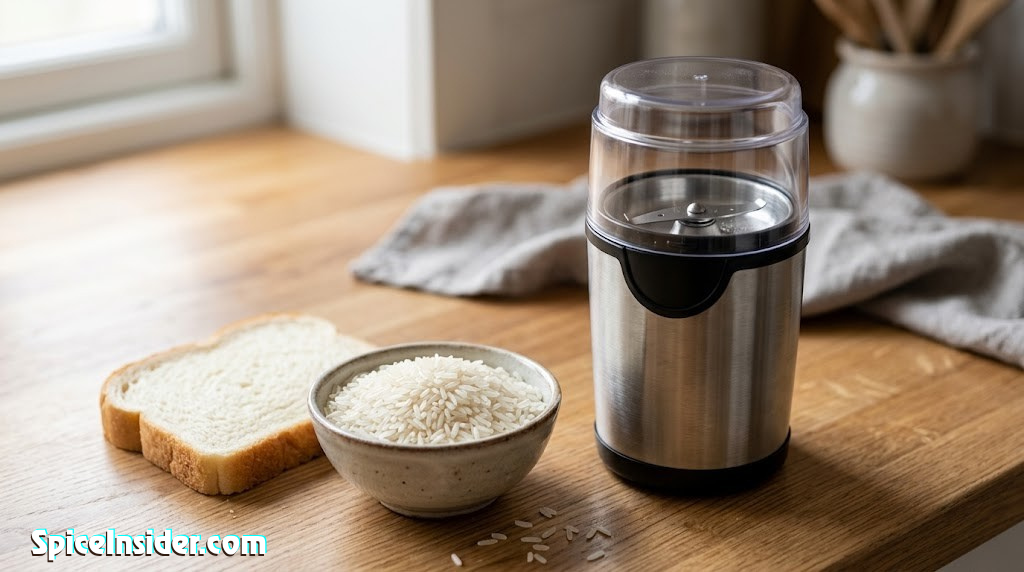
Two pantry staples — dry rice and white bread — are the most effective household tools for neutralizing spice grinder odors.
You reach for your spice grinder to make a fresh batch of cumin-coriander powder. The blades spin. The powder comes out. You lift the lid and your kitchen fills with the ghost of last week’s fenugreek or fish masala. The new spice is already compromised before it ever hits the pan.
It is one of the most frustrating experiences in the home kitchen, and it happens to everyone who uses a spice grinder regularly. The good news is that it is entirely solvable — usually with nothing more than a handful of dry rice or a slice of white bread, both of which are sitting in your kitchen right now.
This guide covers every proven method for removing smell from a spice grinder, from the universally effective rice technique to targeted solutions for the most stubborn odors — fenugreek, asafoetida, dried fish, and smoked chiles. You will also learn why these smells accumulate in the first place, which spices are the worst offenders, and how to maintain your grinder so odor buildup never becomes a serious problem.
Whether you have a blade-style electric grinder, a burr-style machine, or a traditional stone mortar and pestle, every method here has been adapted for each type. If you are also struggling with general cleaning beyond odor, that guide pairs naturally with this one.
✦ Quick Summary
- The rice method (uncooked dry white rice) removes 80–90% of everyday spice odors in under 2 minutes
- The bread method works by fat absorption and is better for oily resinous spices like cloves and star anise
- Salt scrub handles surface oil deposits; vinegar neutralizes sulfur-based compounds in alliums and asafoetida
- For truly stubborn smells (fenugreek, dried fish), a combination attack is required
- Prevention — cleaning after every use — is always easier than remediation
Why Spice Grinders Hold Onto Smell
Understanding why odors linger makes every cleaning method make more sense. A spice grinder is not just a container — it is a system of multiple surfaces, and each one holds aromatic residue differently.
The Three Sources of Lingering Odor
Essential oil film on the grinding bowl and blades. Every time you grind a spice, the blade generates friction heat that drives essential oils out of the cell walls of seeds and bark. These oils are not all captured in the ground powder — a portion coats the interior surface of the grinding bowl and the blade assembly itself. Over time this builds into a stratified film of overlapping aromatic layers from every spice you have ever ground.
Micro-particles in scratches and crevices. The blades of an electric spice grinder create microscopic scratches in both the blade and bowl with every use. These scratches trap fine spice powder that is nearly impossible to remove with a brush or damp cloth alone. When you grind the next spice, the heat reactivates the aromatic compounds trapped in these micro-grooves.
The gasket, lid, and seal. Many blade grinders have a rubber gasket around the lid that is rarely cleaned but regularly contaminated. The rubber material is particularly good at absorbing volatile aromatic compounds. Even if the bowl is spotless, a contaminated gasket will transfer odor to the next grind. This is why simply wiping the bowl interior is often not enough — you also need to clean the lid and any rubber seals.
The physics of how an electric blade grinder versus a burr grinder operates means they develop odor differently. Blade grinders concentrate aromatic oils on a small bowl and blade surface. Burr grinders distribute residue across a much larger surface area of grinding burrs and channels, which can make thorough cleaning more challenging. Most of the methods below are optimized for blade-style grinders, which are by far the most common type used for spices at home.
Worst-Smelling Spices: Ranked by Odor Persistence
Not all spice smells are equally difficult to remove. The chemistry of each spice determines how deeply it penetrates the grinding bowl and how resistant it is to removal. This ranking helps you calibrate how much effort to expect.
🔬 Odor Persistence Scale (in electric blade grinder)
The spices at the top of this scale — fenugreek and asafoetida — require multiple treatment rounds even with the most effective methods. Fenugreek contains sotolone, a lactone compound with a detection threshold so low (in parts per trillion) that even trace amounts are perceptible. Asafoetida is notorious for its sulfur-based volatile compounds that penetrate and persist in almost any porous surface. If you grind these regularly, a dedicated grinder just for pungent spices is not a luxury — it is a practical solution.

Consider a Dedicated Grinder for Pungent Spices
Keeping two grinders — one for mild aromatics and one for pungent spices — eliminates cross-contamination entirely. See which models we recommend in our best spice grinder roundup.
Check Price on Amazon →All Odor Removal Methods at a Glance
Before diving into step-by-step instructions, here is a map of every method covered in this guide, ranked by ease and effectiveness for everyday use.
Step-by-Step: The Rice Method (Best All-Purpose)
The rice method is the most universally recommended technique for a reason: it works on virtually every spice odor, requires no special products, takes under two minutes, and is completely safe for all electric blade grinders. It works through a combination of mechanical abrasion (the hard rice grains scour the bowl and blade surfaces) and absorption (the starchy interior of the rice grain draws out and traps aromatic oils as it pulverizes).
Use uncooked dry white rice — not brown rice, which has too much oil in the bran layer, and not instant or parboiled rice, which is too soft to provide adequate abrasion. Plain, long-grain or short-grain white rice is ideal.
Empty and Brush Out the Grinder
Before adding rice, empty every trace of the previous spice from the bowl. Tap the inverted grinder over a trash bin to dislodge loose powder. Use a dry pastry brush or a small cleaning brush to sweep out the corners around the blade assembly and the area under the blade where powder accumulates but rarely falls out when tapped. Do not use water at this stage — you want the bowl as dry as possible before adding rice.
If your grinder came with a cleaning brush (many do), this is the moment to use it. If not, a firm-bristled paintbrush or a clean toothbrush works well. Spend 30–45 seconds on this step — removing as much loose spice residue as possible means the rice has to do less work on the macro level and can focus on the molecular film of essential oils.
Remove all loose spice powder with a dry brush before adding rice. This maximizes rice abrasion efficiency on the oil film, not the loose powder.
Add One to Two Tablespoons of Dry White Rice
Measure approximately 1 to 2 tablespoons of uncooked dry white rice and pour it into the cleaned but dry grinding bowl. This is enough to coat the blade and create thorough coverage of the bowl interior without overloading the motor. Using too much rice (more than 3 tablespoons) can strain a smaller grinder motor.
For particularly stubborn smells, you can add 1/2 teaspoon of coarse salt alongside the rice. The salt crystals are harder than rice and provide additional abrasive action against the blade surface and bowl walls. This salt-plus-rice combination is particularly effective after grinding cloves, star anise, or other resinous hard spices.
1–2 tablespoons is the ideal quantity — enough for thorough abrasion without overloading the motor. Add coarse salt for extra scrubbing power on stubborn odors.
Grind in Short Bursts
Secure the lid and run the grinder in 3 to 4 short pulses of 5–8 seconds each, pausing for 3 seconds between each pulse. Do not run continuously — the goal is for the rice to abrade the bowl surfaces and blade aggressively, not simply to grind to a fine powder. Short bursts keep the rice chunks coarser for longer, maximizing their mechanical cleaning action against the bowl walls and blade surface.
You will notice the rice powder turning a faint beige, tan, or even slightly gray color as it picks up the aromatic oils from the grinding surface. This is exactly what is supposed to happen — the rice is acting as both an abrasive and an absorbent, drawing the oil film off the bowl surface into the powder.
After the 4 pulses, run the grinder continuously for one final 10-second burst to grind the rice as finely as possible. This final fine grind ensures the powder reaches into every micro-crevice and scratch in the bowl surface.
Short pulses keep rice chunks coarser for longer, maximizing their scrubbing action against the bowl walls and blade. The final continuous burst drives powder into micro-scratches.
Discard the Rice Powder and Wipe Down
Tap the rice powder into a trash bin — not down the sink, as fine rice powder will clog drains over time. Once empty, use a dry paper towel or clean dry cloth to wipe the interior of the bowl. You will often see the paper towel pick up a faint brownish residue — this is the aromatic oil that the rice pulled off the grinding surface. Wipe until the paper towel comes away clean.
Also wipe the underside of the lid, the gasket/seal, and any venting holes near the base. These surfaces accumulate aromatic vapor condensation during each grinding session and are frequently overlooked. Neglecting the lid seal is one of the most common reasons grinders still smell “off” even after thorough bowl cleaning.
If your model has a removable blade assembly, remove it, wipe both sides of the blade with a dry paper towel, and also wipe the very bottom of the bowl beneath the blade where oil deposits concentrate. For a deeper clean of the physical components, refer to our complete guide on how to clean a spice grinder properly.
Discard rice powder in the trash (not the drain). Wipe the bowl, blade, lid, and gasket — the lid seal is where most overlooked odor accumulates.
The Smell Test — and Whether to Repeat
Give the clean, wiped bowl a direct sniff. For most everyday spice odors — cumin, coriander, pepper, cinnamon, fennel — a single rice treatment will leave the bowl smelling neutral or at most very faintly of rice (which dissipates within a few minutes). If you detect a faint residual smell, run a second rice treatment. Two rounds of rice removes the vast majority of everyday spice odors completely.
If after two rounds you still detect significant odor, you are dealing with a stubborn compound — likely fenugreek, asafoetida, cloves, or dried fish — that requires an additional method. See the specific methods below for targeted solutions.
One round clears most everyday spices. Two rounds handles stubborn aromatics like cumin or cloves. If strong odor remains after two rounds, escalate to the bread or vinegar method.
Step-by-Step: The Bread Method
The bread method works on a different principle than rice. While rice relies primarily on mechanical abrasion, bread works through lipid absorption — the gluten and starch matrix in bread is particularly effective at drawing oily, resinous aromatic compounds out of the grinding surface. This makes it the superior choice for spices with heavy oil content: cloves, star anise, allspice, nutmeg, and mace.
Use plain white sandwich bread — not whole grain, not sourdough, not brioche. The simple gluten and starch structure of white bread is what makes this work. Whole grain bread has bran oils that can transfer their own smell; artisan breads with complex fermentation compounds can actually introduce new odors.
Tear and Load
Tear one to two slices of white bread into rough 1-inch pieces. Load about half a slice’s worth into the grinder bowl. The torn pieces should partially fill the bowl but not pack it — you want the bread to tumble freely against the blade and bowl surfaces during grinding.
Grind in Two Stages
Run the grinder for 10 seconds, stop, open, and check. The bread should be forming a coarse, crumbly paste. If it looks dry and crumbly (rather than doughy and compacted), run for another 10 seconds. Add the second half of the bread and grind for a final 15-second burst. The goal is for the bread to create a slightly moist crumb that physically wipes the bowl surface as it churns.
Discard and Wipe
Shake the breadcrumb paste into the trash. Use a dry paper towel to wipe the bowl, blade, and lid thoroughly. Then follow immediately with the rice method — one round of dry rice after bread is the recommended combination for oily spices, as the rice clears any starchy residue the bread leaves behind and provides final abrasion of the surface.

Easy-Clean Grinders Are Worth the Upgrade
Some grinders have removable, dishwasher-safe bowls that make deep cleaning effortless. See if the Secura spice grinder — one of our top-rated picks — is right for your kitchen.
Check Price on Amazon →The Salt Scrub Method
Coarse salt functions as a mechanical abrasive that physically scours the surface of the grinding bowl and blade with harder particles than rice grains. The salt crystals are slightly harder and more angular than rice, which makes them more aggressive at dislodging baked-on aromatic oil deposits — particularly the kind that builds up after months of heavy use without cleaning.
Use coarse kosher salt or coarse sea salt — not fine table salt (too soft, dissolves under friction too quickly) and not Himalayan pink salt (the mineral content can leave a faint mineral smell). Add 1–2 tablespoons of coarse salt to the bowl alone, without rice. Pulse 4–5 times in 5-second bursts, then discard, wipe, and follow with one round of the rice method to remove all salt residue.
The salt method is best used as a periodic deep clean (once a month for heavy users) rather than an after-every-use routine, because the more aggressive abrasion will very gradually increase surface micro-scratches over many repetitions. For routine cleaning, rice is gentler and equally effective for everyday odors.
The Vinegar and Citrus Method
This is a targeted tool for a specific category of odors: sulfur-based compounds from alliums (dried garlic, dried onion) and asafoetida, as well as trimethylamine (the “fishy” smell) from dried fish and shrimp. These compounds are alkaline in nature, which means acid — specifically the acetic acid in vinegar or the citric acid in lemon juice — can chemically neutralize them in a way that mechanical abrasion alone cannot.
Vinegar Method (External Wipe — Not Internal Grind)
This method involves wiping the bowl surfaces with a vinegar-dampened cloth — never grinding liquid in an electric grinder. Dampen a paper towel or cloth with white distilled vinegar (not balsamic, not apple cider — the additional compounds in flavored vinegars can introduce new smells). Wipe down the entire interior of the bowl, the underside of the lid, and the blade. Let sit for 2–3 minutes, then wipe with a dry cloth. Follow immediately with the rice method to remove any vinegar residue and the final traces of the odor compounds that the acid released from the surface.
Citrus Method
Cut a lemon in half and rub the exposed flesh directly around the interior of the bowl and across the blade (carefully — the blade is sharp). The combination of citric acid and the natural aromatic compounds in lemon peel and juice both neutralizes alkaline odor compounds and deposits a fresh, citrus scent that dissipates cleanly after the follow-up rice treatment. This method is particularly popular for fishy smells and asafoetida.
The Baking Soda Overnight Method
Baking soda (sodium bicarbonate) is a mild alkaline compound that neutralizes acidic aromatic molecules — a different class of odor than the alkaline compounds targeted by vinegar. Many of the characteristic “spicy” aromatic compounds (terpenes, aldehydes) are weakly acidic, and baking soda is remarkably effective at neutralizing them passively over time.
This is an overnight method rather than a quick fix. After your daily cleaning, place 2–3 tablespoons of dry baking soda into the empty, dry grinder bowl, secure the lid, and leave it on the counter overnight (8–12 hours). The baking soda absorbs airborne aromatic molecules from within the enclosed bowl space. In the morning, give the bowl one quick pulse to distribute the baking soda across all surfaces, then discard and wipe thoroughly, followed by one rice round.
The baking soda method works particularly well as a passive maintenance technique — used the night after grinding any particularly pungent spice to keep odor from becoming entrenched in the bowl surface over repeated use. Think of it as an overnight reset rather than an emergency intervention.
Stubborn Odors: The Multi-Method Combination Attack
Fenugreek, asafoetida, dried fish, and heavily smoked chiles require more than a single method. If you have ground any of these in your grinder and the smell persists after two rounds of rice, work through this escalating sequence:
The Full Protocol for Stubborn Odors
Round 1 — Rice + Salt: Add 2 tablespoons of dry white rice plus 1 teaspoon of coarse salt. Pulse 6 times in 5-second bursts. Discard and wipe.
Round 2 — Bread: Grind one slice of white bread in two stages. Discard and wipe. This follows the rice/salt to absorb the heavy oil layer that salt and rice loosened from the surface.
Round 3 — Vinegar Wipe: Wipe the interior surfaces with white vinegar on a paper towel. Wait 3 minutes. Wipe dry.
Round 4 — Baking Soda Overnight: Fill with 3 tablespoons of baking soda and leave sealed overnight.
Round 5 — Final Rice: One last round of plain rice in the morning to remove any baking soda residue and restore the clean, neutral surface.
This five-round protocol will resolve even the most persistent asafoetida or fenugreek contamination in a standard blade-style grinder. If odor persists after this full protocol, the problem is likely in the rubber gasket/lid seal — which may need to be replaced. Check your manufacturer’s support page or consider whether this is the moment to look at a more durable grinder with a removable, washable bowl.

Is Your Grinder Past Saving? It Might Be Time to Upgrade
If persistent odors, stuck lids, or a burning motor smell suggest your grinder is worn out, our best-picks guide covers every budget. A fresh machine starts fresh.
Check Grinders on Amazon →Prevention: Stop Odors Before They Start
No cleaning method is as efficient as prevention. Building a quick cleaning habit around your grinding sessions means odors never accumulate to the point of requiring the multi-round protocols above.
The After-Every-Use Habit
Every time you finish grinding, before the machine goes back in the cupboard, run one quick rice round. One tablespoon, four pulses, discard, wipe. This takes 90 seconds. Done consistently, it means aromatic oil films never have the chance to oxidize and harden on the bowl surface — which is what turns a mild cumin scent into a months-old cumin haunting.
Grind Order Matters
When making a complex blend that requires grinding multiple spices separately, plan your grind order from mildest to most pungent. Black pepper, coriander, and fennel first. Cumin and cinnamon in the middle. Cloves and star anise last. This minimizes cross-contamination and means that even without cleaning between every single spice, the final result in the blend is not dominated by the most pungent ingredient. Detailed grinding order and technique guidance is covered in our article on grinding whole spices at home.
Toast Before You Grind — But Cool First
Grinding warm spices after toasting releases far more volatile aromatic oil into the grinding bowl than grinding cold. Always let toasted spices cool completely before grinding. The cooler and drier the spice going into the grinder, the less oil coats the bowl surfaces during the grind, and the less cleaning is needed afterward.
Never Grind Wet or Fresh Ingredients
Wet or oily ingredients — fresh garlic, ginger, moist dried fruits, wet chiles — coat the bowl in a layer of water-soluble and fat-soluble aromatic compounds that are far harder to remove than dry spice residue. If your recipe calls for a wet-paste element alongside a dry spice component, use a separate tool (a small food processor or blender) for the wet ingredients and keep your spice grinder strictly for dry spices. This single habit prevents the most persistent types of grinder contamination.
✅ Good Prevention Habits
- One rice round after every single use
- Grind mildest spices first, pungent last
- Always cool toasted spices before grinding
- Keep dry spice grinder for dry spices only
- Clean lid, gasket, and vents regularly
- Store with lid slightly ajar to air out
⚠️ Habits That Cause Odor Buildup
- Grinding and storing immediately without cleaning
- Skipping cleaning between very different spices
- Grinding warm, freshly toasted spices
- Using the same grinder for wet pastes and dry spices
- Ignoring the lid seal and gasket
- Grinding fish, garlic, or asafoetida in a shared grinder
Complete Method Comparison Table
Use this table to select the right method or combination of methods based on the spice you just ground and how much time you have.
| Method | Time Required | Best For | Effectiveness | Safe for Motor? | Works on Gasket? |
|---|---|---|---|---|---|
| Dry Rice | 90 seconds | All everyday spices | ⭐⭐⭐⭐⭐ Excellent | ✔ Yes | ✘ No |
| White Bread | 2 minutes | Oily/resinous spices | ⭐⭐⭐⭐ Very Good | ✔ Yes | ✘ No |
| Coarse Salt | 2 minutes | Monthly deep clean | ⭐⭐⭐⭐ Good (abrasive) | ✔ Yes | ✘ No |
| White Vinegar Wipe | 5 minutes | Sulfur/fish/allium odors | ⭐⭐⭐⭐⭐ Excellent (targeted) | ✔ Yes (wipe only) | ✔ Yes |
| Lemon Rub | 3 minutes | Fishy / asafoetida smells | ⭐⭐⭐⭐ Very Good | ✔ Yes (wipe only) | ✔ Yes |
| Baking Soda Overnight | 8–12 hours | Lingering background odors | ⭐⭐⭐⭐ Very Good (passive) | ✔ Yes | ✔ Yes |
| Multi-Method Protocol | 12–18 hours total | Fenugreek / asafoetida / fish | ⭐⭐⭐⭐⭐ Maximum | ✔ Yes | ✔ Yes |

Top-Rated: Cuisinart SG-10 Spice Grinder
The Cuisinart SG-10 has a removable stainless steel bowl that makes cleaning dramatically easier than fixed-bowl designs. Read our hands-on Cuisinart SG-10 review to see if it is the right choice for your kitchen.
Check Price on Amazon →Frequently Asked Questions
Conclusion: Clean Grinder, Clean Flavor
The smell lingering in your spice grinder is not a minor inconvenience — it is a flavor tax on every spice you grind from that moment forward. The good news is that the solution is almost always sitting in your pantry: a handful of uncooked white rice and, for more stubborn cases, a slice of plain white bread.
The rice method — one tablespoon, four short pulses, discard, and wipe — handles 90% of everyday spice odors in under two minutes. The bread method tackles the heavy oil load from resinous spices. Vinegar and citrus target the sulfur and amine compounds that come from asafoetida and dried fish. Baking soda overnight provides a passive, gradual reset for any lingering background odors. And the full multi-method protocol gives you a nuclear option when nothing else is enough.
Most importantly: prevention beats remediation every time. One rice round after every single use keeps odor from ever becoming entrenched. It costs 90 seconds and means you never have to spend 18 hours running escalating treatments on a grinder contaminated by months of accumulated fenugreek ghosts.
Your spices are worth the care. The intensity, the nuance, the layered complexity you get from grinding whole spices fresh — all of that potential is realized only when the equipment that does the grinding is genuinely, chemically clean. Take the 90 seconds. Run the rice. And taste the difference.
Ready for a Grinder Worth Keeping Clean?
Some grinders are dramatically easier to maintain than others — removable bowls, stainless steel surfaces, and wider clearances all make cleaning faster. See which ones made our top picks list.
See Our Best Spice Grinders →